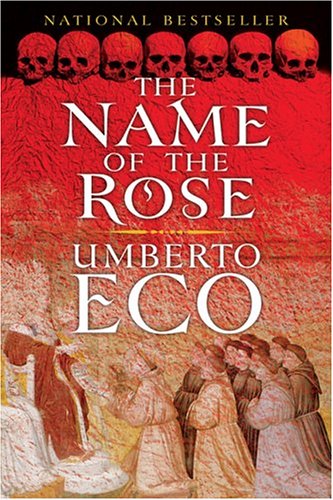
The scene: The Italian Alps.
The year: 1327.
The background: It’s the late medieval period. The Crusades are over, the Holy Land lost beyond recovery. There are no external enemies to fight. Christianity is now divided against itself, between Pope and Emperor, the secular and the ecclesiastical, heresy and logic, the old and the new.
The plot: Someone is killing the inmates of a remote Benedictine monastery in bizarre ways, and the monks take this as a sign of the Devil at work and of the approaching Apocalypse. Enter the narrator, a novice Benedictine called Adso of Melk, and his mentor, an English Franciscan monk by the name of William of Baskerville. They are there to attend a theological conference, but William, who has experience as an investigator, is charged by the Abbot to look into the murders, not just to find the truth but if necessary to cover it up for the “greater good” of the Church – for if it is the Devil at work, he is to be countered, but if it is a monk who is to blame, William should be careful that the ordinary people – the “sheep” – do not grow to distrust all their “shepherds”.
As more bodies turn up, William is confronted with the mystery of symbols and contexts, and how the past influences the present. When an inquisitor arrives to carry out his own hunt for heretics, Satanists and witches, William’s position becomes more difficult still, but he is still determined to get to the bottom of the mystery.
The scene: Istanbul, Turkey.
The year: 1591.
The background: The Turkish Empire is caught between two forces. On the east is the Persian Safavid Empire. On the west are the Venetians and the other “Franks” – the Europeans, who are well into the Renaissance and whose military prowess is far less important than their flowering of modern thought and culture. Turkey can no longer stay insulated from foreign ideas and ideals, and this arouses resistance – as always – from various quarters, and for different and often conflicting reasons.
The plot: One of the Sultan’s master miniaturists is murdered and his body thrown into a well. The man was one of a small and highly select group of painters and gilders entrusted by the Sultan with a secret commission: to create a book of illustrations in the “modern” European style instead of the traditional Afghan and Persian style rigidly adhered to by the miniaturists of the Muslim world of the time. The European style is thought to be bordering on the blasphemous by both the traditional miniaturists and the mullahs of the mosques, for different reasons, and the killing of the master gilder, Elegant Effendi, could be an attempt to stop the book from being created – or could it?
Enter Black, once an apprentice painter, who went into self-exile for twelve years after falling in love with his maternal uncle’s daughter. Now, the maternal uncle has called him back to Istanbul to help him complete the book, and Shekure, the cousin he was in love with, has a husband presumed dead in the wars and is living with her father with her two sons.
When the killer strikes again, Shekure tells Black he can have her if he finds the killer and takes care of her and her two children. And meanwhile, the Sultan’s officers suspect Black himself of being involved in the killings.
The first of these books is The Name Of The Rose, by the Italian academic and novelist Umberto Eco (please note that I am talking about the book, not about the film, which many more people are familiar with). The second is My Name Is Red, by Turkish Nobel laureate Orhan Pamuk. Written a couple of decades apart by different authors living in different countries, it’s still extremely usual to read of one compared to the other, specifically Red to Rose, as though the two were in competition.
I’ve read both these books, and I believe that though they can be read, and enjoyed, individually, they form two parts of a diptych; one compliments and buttresses the other. In this article I’ll try and discuss how.
The first piece of similarity is the fact that they are both putative detective stories, where the detection part doesn’t really matter in itself. To put it differently, neither is an Agatha Christie style murder mystery where everything hinges on the final revelation and the identity of the killer. In both these books, the identity of the murderer is almost incidental, and the detective story is only a hook on which to hang the rest of the novel.
Both these novels are historical novels, and historical novels in a dual sense. Not only are they set in the fairly remote past, but they are both all about history – how the past influences (their) present, and how it is essential to interpret the past in order to understand what is happening around the characters.
In both novels the real battle is essentially one of ideas – the new flooding in and being desperately resisted by the old. In The Name Of The Rose it is the flowering of logical thought that led to the Renaissance, which is so bitterly resisted by the entrenched Church which had so much at stake in keeping the masses poor, ignorant, and afraid. A relatively minor character in terms of the number of pages he occupies, the inquisitor Bernard Gui (a genuinely nasty piece of work who actually existed and was responsible for burning upwards of forty people at the stake) is the embodiment of this reaction. All Bernard wants is heretics to burn; he cares for nothing else, as though destroying free thought and other kinds of “heresy” can hold back the flood of modernity. He will bully and browbeat his suspects into admitting their guilt, twisting their words so that they can say nothing that does not incriminate them. And that is why he is a successful inquisitor.
In My Name Is Red, the conflict of ideas takes the form, not of faith versus heresy, but of schools of painting. Medieval Islamic art was extremely stylised. It invariably showed the world, not as it actually was, but as “Allah” might see it from the top of a minaret, without any attempt at perspective or realism. Realism, in fact, was specifically discouraged, because that introduced the “personal element” of the artist’s vision. Since only Allah was perfect, only what Allah might see could be perfect and the artist tried to depict what he thought Allah would perceive of any given scene. And so the painting style became not just stylised but repetitive, with miniaturists striving to paint exactly as the old master miniaturists of such cities as Herat had done. And, in fact, this is the key to the killer – for the only clue to his identity is the fact that he has painted a realistic horse, not an ideal one, and therefore has a personal “style”.
Meanwhile, the realism of European style painting, with portraits which actually depicted people as they looked, and the world as it looked to a human being, was working its way into the Turkish consciousness, and no less a person than the Sultan himself had decided that he wanted his portrait painted in this style. The reactionaries fell into two camps – one, the traditional miniaturists, personified by Master Osman, the head of the artist’s workshop, who would rather go blind than paint in the European style; and the other the mullahs, who were opposed to all painting as being forbidden by the Koran, and blamed all the ills of the Empire on society’s moving away from Islam.
As with Bernard Gui in the Italian Alps, Pamuk’s book has an ecclesiastical opponent of all things modern, though he never personally makes an appearance. He is a cleric from Erzurum, one Nusret Hoja, who has by the end of the book gathered together a little private army of his own and is determined to force his vision of Islamic rectitude on society, by destroying coffee houses and dervish lodges. He’s a very Mullah Omar kind of figure, whom it is lethally dangerous to mock, as a storyteller who makes repeated appearances throughout the book discovers.
Another similarity is that by modern standards the motives of the two killers is laughable. But the situations of these two books aren’t modern, and the killers aren’t modern people. To them, in the darkness of their little medieval minds, their own purposes were perfectly logical, important and legitimate, no matter how insignificant they would seem to us from the standpoint of the 21st century. One wonders how our motives will be regarded by our descendants six or seven hundred years from now. Not very flatteringly, one feels.
There are many differences between the books, of course, and it’s possible to allude to only a few here; but the similarities in themes and ideas are far more important than the differences.
Taken as a detective story, pure and simple, there’s no comparison: The Name Of The Rose stands head and shoulders above My Name Is Red. Its detective, William of Baskerville, is an open tribute to Sherlock Holmes even to his name (taken from The Hound Of The Baskervilles), with Adso of Melk as a serviceable Watson. In his very first appearance, he makes a very Holmesesque deduction about the whereabouts, name and even the appearance of a runaway horse he has never seen before. He is methodical, knowledgeable, and fact-oriented, rejecting the then-standard belief that the Devil was behind all the evil of the world. William prefers a much more immediate malefactor. William’s motive is the search for truth.
In comparison, Black of My Name Is Red is only a reluctant detective, whose real motive is only to marry and then to sleep with Shekure, and it is only because she orders him to find the killer that he takes the task on himself. This burden takes on added urgency when the Sultan’s officials give him three days to track down the killer, or he and the miniaturists involved in the making of the Sultan’s book will all be put to the torture. And his deductive skills are anything but logical; he depends on serendipity and the aid of Osman in his detective endeavours, and is constantly distracted by Shekure and his own rejection by her children, not to speak of the fear of the torturers.
Then there’s the question of writing style. The Name Of The Rose is linear; told by Adso of Melk, everything that happens is narrated by him directly or as a matter of his knowledge. He thinks as a fourteenth-century monk might think, without a trace of liberalism, except that which has rubbed off on him from William. His characters come across as props for his account; he scarcely even bothers to describe most of them (except William himself), because, to paraphrase him, “What’s the point now? They’re all long dead anyway.” His account has long digressions into history, ecclesiastical expostulation, and symbolism, where the human element is entirely removed. It reads, as it is meant to, as a treatise more than a novel for much of its length.
My Name Is Red is anything but linear. Each chapter is told in a different voice, not just those of the main characters but of dogs and such, even of such intangibles as corpses, the Devil, and the colour red. Over and over, the same ideas and episodes are re-examined from different viewpoints and perspectives, almost as in the film Rashomon. Unlike Rose, Red’s characters are infinitely better drawn, which is rather natural when one looks at the personal voice in which the book is presented. And again unlike Rose, which has a grand total of one female character, who is not even allowed the dignity of a name, Red’s best drawn characters are women: there is Shekure herself, desperate for security for herself and her children, unsure of Black’s love for her, and dreading the brother of her late husband while at the same time retaining affection for him. There is Hayriye, her scheming slave girl, who hates her so much that she sleeps with Shekure's father, Black's uncle, as an act of revenge. There is Esther, the Jewish clothes peddler and itinerant matchmaker, who acts as a double and triple agent as she carries around messages between Shekure, Black, and Shekure’s brother-in-law Hasan. There is even the mythical character Shirin, who appears over and over again in paintings throughout the book, to the extent where she is almost a character herself.
Since these two books are allegedly detective stories, it would be unfair to completely ignore the killers, who are also very different, though, as I’ve said, their motives are equally nonsensical to a modern mind. My Name Is Red’s killer is actually easily guessable (at least I correctly guessed his identity halfway through the book from the clues liberally provided); his crimes are committed in the heat of passion, and one soon realises that he’s not really a bad man. The Name Of The Rose’s murderer is of a completely different nature, a cold and calculating psychopath who uses his own wits, knowledge and logic in his battle with William of Baskerville. He is a far more impenetrable and frightening figure, and one tracks him down alongside William, discovering the clues as William does (another way this book is Sherlock Holmes-esque rather than the whodunit type).
Both books are often slow-going and are emphatically not for those with short attention spans. Red has dashes of black humour, but humour is (and this turns out to be thematically significant) utterly lacking in Rose. In the end, though, neither book’s message is anything to laugh about – and that message is the same.
Personally, I preferred The Name Of The Rose, but that’s probably due to the fact that I read that book much earlier and because the constant shift of viewpoint in My Name Is Red isn’t suited to my tastes. But that’s only on a personal level – at the level of intellectual discussion, these two books strongly complement each other.
I suggest you read them both.

.jpg)