Showing posts with label culture. Show all posts

Tuesday, 3 November 2015

Let's Talk About Sex, Baby

Let's talk about sex, baby
Let's talk about you and me
Let's talk about all the good things
And the bad things that may be
Let's talk about sex
~ Salt’N’Pepa

I was, if I am not mistaken, eleven years old when I first discovered sex.

No, I do not mean I got laid at eleven, so you can put your eyeballs back in their sockets. No, this is what I meant:

I was eleven years old when I first found out what men and women did with each other so babies were made.

OK, I was not exactly that innocent. It wasn’t as though I didn’t know that babies came out of a woman’s belly and that the male parent had something to do with it. But the mechanics had been pretty much a mystery to me.

I think I shall have to take a step back and begin at the beginning.

My parents, it will not be a surprise to anyone to learn, never ever mentioned the word “sex” to me. Nor did they ever actually come out and admit the fact that I grew out of an embryo inside my mother’s belly – though, being a Caesarean, I allegedly nearly killed her (my father had to donate blood to her! Horrors!) and it was one of her recurrent grouses in later years, until I was in my teens, that she was still feeling the pain of giving birth to me.  

Of course, as I may have mentioned earlier here and there, neither of my parents had much to do with bringing me up. That was left to my paternal grandmother, whom I called “mother” until the age of three or four when she taught me different. My grandmother, a noted liberal for her day – she was born in 1907 – had not as much compunction about telling me about things as my parents did. The first time I asked her about where I’d come from – I must have been four or younger at this time; it is one of my earliest memories – I remember that she replied that my grandfather had “prayed to god” and I’d come floating down from heaven on a lotus flower. [My grandfather died when I was four, and he was alive at this time, which is how I know my age when I asked this.] By that time I had independently heard that my birth had had something to do with a hospital, so I had to somehow reconcile the flower story and the hospital story. I don’t think I ever did.

Some years later, my grandmother gave me a more detailed account of how a child came into the world; it grew, I learnt, inside the mother and later emerged. How did it emerge? I didn’t at that time think to ask, though somehow or other I took it for granted that it would be through the navel. I mean, it made sense, didn’t it? The navel was right there, in the middle of the belly!

No, actually I was not totally ignorant of the fact that males and females had different genitalia. I grew up with a cousin – whom I’ll call Miri – who was born exactly, to the day, a month before me. As kids, we saw each other naked all the time, and when I was visiting my maternal uncle, his kids and I also played naked in the heat of the summer day. So I knew that girls were different from me between the legs. I just didn’t know what it meant.

I remember one time when my maternal cousin and I were playing with their neighbour’s daughter. We were all naked – all of us were maybe five years old, so this was hardly something scandalous – and the girl (whom I remember to have been very pretty, even then, with a lovely little triangular face) told us solemnly that the previous night she’d woken up and seen her mum pulling her dad by the penis. All of us had a good laugh at the idea. Only many years later did I understand that she must have actually seen them having sex.

At that time, of course, I had no notion of what on earth “sex” was, anyway.

So, back to the navel. I once, probably around the age of eight or so, asked a family friend, all unwitting, if unmarried women never had children; I’d noticed that only married women seemed to be mothers. He blushed bright red and muttered something like “No, no, it only happens when you marry.” I then – curiosity totally unquenched – asked further if the baby did come out of the navel. He nodded vigorously and if I recall took the first opportunity to leave the room.

My grandmother had overheard this conversation, and she later drew me aside and informed me that the baby actually entered the world via the mother’s vagina, and that was how she’d had all her (eleven!) children. Only she didn’t say “vagina” – I did not know the organ existed – but used a child’s word that included both the male and female genitals. The English equivalent might be the “hoo-ha”. I was flabbergasted at this, because by then I’d long since got past the stage when I was still permitted to run around in the nude. By then I’d been taught that the genitals were shameful and had to be covered up. So I stared at my grandmother and asked her, “Weren’t you ashamed that the doctors and nurses were looking at your hoo-ha?”

“I was in so much pain,” she replied drily, “that I couldn’t spare any thought about who was looking at what.” And that was how I learnt that the birthing process was painful.

During all this time, of course, my parents – my actual, biological parents – had never once mentioned a word about how children were born to me.

No, we had no sex education at school. As far as I know, there is still no sex ed at school. And as long as the Hindunazis and other antediluvian morons rule over us, there still will not be any sex ed at school. After all, a couple of years ago yet another government commission decided that sex education was “unnecessary” because “sex comes naturally and does not have to be taught.”

Really. They think sex education is about teaching children how to have sex. I am not making this up.

I will return to that point in a bit.

Naturally, just because there was no sex education at school didn’t mean that kids didn’t pick up things from outside, and by the time I was ten I began to hear giggly whispers in the classroom corners about “fucking”. I didn’t know what it meant. I assumed, from the little I picked up, that it meant “marriage”. So one time I made a fool of myself by replying, in front of the whole class, to a question about what I thought two characters in a story might do at the end: “I think they’ll fuck.”

I brought the house down, and I didn’t even know why.  

Later on, I heard some muttering that led me to think that someone was actually saying that the man put his hoo-ha inside the woman’s hoo-ha. Of course, I rejected the idea at once. It didn’t even bear thinking about. Such a ludicrous thing could never happen. How could anyone ever come up with it? So when a biology textbook coyly suggested that “fertilisation happens when the male sperm swims to the female’s egg and fuses with it” I envisioned the sperm crawling out of the man’s body, wriggling over the bedsheets, and then worming its way inside the woman. That was far more believable than one hoo-ha being put inside another.

And then I was eleven years old, and one rainy Sunday – which is etched clearly in my memory – I was going through the bottom shelf of a cupboard full of books. The top shelves were for the books everyone read – I was already, it will be no surprise to learn, a voracious reader at eleven – while the bottom shelf gathered all the detritus: old textbooks, Reader’s Digests, and the like. I was going through them looking for something interesting – I’d found a book of fairy stories there, and another on dairy farming, on earlier occasions – when I came across one with no cover on it, and no title page. It was bound in plain white paper front and back.

Curiosity aroused, I opened it at random, and – I promise you this – this is the first sentence my eyes fell on: “...after the natural insertion act of the penis.”

It was a sex manual. I think it was my father’s, though it might have been an uncle’s as well. I never knew whose it was. Not that it mattered. What mattered is that it was a bloody sex manual.

It was an extremely badly written sex manual. I think it was called the Koka Shastra. I don’t know who wrote it or why anyone would write such utter bilge. Sperm, for instance, were described as “small worms”. Men and women belonged to four different types each dependent on the lengths of their penises and the depths of their vaginas, and it was only when the matched pairs got together that they could be happy in their relationship; I recall three of the men being “rabbit, deer, horse” while the only woman type I recall was known as “she-elephant”. These were illustrated with coy line drawings of men and women chastely embracing each other. The men were all mostly dressed, the women at least had their breasts and pudenda modestly covered. There was not, in the whole entire book, a diagram of the human genitalia. And this was supposed to be a sex manual.

The whole book, in fact, was written for the male only. It was assumed that the reader would be a male. He was told how to seduce the woman, who was a naturally frigid creature who had to be warmed to want sex. The book specifically warned against sex with “very much laughing girl” and for some reason “woman with green eyes.” Don’t ask me why. Maybe laughter or green eyes meant lust?

This is part of the scintillating prose that is, after all these years, indelibly stamped in my memory:

“The man should lie the woman on the bed and tell her sex talk and coitus tales. By this the woman’s desire can be raised to some extent. Then the man can request the woman to remove cloth. First naked your male organ and press woman’s bust hardly but not so cruelly. Signs of woman’s desire: The woman will begin breathing fast, her eyes will become red and sweets will come out of hair veins. The woman will then become shameless, spread her limbs and let the man to do anything with her body as he wishes.”

Deathless erotica. Deathless, I tell you!

There was a little bit about pregnancy, including the information that the growing foetus caused pressure on the bladder that made the woman urinate more frequently, an interesting bit of trivia I hadn’t known. There was of course not a word about sexually transmitted disease, though there was some confusing and confused material about condoms...including one “which fits over the head of the penis only but I find not safe.” The only sex position described, of course, was missionary. Heaven forbid that the woman get on top, because that would need her to take the initiative instead of being led by the hand, after all!

In one way, though, I am still profoundly grateful for this utter and undiluted tripe; it was, however ridiculous, at least information; unlike the gurgle of rumour and innuendo which filled the classroom. At least I had some facts to work with – while they had none.

In after years I came to realise just how lucky I’d been; I had, and have, no sexual hang-ups, from genital size to belief in any myths about virginity. I later discovered highly educated men who were so crammed to the brim with misinformation about sex that they could barely be called functioning sexual beings. I mean, they could breed and all that, but in that they were little better than sperm donors. I doubt they ever gave their partners an orgasm except by accident.

In fact, I’m pretty sure that they would have regarded their wives having an orgasm with deep suspicion. “Where did you ever learn to have pleasure in sex?” would be the idea floating above their heads. “How dare you have pleasure? With whom will you go looking for it if I don’t give it to you?”

This was all, of course, before the mental meltdown of my late teens, a phase marked by obesity, deep depression, acute loneliness, and death thoughts which culminated in three suicide attempts in five days; even if I’d had access to female company, and being in an all-male educational institution run by Catholic monks I didn’t, I had rather more important things on my mind than girls. The question of just how I would kill myself, and when, for instance. It wasn’t until a few years later that my attention returned to the female gender, and that was when a certain young woman in an evening class took me home, took me to bed, and then informed me – after rubbing herself off to a couple of orgasms on my body – that she didn’t want sex. That, again, pretty much killed off my sexuality for a while.

But that’s enough about me.

During the course of this narrative, I’m sure, the reader will have noticed that I have repeatedly said that my parents never mentioned sex to me. I think the only time my father even skirted the topic was once when I asked him, and this was before I found the book, how a woman knew she was pregnant. He replied, without even looking at me, that “when she thinks she’s pregnant, she goes to a doctor and has tests done.”

Was this an answer?

This reticence wasn’t, and isn’t to this day, unusual among Indian parents. Quite the reverse. Among all my friends, acquaintances, and lovers, I have only known one person who told her daughter about sex. And she later met another young woman who...at the age of 23...did not even know she had a vagina.

Not joking.

This, you understand, is in a country with appalling levels of overpopulation, with cities whose infrastructure is falling apart at the seams, with a still unacceptable rate of maternal mortality, where women of all but the upper classes still have virtually no control over what to do with their bodies. This is a country where men still don’t even know that you can get diseases from sex, or, if they do know, they think it can be cured by such expedients as deflowering a virgin. Brothels even have virgins laid on for customers willing to pay for this kind of privilege. (I will refrain from pointing out the college students in the West who similarly auction their virginities to pay for college tuitions.) This is a country where 53% of the children are sexually molested to some extent or other at some point – more than half – yet they are never told about sex, let along what touch is “inappropriate”; and they don’t even know they can be sexually exploited until they already have been.

I recall some years ago, after the figures about child molestation rates came out, there was a debate in the execrable tabloid known as the Telegraph of Calcutta (an even more right wing excuse for journalism than the British Telegraph). The topic was whether children should be warned about sexual exploitation to save them from it. The instant response from parents was “No, it will spoil their innocence.” It would be laughable if one didn’t know that a substantial proportion of the sexual exploiters of those kids...were their own parents.

And this is the country whose government claims sex education is not necessary because “sex is natural and does not have to be taught.”

In fact, yes, it does have to be taught. Prakash Kothari is India’s most well known sexologist, who had pioneered the field when it was almost taboo. He has recounted several pathetic and hilarious cases. For example, once, a woman brought her daughter and her son-in-law in for an examination, since the younger woman had not become pregnant even after a few years of marriage. Kothari speedily discovered that the couple had never had sex. The man, when asked about it, however, angrily denied that they hadn’t done it. “We have sex every night,” he said.

“How do you do it?” Kothari asked.

“Why,” the man said, “I embrace her and go to sleep, of course.”

Kothari calls India the Land of the Unconsummated Marriage. Of course, a lot of them are also “lavender marriages”, where gay men get married to try and pretend, even to themselves, that they aren’t gay. Not surprisingly, they can’t exactly rouse themselves to passion with a female partner. And then they both suffer in silence, unless they have the courage – as an increasing number do – to file for annulment or divorce.

It wasn’t always like this, of course. Go back a couple of thousand years, when the Kama Sutra was being written, and Indian society was open about matters sexual. Women routinely went topless, men didn’t wear that much in the way of clothes either, and sex education was imparted in the most direct way. Young men went to temple courtesans to be initiated into sex. Young women grew up together, and it was expected that they would experiment with each other, and of course they did. Even the artwork of the time made no bones of that. The most popular Hindu deity of the period, Krishna, was a hypersexed multiple seducer who had a huge harem of concubines, and whose most torrid relationship, described as sacred, was with a woman who was very much not his wife.

You could not say Indian society, whatever other faults it had, was shy about intercourse.

What happened?

The Muslims came, with their Puritan ethic. They stayed, mellowed a bit, but never fully. They were the rulers, and they imposed their cultural Puritanism. However, it didn’t totally destroy Indian sexuality. That was left up to the British. The Victorians, you know.

Today, Indian laws, including sexual laws, are almost all still based on British edicts passed a hundred and fifty years ago. That’s why (male) homosexuality is still illegal in this country; lesbian relations aren’t because Indian women, being pure, are supposed not to have any sexual desire anyway.

Just how ludicrous the whole situation is can be seen by the simple fact that actual Indian society isn’t sexually isolated at all. In fact, ever since the 1990s, India’s been going through a quiet sexual revolution. Even before the days of the net, porn was freely available in back alley bookstalls, and contraceptives can be bought over the counter at any pharmacy. It’s a totally different thing that since there’s no sex education half the people don’t even know what the hell contraceptives are and wouldn’t know how to use them anyway.

Today, airport bookstalls have highly detailed sex manuals of an infinitely superior standard to the awful Koka Shastra, sold perfectly openly, right next to shelves with children’s comics, and, as a certain actress said a few years ago, “No educated man should expect his wife to be a virgin.” In fact, there are hardly any virgins among educated young people any longer. I don’t know of any among my, admittedly limited, acquaintance. But having sex and having safe sex are different things altogether, and how many of them do the latter I wouldn’t venture to guess. Especially since they have to mostly do it surreptitiously, hiding the fact from their parents that they are sexual beings.

That's probably why most towns have ads promoting quacks who promise remedies for all sexual ailments, come to that.

Yes, I believe parents have a duty to tell their kids about sex. No, I do not believe they will do so. And nowadays, with the internet, they imagine there is no need for them to do it, since it’s all available online anyway.

Literotica as a sex education manual. That’s going to work so well, right?

I’m, of course, not a breeder, and never will be one. But if I were, I’d definitely tell my kids all about it.


That is one thing I could do for them.

[Image Source]


Tuesday, 3 March 2015

Jihadi John and the 1% of the 1%: A Prediction for the Future

We live in a world run by psychos.

This is not something, of course, that I was the first person in the world to realise. As we have known for some time, leadership and success in business and politics – in most fields, probably – requires a particular kind of narcissism and the sort of sociopathy that allows one to ruthlessly use others as stepping stones and manipulate them to one’s own ends. But in recent days the process seems to be getting far more overt.

Some of the overt psychopathy is very deliberate and in your face. I don’t know where my assistant gets these videos. But a few days ago he sent me one more, of an ISIStani man cutting off people’s heads with a...sword. This wasn’t the staged and probably faked videos of people in impeccably clean orange jumpsuits, kneeling before masked evildoers and reciting prepared scripts before being “beheaded” off screen.

No, this was the real thing, with a blindfolded man in civilian clothes being made to kneel on a piece of ground soaked with blood, one ISIStani pushing down his head and another then cutting it off with one stroke of a sword. Where does an ordinary citizen obtain a sword, by the way, let alone training in how to use it? Saudi Barbaria? They then drag off the corpse to dump it on a pile of decapitated bodies. And there are at least three kids among the quite considerable crowd watching the spectacle.

Not the most pleasant video I have ever watched, you’ll understand.

[Source]

But ISIS – assuming it even exists as an entity, and isn’t a smoke-and-mirrors proxy of the Empire like al Qaeda, something which is extremely likely – is only small potatoes in the psychopathy stakes. After all, what can it do, chop off some heads, burn some people to death, crucify a couple of others, and in sum, outside its area of operations, act as at most a minor inconvenience? Unless it's artificially nurtured and kept alive by its alleged enemies like its parent al Qaeda is, in a few years, what will be left of it? Nothing.

Actually, ISIS has nothing on the real psychos, the ones who rule the planet. These are the people who inhabit what’s been called “Richistan”, people so obscenely affluent that normal life has ceased to have any relation to them. They’re further away from the common herd than any medieval emperor or sultan. They’re more isolated from common humanity than the earth is from the star Proxima Centauri. They’re, one might say, the 1% of the 1%. And they are far from alone in their attitude.

One can even watch this sociopathy grow. I’ve often spoken of the Great Indian Muddle Class, and how it’s become a parasite feeding off the country, It’s a creeping loss of all the values one used to be taught that civil society was based on. It’s looking at starving, ragged people and not only feeling no compassion for them, no desire to help, but an active revulsion, so that one’s only wish is that they were gone. It’s hate sublimated as common behaviour, and anyone who doesn’t conform to that hate is a class traitor.

And this kind of thing, sad to say, seems to be getting worse in much or most of the world. Perhaps a few relatively egalitarian societies like Cuba or the Scandinavian nations are holdouts, but as for the rest, the Richistanis and their imitators have got a vice-like grip on the planet. And since they are, actually, rich enough to create a bubble of their “own reality” around themselves, what happens to the rest of us doesn’t make that much of a difference to them as long as they get what they want. To this end they buy themselves governments to legitimise their policies, private armies to protect them, wars to further their interests, and plan for the time where they will remain essentially unchallengeable till the sun burns out.

And unlike the crude and infantile violence of ISIS, these people also create their own reality. They invent their own history, they manufacture facts to validate what they do and say retrospectively, and they don’t feel the slightest, faintest trace of shame or embarrassment.

In other words, they’re psychos.

Now, I believe that – assuming we don’t annihilate ourselves in a nuclear war, another thing I consider extremely likely – that this control by psychopaths is going to have, in the long term, significant biological consequences for our species. Yes, I said biological. Consider:

We all – those of us reading this – believe in evolution, I take it? When one section of the population of a particular species is somehow isolated, and stops breeding with the rest of the species, that’s when evolution starts separating them into two different species. So far, this separation was usually geographical; ‘islands” as they’re called. Let me take a moment to explain.

These “islands” aren’t necessarily actual islands, but ecological areas across which members of one species can’t venture easily. For instance, suppose there’s a large and very dry desert, on one side of which there’s a range of mountains, and on the other, a coastal forest. Let’s then say there’s a species of antelope which lives in the hills. Owing to the paucity of water and food, few of the antelope venture out into the desert, but sometimes – let’s say for reasons of overcrowding – a few do. Most perish from thirst and starvation, but a very few lucky and hardy ones manage to make it all the way across to the coastal forest. Now of course there is enough food and water in the coastal forest for the antelope population to build up there again, but the conditions in a coastal forest are distinctly different than in an inland mountain range. Let’s say that in the mountains long legs for jumping from crag to crag, and long horns for sexual displays and courtship battles are better for survival. But in the coastal forest long horns would merely snag in vegetation, rendering one defenceless against predators, and short muscular legs rather than long and spindly ones would be of much greater use in pushing through the undergrowth. So the two different populations of antelope would soon become drastically different in appearance, and in a relatively short span of time would – by accumulating random genetic changes – become incapable of breeding with each other to produce fertile offspring.

In other words, they’d become different species.

Now that’s something, as I said, happens in the case of a geographical separation; but what if it’s not geographical, but social?

What if the human race splits into two sections which don’t interbreed at all, or not enough to matter?

Long ago, HG Wells, in The Time Machine, postulated a future in which Homo sapiens had split into two different species, the Eloi and the Morlocks, after the ancestors of the first had forced those of the second underground as workers in subterranean factories, there to slave in perpetual darkness. Not surprisingly, this was far too communistic a situation for Hollywood to handle, which is why its first attempt at a movie adaptation had the Morlocks become merely evil savages, contrasted to the intelligent, cultured, simpatico Eloi. But that was, of course, fiction.

Still from Hollywood's 2002 movie. Anyone who knows me knows my sympathies are with the Morlocks

If humanity survives, and current trends continue, this may not necessarily remain fiction. Societies today are not only stratified, they’re becoming more so by the day, with an almost unbreachable separation between the Richistanis and everyone else. And, of course, just like the kings of yore, the inhabitants of Richistan breed among themselves.

Now this is significant. In nineteenth-century Europe, the constant intermarriage between royal cousins meant that haemophilia became an extremely common illness in those circles, because the responsible genes kept getting shuffled back and forth in the limited pool. Now, as I said, the Emperors of the World are psychopaths, who care less than nothing for what happens to everyone else. I can’t prove that this is genetic, but it might well be. What is certain is that culturally, at least, they pass on their attitudes into their own circles.

And of course they can afford the best of everything – the best food, medicine, shelter, everything. When climate change and desertification unleash starvation and disease on the world, they’ll still be the ones who will have access to those things – the only ones, given enough time. So they’ll remain more or less as they are now.

Meanwhile, the rest of the human race will become stunted through lack of nutrition, and dwarfism will become a positive survival advantage because very short people would not invest scarce food into attaining great height. People who can more efficiently use water – maybe because they sweat less, and have kidneys which produce more concentrated urine – will have greater chances of survival than those who don’t. People who are more disease resistant, in the absence of affordable medicine, will live to breeding age rather than their more delicate peers. And it’s more than probable that those who bond together in tribal groupings will have much better prospects than those who don’t.

Even then, life will be brutish and short, and rapid development to breeding age will be significantly important. If one can breed before one dies of starvation, disease or tribal warfare, one can pass on one’s genes. Not otherwise.

So, as time goes on, it’s going to be a tale of two subspecies; one, a tall, well-fed, healthy, relatively modern overclass with a very strong sociopathic streak; and the other, a scrawny race of tribal midgets with thick skin lacking sweat glands, who attain puberty quickly (devoting resources to reproduction rather than other bodily development) on the other.     

Then, I suppose, when the resources of the planet are all but run out, the overclass will sail off to the wide black yonder in a starship and leave the world to the dwarfs. 


And the meek shall inherit the earth.

Or something like that.


Sunday, 20 April 2014

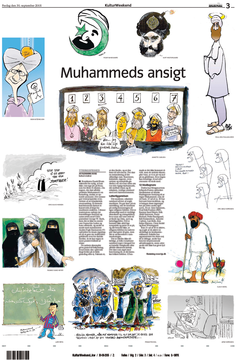
On the Muhammad Cartoons

I have put off writing this article for about eight years now, and repeatedly imagined that I would never have to write it. But, apparently, some things have to be stated out loud, with full details and reasons appended.

Before I begin, I would like to state two things clearly:

Firstly, I am an atheist, and I am against all religion, because magical thinking muddies logic and destroys analytical ability.

Secondly, I am in favour of free speech as a right. However, if there is to be free speech, it must be applicable equally, across the board. If there are restrictions, they too must be applied equally, across the board.

Right.

It was in 2006 that I first became aware of the so-called Muhammad Cartoons “controversy”. Back then I was on Orkut, which as far as I am aware still exists, though I don’t know anyone who still uses it. Back then, though, Orkut was a vibrant network with a fairly large user base, and there were many “communities” of atheists where they exchanged notes.

Well, what did I find but that these atheist communities suddenly filled with people sporting Danish flags as their avatars as a gesture of support to Denmark. I’d already, of course, heard in the news about protests against the cartoons, but this Danish flag-waving left me scratching my head. After all, a lot of these same people were, only days earlier, condemning the occupation of Iraq and Afghanistan, partly carried out by these same Danes. It was surprising to say the least.

The murkiness of the whole thing was exacerbated by the fact that the other nations of Western Europe lined up behind Denmark and offered full support. This was fully and completely amazing because these were the exact same nations which criminalised Holocaust Denial – locked up people for even questioning the official account of the Holocaust, in fact, such as the exact number of dead, not denying it outright – and in the case of Germany even criminalised the swastika. There seemed, to me, something of a gigantic piece of double standards at work here.

On the surface, though, it seemed to be a fairly typical case of Muslim overreaction. A Danish newspaper, Jyllands-Posten, which is the largest in Denmark, but virtually unknown outside it, holds an experiment in free speech by inviting some of its staff and other cartoonists to draw the Prophet Muhammad. Result: large scale rioting across the world, death threats against the cartoonists, economic sanctions against Denmark. Those Muslims again, blowing their tops as usual.

Of course, it wasn’t anything like as simple as that. These things never are.

To begin with, we should know who Jyllands-Posten are. By no means is the paper a liberal voice of free speech; in fact,

the solicitation and publication of the Ê»Muhammad cartoonsʼ was part of a long and carefully orchestrated campaign by the conservative Jyllands-Posten (also known in Denmark as Jyllands-Pesten – the plague from Jutland), in which it backed the centre-right Venstre party of Prime Minister Fogh Rasmussen in its successful bid for power in 2001. Central to Venstreʼs campaign, aside from its neoliberal economic agenda, was the promise to tackle the problem of foreigners who refused to 'integrate' into Danish society. [Source]

Therefore, we have a right-wing paper in a nation with an increasingly large Muslim minority, using the excuse of “free speech” to advance its agenda. I wonder what we would find if we looked at Jyllands-Posten’s record where non-Muslim religious matters are concerned?

While Jyllands-Posten has published satirical cartoons depicting Christian figures, it rejected unsolicited cartoons in 2003 which depicted Jesus, opening it to accusations of a double standard. In February 2006, Jyllands-Posten refused to publish Holocaust cartoons, which included cartoons that mocked or denied the Holocaust, offered by an Iranian newspaper which had held a contest. [Source]

While not definitive, there does seem to be a distinct double standard here, especially since the paper published the initial cartoons as a deliberate and conscious decision, gathering together cartoonists for the specific purpose of drawing them. And though the different cartoons depict completely different scenes – for reasons I will mention, I am not going to post the cartoons on this article, but they can be viewed here – there are several, especially one which shows a bearded man with a bomb for a turban, which are unambiguously meant to offend.

[Besides, the paper later published some of the Iranian cartoons, after taking the advice of rabbis. You'll note that the advice of no Muslim, let alone  a mullah, was taken before publishing the Muhammad cartoons. Double standards much?]

So, where does that leave us, exactly? When you go out of your way to offend someone, and that person is offended, are you entitled to claim that you’ve been unfairly victimised because that person has been offended?

And why, oh, why, were the Muslims offended?

Let’s get one thing out of the way, first: if there is one thing you can absolutely guarantee will rouse a Muslim reaction, it’s insulting the Prophet Muhammad. Everyone with even baseline knowledge of Islam knows that. Muslim poets over the centuries have routinely poured scorn and censure on Allah and on the mullahs, but not one of them has ever insulted Muhammad. That would be the equivalent of a devout Jew insulting YHWH.

Then, the cartoons weren’t all the same. Some of them were neutral depictions of Muhammad. One depicted not the Prophet Muhammad himself but a schoolboy called Muhammad. And some of them were openly and deliberately insulting.

If the cartoons had not been insulting, it’s a guarantee that nothing would have happened. It isn’t as though Muhammad is sacrosanct from depiction in Islam. Shia Islam, in fact, has a fair history of depicting him. But there’s a difference between depicting him and insulting him.

Then, too, it wasn’t just an isolated example, though for the Manichean narrative favoured by the West fed on a diet of Hollywood movies, there’s no such thing as nuance. Just as the Afghans said that the protests after American troops burned Korans in Afghanistan weren’t just about the Korans – it was the culmination of a series of humiliations, the straw that broke the camel’s back – it was a culmination of a series of instances in which immigrants, specifically Muslim immigrants, were targeted in Denmark. And that’s not even including Danish involvement in the illegal imperialist invasions of Afghanistan and Iraq.

If Jyllands-Posten had wanted a debate about Islam and free speech, as it claimed, it could have chosen literally anything about Islam to draw or write about, rather than this. There are so many things unambiguously wrong with Islam that there is endless material to pick on, from suicide bombing to the treatment of women to the rejection of modern scientific thought. All of those would be perfectly valid, and all of them would also not result in any kind of outpouring of Muslim rage. In fact, sections of Muslims would probably even have welcomed them.

Why was this not done? There’s only one interpretation, that the newspaper had no intention of promoting a free discussion as it claimed. As I said, its only purpose was to offend as many Muslims as much as possible.

By any logical definition, an action designed to offend another person comes under hate speech. Freedom of speech is not absolute anywhere in the world; you can’t go into a crowded theatre, yell “fire” and then claim that you’re innocent of the resultant stampede because you were merely expressing your freedom of speech. Similarly, if you go to scream racial epithets at someone, and that person reacts with anger, you can’t get away from the responsibility for knowingly and deliberately provoking that anger. That’s why hate speech laws exist.

[And that is why I am not going to publish the Muhammad cartoons in this article, because it’s just as much hate speech as painting swastikas on synagogues, and for the same reason, I am also not going to post pictures of swastikas on synagogues.]

Even then, the reaction was far from being as immediate or as generally thought. The cartoons first appeared on 30th September 2005, to general public weariness. It wasn’t till 4th October that a death threat was made (by a teenager, whose mother turned him in). After that this is what happened:

…a group of Islamic leaders…called a meeting to discuss their strategy, which took place in Copenhagen a few days after the cartoons appeared…The meeting established 19 "action points" to try to influence public opinion about the cartoons. Ahmed Akkari from an mosque in Aarhus was designated the group's spokesman. The group planned a variety of political activities, including launching a legal complaint against the newspaper, writing letters to media outlets inside and outside Denmark, contacting politicians and diplomatic representatives, organising a protest in Copenhagen, and mobilising Danish Muslims through text messages and mosques…A peaceful protest, which attracted about 3,500 demonstrators, was held in Copenhagen on 14 October 2005.

So far, not the slightest sign of violence. Everything completely peaceful and legal. What happens next?

 This: 

Having received petitions from Danish imams, eleven ambassadors from Muslim-majority countries… asked for a meeting with Danish Prime Minister Anders Fogh Rasmussen on 12 October 2005. They wanted to discuss what they perceived as an "on-going smearing campaign in Danish public circles and media against Islam and Muslims". In a letter, the ambassadors mentioned the issue of the Muhammad cartoons, a recent indictment against Radio Holger, and statements by MP Louise Frevert and the Minister of Culture Brian Mikkelsen. It concluded:
We deplore these statements and publications and urge Your Excellency's government to take all those responsible to task under law of the land in the interest of inter-faith harmony, better integration and Denmark's overall relations with the Muslim world.


In other words, not only were the initial reactions completely peaceful, this is direct proof that the cartoons didn’t suddenly appear out of nowhere, in a void; they were part of a series of actions that the Muslims of Denmark viewed as discriminatory and offensive.

As to why other Muslim countries got involved, there’s a simple response: when neo-Nazi hoodlums vandalise Jewish cemeteries elsewhere or scrawl swastikas on synagogues, why does the relevant Israeli embassy immediately get involved? What’s good for one is good for the other, as long as we are even going to pretend to be neutral and even-handed.

The (right-wing) Danish government, which was supported by Jyllands-Posten, refused to meet the ambassadors, and also ignored further representations from the Organistion of Islamic Countries and the Arab League. If it had met the ambassadors, and stated that it stood for good relations with all religions, but that it had no control over the media, and this officially dissociated itself with the issue, it would have been Jyllands-Posten versus any Muslim who wanted to take it to court. The Danish state would have been out of it. But by refusing to take this simple step, the government entangled itself in the issue, to no credit to itself at all; instead, Danish right-wing Prime Minister Fogh Rasmussen (today, a NATO bigshot, the same NATO which is allied with radical Islam against moderate Muslim people and nations) endorsed the Jyllands-Posten stand in an interview. Far from being even a neutral, therefore, the Danish government allied itself to one side in the dispute.

It was only at the end of October, nearly a month after the cartoons were published, that there was any further action, and that consisted of lodging a police case, which was dismissed in January 2006 on the grounds that the cartoons were in the “public interest”. By that time, a committee of Imams toured West Asia with a dossier of documents relating to the case, including cartoons from another paper published in November 2005, which were allegedly “even more offensive” than these. There were also – and this caused a great deal of problems – images which were taken from a French “pig squealing contest”, and had nothing whatever to do with the cartoons, but which were (deliberately or inadvertently) passed off as part of the anti-Muslim mindset in Denmark.

Richard Dawkins, in The God Delusion, goes into a discussion of these extras, and strongly defends the cartoons. Like his “New Atheist” counterparts, Sam Harris and Christopher Hitchens, Dawkins has been accused of cloaking his hatred for Islam in atheism. Personally, I know little about Sam Harris and I only have total and absolute contempt for Hitchens, who was one of the vociferous supporters of the invasion of Iraq. Dawkins, as I have seen, drops all his otherwise careful scholarship when it comes to Islam, and makes sweeping statements which would be hilarious if they weren’t so ugly and inaccurate.

But, Dawkins or the others should be asked, what did they expect to happen when the situation reached the point where it became the property of the mullahs? Did they imagine that there would be no rabble-rousing, no playing to the gallery? In fact, is this rabble rousing and playing to the gallery not precisely the reaction the cartoons were designed to provoke? So, what exactly is the point, that Muslims were guilty of getting angry at something deliberately crafted to make them angry?

It was only after the Imams made this trip, in late January and February 2006, that the protests turned violent. This is in complete and absolute contrast to the usual narrative of lunatic Muslims going on the rampage at the drop of a cartoonist’s pen. In fact, the protests were fuelled by local mullahs who deliberately and cynically egged on people who had not, of course, ever seen the cartoons for themselves, and who had no opportunity to see the cartoons for themselves. Again, this was completely and utterly predictable. Some of these protests were actually just a manifestation of other long-ongoing battles, as in Nigeria where they exacerbated Muslim-Christian conflicts.

 By March, some West Asian countries organised a boycott of Danish exports, another thing which was a direct result of the Danish government’s refusal to stand clearly aside from the cartoons, as we’ve seen. In effect, these boycotts had little real effect, but these were the only official reactions by Muslim nations or organisations to the cartoons. The Organisation of Islamic Countries not only denounced the death threats to the cartoonists, it called the protests “un-Islamic”. But that is something that didn’t fit the dominant anti-Islamic feeling in the West. Nor did the fact that an extremely small minority of the world’s Muslim population participate make it to the dominant Western consciousness; it simply did not fit the theme.

Let me say something clearly here: just as a hundred and fifty years ago, racism against non-white people was perfectly acceptable in mainstream Western society, and as anti-Jewish racism was also acceptable till the end of the Second World War, today anti-Islamism is completely mainstream in the West. It’s also every bit as stupid and ignorant of Islam as racism and anti-Judaism were stupid and ignorant in their turn. The danger is, though, that it tends to turn itself into a self-fulfilling prophecy. If people are made to feel consistently attacked and vulnerable, they will react in ways which are consistent with defending themselves. They will listen to leaders who dramatise the sense of insecurity to cement their own hold on power. This is as true of Islam as anything else, and anyone who pretends shock at the Muslim reaction is being dangerously disingenuous.

Also, let me point out that Islam isn’t a single, unified entity. Like Christianity itself, it isn’t a religion so much as a collection of different religions with only some points in common. The overwhelming number of Muslims are actually more concerned with day to day living than any religious matter, and they couldn’t care less about things like this as long as it’s not shoved in their faces. Even then, the vast majority will not react in any way. But the media will go out of its way to depict the entire Muslim world as violent and unstable. Because that sells.

There was also, at this time, what I feel personally is the single most cynical action in the whole cooked-up “controversy”. It was the decision of other newspapers across Europe to reprint the cartoons in “solidarity”. Now, Denmark, for all its faults, does treat freedom of speech relatively even handedly, and has no laws against Holocaust Denial. However, papers in nations which do have such laws – countries which lock people up for questioning the standard narrative of the Holocaust – gleefully reprinted the cartoons. I don’t know if they felt any cognitive dissonance, but I doubt it.

Whenever I bring this point up – the blatant double standards of those European nations – I can absolutely guarantee that somebody is going to accuse me of being a Holocaust Denier. My response is always the same:

First, that those who deny the Holocaust happened are equivalent to those who claim the earth is flat. Do these European nations have laws against Round Earth Denial?   

Second, the fact that the Holocaust happened does not sanctify one particular narrative of it, and indeed by enforcing one particular narrative, plays into the hands of Holocaust deniers.

Third, the fact of the Holocaust does not excuse the crimes of the so-called state of Israel; and these same nations are completely in support of those crimes.

Right.

So, as you probably will have guessed by now, as an atheist I am strongly against the Muhammad cartoons, for the following reasons:

1. They are clearly an example of hate speech.

2. They are calculated to produce the exact same divide in society that they claim to be against.

3. The standard narrative of them in the popular consciousness is completely opposed to the facts.

4. There are blatant double standards where the Holocaust is concerned.

The real tragedy is that I have to actually point these things out at all.


Thursday, 22 December 2011

Thoughts on the nude as art


Statutory warning: everything in this post is my own opinion and more likely than not hogwash.

I still remember the first nude art I ever saw.

I must have been about seven or eight years old. My youngest uncle, then about eighteen or nineteen, and a college student, had brought home a calendar, and showed it around at the dinner table.

It was a calendar of nude artwork (at this distance in time I can’t recall them too well but I’m pretty sure they were by European masters of the Renaissance era), and not the most common thing to be passed around over dinner – not back in the late seventies, when there was no TV hereabouts and a bikini in a magazine ad was about as much skin as one could ever see.

My grandmother, that gracious lady, didn’t turn a hair.  I still remember her looking at one of the paintings – depicting a man clasping a woman from behind and stabbing her between the breasts – and discussing how well the whole thing was painted, how the woman’s eyes were crinkled with agony, and so on. She didn’t even mention the fact that nobody had any clothes on.

This little episode was my first introduction to something that I’d never even thought about – nudity as art. Back then, nakedness had either been something to be ashamed of, or something one didn’t even think about. It wasn’t anything to do with sex, of course, because our parents and teachers back in those days pretended sex didn’t exist.

It was much later – long after I’d outgrown the teenage hormonal rush which made me look at every exposed nipple with a thrill going from my brain down to my genitals – that I began to re-examine the concept of nudity as art, and art pure and simple. You know, like the shift when one person’s dirty postcard became his own art masterpiece. Not, actually, that I needed all that much persuasion to start thinking of nudity as art. Most of it seemed too plastic to show real people anyway.

Is that silicone, or am I mistaken?


Now, of course, there are two distinct subdivisions of art – the naturalistic and the stylised. Now, if you’re anything like me, you’d assume the stylised would come first and give way to the naturalistic at a later date, when techniques and technology developed. By which you realise that I know nothing whatever about art.

The point that stuck in my mind though was this: why was nudity art? Specifically, in probably 80% of instances, why was the naked female form art? (Please understand that I’m not including pornographic or erotic art here.) Starting off with the Venus of Willendorf, a piece of Neolithic sculpture for which my own admiration has been utterly unfeigned since I first laid eyes on her. 


What is it about the unclothed form – and, if you set aside Michelangelo, just about always the unclothed female form – that draws out artists?

I don’t have a specific answer, but let me stick my neck out anyway – the nude as art exists because we are all drawn to the female sex as a nurturing and generative figure. Just like the Venus of Willendorf, which was most likely a fertility figure, ultimately the female nude is the equivalent of worship of the feminine in a form which isn’t readily recognisable as worship.

This can take the form of naked goddesses, like Diana:


Or Kali:


 And don't forget her, either:

Am I the only one wondering how the cloth stays on?

Or it can look like this, whatever the hell it is:

Pubic hair and all


I assume the artist had some kind of mammary fixation. Well, that pretty much proves it. 

I rest my case.

The Venus of Willendorf


In a museum in Wien, Austria, there is a little limestone statuette. They call her the Venus of Willendorf.

She isn’t large; only eleven centimetres from head to shin, about big enough to hold in the palm of one’s hand, and that (for reasons I’ll go into in a moment) is significant. She’s also old; very old, as it happens. She was carved between twenty seven and thirty two thousand years ago. Imagine that for a moment. At the time she came into existence, the Pyramids were seven to eight times as far away in the future as they are in our past. The human race was yet to discover agriculture. And yet someone made her, with such extreme care that she remains a work of art to this day.

So what’s so special about her, anyway?

At first sight, she looks like a fat naked woman, with huge breasts and abdomen, and a very carefully carved vulva with prominent labia. Her thighs are thick and lifelike, her large buttocks flat and also lifelike, and her stick-thin arms, which hold on to her upper breasts, bear the clear representation of ornaments akin to bangles on the wrists. She does not have feet, and never did; the feet aren’t broken off, they just never were carved. And she does not have a face. Instead, what covers her head is a series of seven carefully carved concentric circles, for all the world like coils of braided hair. She is a thing of beauty, above all else. But she’s not just a thing of beauty.

While it’s impossible to tell precisely why she was made, it’s possible to conjecture; there are enough clues available that such conjecture isn’t blind guesswork. For one thing, she’s not alone; the period she was made has sent down to us many other stylised representations of women, and only of women. But, while some of the other carvings are less and some more detailed than the Willendorf Venus, they lack the clues that she gives us.

Take another good look at her; and think of the era in which she was made. Back then, humans lived in nomadic hunter-gatherer societies, and life was really nasty, brutal and short. One would be lucky to live till one’s mid-thirties, and there was never any certainty over whether one would live to see the next day. And remember, always, that biologically, a human being is no more than a way for a gene to create another gene. That’s behind the urge to reproduce, an urge which most of us give in to this day. If you aren’t sure whether you’ll live to see tomorrow, it makes sense to reproduce today while you still can. Doesn’t it?

And, who carries out the actual business of reproduction? The man can donate his sperm, but it’s the woman who bears the baby in her womb, brings it forth from between her legs, and cares and nurtures it as long as needed. The woman is the well-spring of life; as it were, the “sacred feminine”.

Suddenly, the Venus doesn’t look like a morbidly obese woman any more; with her swollen breasts and her swollen belly, at which she seems to be looking, she appears to be a lovingly depicted and somewhat exaggerated vision of a pregnant woman, and her meticulously carved vulva is the gateway of future life to come.

And it’s also significant that she was found covered in red ochre paint, as of menstrual blood. Menstruation must have been a most significant occasion in women’s lives, if only because it would stop if she conceived, and was pregnant; and, of course, pregnancy was the very essence of her femininity, the state where she could do what no man could ever do: give birth to a new human being.

Also, remember that the Venus is small, only large enough to be held in a hand. In fact, she seems designed to be held in a hand, her curves sensual and rounded, the flowing lines desiring, almost, to be stroked. Obviously, she wasn’t meant to be left somewhere. She was meant to be carried along...to be, if one might say so, loved.

Therefore, I suppose it’s pretty logical to assume that the Venus was meant as a paean to femininity, a song of praise to womanhood. Let’s assume that for the moment and see where it gets us.

The first thing we should remember, of course, is that imperative to reproduce I mentioned a while back. Since it’s hardly likely that people of the time were so dumb that they hadn’t worked out the connection between sexual intercourse and childbirth, it seems logical to assume that sex itself would come to have a special and highly significant, probably ritualistic, place in the society of the time.

And that, directly, leads us to something that – modern legalities aside – should be realised; after the onset of sexual maturity, virginity is a highly abnormal state. We’re programmed to have sex for a reason; and that reason is, primarily, the continuation of the species. Whether said sex is heterosexual, and directly concerned with propagation, or homosexual, and concerned with societal bonding, the fact is that virtually all of us are programmed to have it, and to enjoy it.

Logically, then, since giving birth was a precious and extremely necessary thing for the societies of the time, virginity was not only useless but actively harmful, since it wasted valuable sexual energies. In fact, I’d go so far as to say that being a virgin was pretty much tantamount to being a traitor, because it imperilled the group. And it’s more than likely that young men and women were ritually deflowered and initiated to sex as soon as they reached sexual maturity.

It’s most likely that the reverence for virginity (which is still sputtering along in today’s so-called modern society) is a much more recent phenomenon, one that grew with the emergence of settled communities and the concept of property. Obviously, a nomadic hunter-gatherer society can’t afford to have personal heritable property, or even defined family groups. It’s more likely than not that such societies brought up their children in common, and the children belonged to the group in common. But once a society settled, and became property oriented, a man had to have a reason to work for the future. If he had children, he needed to have a reason to work to pass on the fruits of his labours to the children. And why should he work for children he wasn’t sure were his own?

The solution, therefore? Get hold of the woman early, as soon as she becomes sexually mature, and control her so that she has sex exclusively with you. Whatever children she brings forth into the world will be yours, and therefore worth caring for. And in order to control her sexuality before she is yours, turn her virginity into an iconic state, instead of the stigma it was. Once you make her the custodian of her own virginity, your battle's won.

The attitude is just the opposite, in fact, of that shown by the Venus of Willendorf.

Men are the weaker sex biologically. We live shorter lives, and carry more genetic defects. Men are the weaker sex sexually as well; women have stronger sex drives than men, and biologically are programmed to that as well. The imperatives of reproduction ensure that. And, subliminally, men are aware of it, and, I suspect, faced with the raw sexuality of a woman, they’re terrified.

It wasn’t always like that though. Once upon a time, men and women were perfectly aware of each other’s respective sexuality, and rejoiced in it.

The Venus of Willendorf tells us it’s so.


Further reading:

http://witcombe.sbc.edu/willendorf/willendorfwoman.html (A detailed physical description of the statuette)

http://www.donsmaps.com/willendorf.html
(A site with photographs of her from various angles, and a description of how she was found)