Showing posts with label war. Show all posts

Thursday, 20 July 2023

The End Of The Grain Deal And The Kerch Bridge Explosions


By now anyone remotely interested in the conflict in Ukranazistan will be aware that Russia terminated the Grain Deal that’s been in effect since 22 July 2022 and which allowed Ukranazistan to export grain from Odessa. In all probability the majority of those who are aware of it will have been made awar of it by the media shrieking that this will cause starvation in poor countries.

Will it?

This article,[1] for instance, ends with:

"Terminating the grain deal will only bring higher food costs and shortages for countries that import agricultural products from Ukraine."

Here's the truth about where the grain from Ukranazistan goes:[2] 

"China has been the main destination for cargo exports of Ukrainian grain at 8 million tonnes, followed by Spain at 6 million tonnes and Turkey at 3.2 million tonnes."

Only 2.5% of Ukrainian grain went to poor or developing countries according to the UN official data.

Low-income countries received 2.5% of the over 32 million tonnes of grain exported under the Black Sea Grain Initiative, according to figures by the United Nations (UN).

Of the 6 million tonnes sent to Spain, the vast majority went to feed pigs to make jamon

The majority of the 3.2 million tonnes to Erdoğanistan was processed into flour and sent right back to Ukranazistan. 

So, no, it won't. 

In fact, it won’t even significantly raise wheat prices, as Moon Of Alabama points out: [3]

“More wheat is coming to the markets from other producers than Ukraine. During the next year, even without grain from Ukraine, prices for wheat and corn may actually come down:

World wheat supplies are strong following exceptionally high exports from Australia and Russia and a rebound in Canadian shipments after droughts disrupted last year’s season. After falling for years, global stocks may finally rise in 2023. As for corn, Ukraine’s shortfall may well be filled by expected record sales from Brazil, reckons Alexis Ellender of Kpler, a data firm.

So this is much ado about nothing. Globally Ukraine just isn't important at all.”

Of course you wouldn’t know this from the usual media suspects, whose primary purpose is to blame Russia for everything.

If there is anything Russia is to be blamed for, it’s for signing the grain deal in the first place.

What were the terms of the grain deal? Ships from Odessa and Nikolayev would carry Ukranazistani grain – wheat and maize – to Erdoğanistan (that’s Turkey to you) where it would be inspected by Russian and Turkish officials to ascertain that there were no military supplies on board, after which it would be shipped on elsewhere.

In return Russian grain would be allowed free movement, Russian ammonia pipelines to fertiliser factories would be permitted uninterrupted, and Russia would be reconnected to SWIFT.

Predictably, none of that happened. It is astonishing that anyone could imagine that it would have happened, but Putin’s capacity to be deceived by his Western “partners” seems almost limitless.

Well, I said almost, but with any luck that limit has finally been reached.

It was not just that the Ukranazis’ Western masters did not follow through on their own commitments to the grain deal: they used it to arrange both the partly successful attacks on the Kerch Bridge, the one last year and the one a few days ago.

Here’s how the bridge blast by an explosives-rigged lorry last year went, as pieced together by Russian intelligence:

A Ukranazi ship loaded with explosives sailed out of Odessa as part of the grain deal, but instead of going south to Erdoğanistan it turned west and sailed up the Danube to an inland port in Bulgaria.There it unloaded its explosives, which by a circuitous route went through Georgia into Russia, where it was transferred to the final lorry (whose driver had no idea what he was carrying) for shipment to Crimea across the Kerch bridge. Once on the bridge, the lorry was exploded by a remote controlled detonator.

This kind of thing is no longer possible, since every vehicle is now X rayed and searched before being allowed on the bridge. Multiple attempts at missile strikes on the bridge since then by the Ukranazis with their Brutish-supplied Storm Shadow missiles have also failed against the now heavy and layered Russian air defences. So the Ukranazis’ Western masters had to step in directly.

The second attack on the Kerch Bridge was carried out by Brutish underwater drones released from a civilian dry goods bulk carrier cargo ship, sailing as part of the Grain Deal, off Snake Island. This followed Brutish plans to destroy the bridge [4] hatched over months. Instead of destroying it, though, they managed to cause actually rather less extensive damage than the lorry bomb attempt. While one span of the road bridge was broken, the other was undamaged, and the far more important railway bridge untouched. [5] Military traffic to Crimea was not affected at all.

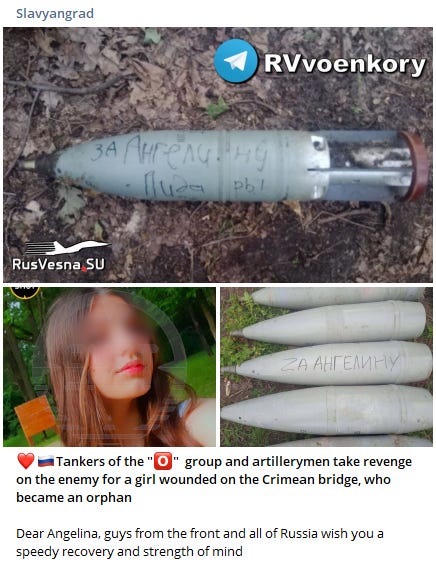
What the Ukranazis and their NATO masters managed to do was murder a holidaying couple [6] and put their 14-year-old daughter Angelina in a coma. This has not unnaturally led to fury among Russian forces, and writing “For Angelina” on shells being fired at the Ukranazis.


It has also led to many of the blueyellow-ragwagging nazi worshippers online revealing just what kind of hate-filled vermin [7] they are. Consider this character:


It is allegedly a teacher.


Fortunately, this one was so stupid as to post under its real name, and has been speedily doxxed, with everything including its address, email, and phone number exposed:


Hopefully it will soon receive a visit from several large biker/trucker types. From reading online comment fora I’m led to believe there’s a lot of sympathy among that demographic for Russia.

Meanwhile, Russia is making sure the Ukranazis and their NATOstani masters won’t be able to sneak grain (or “grain”) ships into and out of Ukranazistan by reducing the Odessa port facilities to scrap.[8]

In return for relatively minor damage inflicted to the Kerch Bridge, I don’t know if the Ukranazis and their NATO masters still think it’s been worth it.

 If it means Putin has been finally disillusioned about his western "partners", it's not been worth it at all.

Sources:


[1] https://www.zerohedge.com/commodities/wheat-prices-soar-russia-considers-ships-heading-ukraine-carriers-military-cargo

[2] https://www.agriland.ie/farming-news/black-sea-grain-initiative-2-5-of-exports-to-low-income-countries/

[3] https://www.moonofalabama.org/2023/07/much-ado-about-nothing.html#comments

[4] https://thegrayzone.com/2023/07/19/leaked-files-british-kerch-bridge-strike/

[5] https://simplicius76.substack.com/p/kerch-bridge-deja-vu-breakdown

[6] https://awfulavalanche.wordpress.com/2023/07/18/ukraine-war-day-510-innocent-victims-of-the-bridge-attack/

 [7] https://awfulavalanche.wordpress.com/2023/07/19/ukraine-war-day-511-the-child-on-the-bridge/

[8] https://simplicius76.substack.com/p/putin-strikes-back-ukrainian-ports


Wednesday, 12 July 2023

Have you noticed?

 Gone are all those airy puff pieces talking about Ukranazistan's  inevitable  victory, as gone as those ten years ago predicting the "imminent and inevitable" fall of Assad. Gone is the triumphant air of imminent control of the world. The increasingly  desperate tone is that Ukranazistan cannot be allowed to lose because that would be a disaster for the "world". The "world", in this case, means the Wall Street warmongers, their political puppets, and the Europistani slaves, naturally.  And yet the only way that Ukranazistan's defeat can be staved off is an open NATO intervention,  but they can't risk that because Russia has been pushed to the point that it can't and won't back down. And yet Ukranazistan's  defeat will mean the economic ruination of Europistan, which thought it could recoup its losses from looting Ukranazistan and from "war reparations" from Russia. It is a conundrum that can't be solved without kicking out Uncle Sam, but kicking out Uncle Sam is impossible  because in order to spite Russia Europistan has sold itself to him as slaves and chattels even more completely than ever before. 


Meanwhile German tanks painted with WWII nazi cross insignia continue to burn in the fields of Ukranazistan. 


I don't know if the media that give the rainbow haired liberal freaks their daily outrage instructions have told them about it.

Wednesday, 28 June 2023

A pro Putin post from me?!? What's happening???


Let's just assume for the sake of argument that the claims that Prigozhin launched a NATO funded coup attempt to overthrow Putin are true.

Proponents of that hypothesis, who call Prigozhin a "traitor", are claiming that he should have been killed or arrested, and it was weakness on Putin's part to let him go free.

No.

It wasn't weakness. 

1. Russia has no death penalty. Prigozhin couldn't have been just summarily given a bullet to the head.

2. Prigozhin was not in the convoy headed to Moscow, he stayed in Rostov. This means:

(a) He would either have to be arrested somehow after fighting a city battle past 6000 highly experienced and heavily armed Wagner soldiers and brought to trial, or

(b) The military  HQ in Rostov bombed to rubble to kill him.

Any of this would have resulted in massive numbers of civilian and regular troops being killed. And the regular forces going to Rostov were Chechens. Chechens killing Russians in a Russian city? It would be a NATOstani wet dream. It would've immediately made divisions between Russians and Chechens flare up again.

In short, trying to kill Prigozhin is exactly what the NATOstanis would have loved. This way Putin got rid of Prigozhin without turning anyone against Russia.

Seems a good way to deal with it to me.


Saturday, 10 September 2022

The SMO is Done


Hello, everyone reading this.


This is one of the hardest things I have ever had to write, and if you think Putin is a genius or a 5D Chess Player or whatever, you might as well stop reading now.


In brief: The Russian Special Military Operation, or SMO, is over. It has failed, totally and absolutely.


We were lied to, it appears, from the beginning. We were lied to about Russian aims, Russian plans, and Russian abilities. And this is the result.


If you still believe this Kharkov Offensive is some kind of genius masterstroke by Putin, some enormously wonderfully constructed “trap”, you are either in need of a brain transplant or your name is The Faker or Andrei Martyanov.


Russia lost in Kharkov. It wasn’t the result of a “trap”, it wasn’t a “strategic retreat”, it was a rout, and the analogy in terms of the effect are not – as some people are comparing it to – the Battle Of The Bulge in WWII, but the Tet Offensive of 1968 in the Vietnam War.


What was the Tet Offensive? It was the mass attack all across South Vietnam by the Viet Cong, which suddenly and rapidly overwhelmed the defences of the South Vietnamese puppet regime and their American masters. The city of Hue was among the places liberated; a Viet Cong suicide squad even penetrated the American Embassy in what is now Ho Chi Minh City.


Now for three years the American Empire had been telling its subjects, as well as the rest of the world, that the Viet Cong had been defeated, that they were on the ropes, and yet here they were rampaging through South Vietnam and shooting up even the vaunted American Embassy.


So what happened? In the end the Viet Cong were pushed back with every single thing they had captured being taken back by the Americans and their puppets. The Viet Cong also suffered such devastating losses – 35000 guerrillas and main force regulars killed – that it never recovered. From 1968 to the end of the war in 1975, Viet Cong activity was low to nonexistent.


But so what? Behind the Viet Cong, ready to take over, was the North Vietnamese People’s Army. From 1968 on, the bulk of all the fighting was done by the NVPA; there was little to no VC activity.


And what happened? The world saw that the American Empire was clearly lying; the faith of the American people in their regime was irretrievably broken; and from that moment on the final defeat of American though still distant, was as clear as day.


This, ladies and gentlemen, is the Tet Offensive moment in Russia-Ukraine. From this moment on no sane person should believe a single thing the Russian Ministry of Defence has to say.


This is a defeat so overwhelming that at this point, and I will explain why, there are only two options before Russia:


1.       Stop the conflict immediately, negotiate peace on any terms available – it will certainly involve throwing the Lugansk and Donetsk People’s Republics under the blueyellow nazi bus and gigantic “reparations” payments – and withdraw from Ukranazistan. If the negotiations go very well, Russia might just be permitted to keep Crimea, though I doubt it.

Or:


2.       To hell with the “special military operation”; stop the rubbish. This is a war, declared or undeclared; start fighting it like one. Turn Elensky and the rest of the nazi regime into a smoking hole in the ground. If that involves massive collateral damage, so be it.


What cannot be done is continue things as they are.


What has been happening over the last couple of months?


First, after the capture of Lisichansk, Russian advances practically stopped. Most of the Russian army, in fact, went home; there were only about 50000 regular soldiers left in Ukrainian territory. The advances, such as they were, depended entirely on the heroic fighting of Chechen volunteer units, the Wagner PMC, and the Russian Rosgvardia paramilitary.


The constant missile attacks on nazi ammunition and weapons depots in Lvov and other parts of western Ukranazistan, such a constant feature of the first three or so months of the conflict, dried up. Absolutely inexplicably – even gross incompetence cannot explain this – the bridges across the Dneiper river, and the railway networks that the nazi regime used to haul every bit of weaponry  coming to the front haven’t been touched. Even a mindless clod knows to cut off the enemy supply routes, but the Russian High Command, assuming such a beast exists, did not do it.


Meanwhile the Lugansk and especially the Donetsk People’s Republics forces were virtually left to themselves to fight their way with excruciating slowness through the massive trench lines and fortifications the nazis had set up in the eight years since 2014 when Putin had thrown the Donbass under the nazi bus the first time round (see the book “85 Days In Slavyansk” for a full analysis of Putin’s betrayal if you aren’t already familiar with the details). Since the 16th of February, nazi artillery in Avdeevka and Mariinka have been shelling and anti personnel mining Donetsk City, yet the Russian aviation, which allegedly controls the skies over Ukranazistan, did nothing to destroy the emplacements. When we asked why not, we were told that the Nazis were hiding among civilians. Well, so what? Are the lives of Donetsk civilians worth less than the lives of the alleged civilians of Avdeevka? Nobody deigned to give us an answer.


There was also the deliberate myth created by the Russian side that it was only the Nazis that were targeting the Donetsk civilians, that regular Ukrainian forces were not involved. This was, as any number of LNR and DNR people pointed out, absurd; the Ukrainian military had never permitted the nazi units to acquire any heavier artillery than light mortars. It was the regular forces shelling the civilians, but the Russian military refused to admit that.


Pro-Russia channels on Telegram delighted in videos of DNR quadcopters dropping grenades on Ukrainian troops (impossible to tell whether they were nazis or not). Their accuracy, judging from the videos, was fairly impressive (of course they only posted videos of hits) but, and this was a problem those of us familiar with the tactics of the Syrian war instantly noticed, this is not something a regular military should have to resort to doing. This is what ISIS, and with considerably greater effect, using bigger drones and mortar bombs instead of hand grenades, did in the Battle of Mosul. Not only did the DNR have to slog through fortifications by itself, it had to resort to the tactics of a terrorist group to provide itself a modicum of air strike ability.


Not that Russia helped in other ways either; to this day, almost seven months since the conflict started, the Russian side has not set up a unified command for the “allies” (LNR and DNR) and itself.  It’s as though D Day was fought as a number of separate landings, with the Brits, Canadians, and Americans doing their own, totally independent, thing. Can one imagine that to be a recipe for success?


 Then, mutters began to come out about “negotiations” again; the negotiations that the Ukranazis had abandoned in March, reportedly at the instigation of Boorish Johnson. What were these “negotiations” supposed to be about?


Who knows?


What, in fact, was the Russian final plan for Ukranazistan? Denazification? Then why is Elensky still alive? Why has not one nazi in Ukranazistan, including rabid Hitler-saluting vermin like Oleg Tyagnybok, been eliminated? How do you denazify a nazi state without eliminating the regime?


(I might as well insert here the ludicrous replies I encountered when I asked this question.  “Russia needs Elensky alive because he might be replaced by someone competent.” Oh yeah? Who? You also acknowledged that Ukranazistan is a NATO puppet. So the hypothetical ‘competent’ person won’t be a puppet like Elensky is? Or was it “Russia need Elensky alive to sign the surrender”? What surrender? Who would permit Elensky to sign a surrender, his NATO masters? Instead of making him a martyr by murdering him and blaming it on Russia, or at least spiriting him off to head a puppet regime in exile? Really?)


Or was it demilitarisation? Then how is it that the Ukranazis were permitted to build up a military so strong that, even without control of the air, it could launch two major offensives on two widely separated fronts of the very, very long frontline within days of each other? That one of the offensives was a predictable failure and the other might, like the Tet Offensive, still fail militarily in the long run makes no difference. Putin isn’t out to demilitarise anything.


Then what’s left? Preventing Ukranazistan from joining NATO? Elensky already admitted months ago that this was not going to happen; ironically it is now more than likely to happen if Russia is defeated.


Is it capture of Ukranazi territory? Then why did Russia unilaterally abandon the whole of north Ukranazistan – won in a couple of days back in February – in April?


Is it an “existential war” for Russia as some people are saying? Then why is it Ukranazistan that’s treating it as an existential war, while Russia isn’t treating it as a war at all? How does that make sense?


What is Russia then fighting for? I’m damned if I know, and, apparently, the Russian government doesn’t, either.


Anyway, back to this offensive on Kharkov; at the time of writing Russia abandoned territory it had captured in brutal battles over two months in 72 hours, abandoning the civilians to the tender mercies of the Nazis. These were the same civilians who had earlier appeared on videos profusely thanking Russia for liberating them, and more and more often openly demanding guarantees that they wouldn’t be abandoned. Well, they have been abandoned, and why should they trust Russia again?


Why should anyone trust Russia again?


And here we come to the comparison with the Tet Offensive again. Ukrainian army chief General Valery Zaluzhny – and I have been saying this for months on Telegram  and Twitter (till they banned me again, which was a good thing in retrospect though it cost me more than 3600 followers because I couldn’t take the Putin cultism now) – General Zaluzhny, who isn’t a nazi, is a highly competent and utterly ruthless professional officer far more like a WWII Soviet general than like anyone on the Russian general staff, assuming such a thing exists. Zaluzhny is throwing conscripts and Kraken Battalion Nazis (the Kharkov franchise of the infamous Azov Regiment) into attack as shock troops, and holding back his regular forces to exploit the breakthroughs. In other words, he’s throwing away his Viet Cong, and when they’re gone he’ll still have his North Vietnamese People’s Army.


So what, exactly has Ukranazistan won?


Firstly it’s won the – even if terrified and coerced – allegiance of the people. If there are people in Odessa and Nikolayev waiting for liberation from Russia, they aren’t blind, deaf, and dumb; they can see clearly that even if their cities are occupied by Russia they will be abandoned the moment a nazi offensive shows up. Why then should they do anything but support Ukranazistan, just for self-preservation? Wouldn’t you?


Secondly, and you can’t overstate how important this is, it’s a major step towards winning the support of the neutral world. You know all the maps showing how no non white nation except American slaves Japan and South Korea had sanctioned Russia? Well, most of the rest were going with who they saw as winning. Earlier this year 143 countries at the UN General Assembly voted to condemn Russia; a week or so ago that number had dropped to 54. It only takes a nudge to turn the pendulum the other way again. I myself know Modi will change sides in a moment if he thinks it'll be good for him.


(I would say that in this the death of Lizardbreath von Saxe Coburg und Gotha was extremely fortuitous for Russia. The Ukranazis had more likely than not planned to splurge their victory all over the world media, but the media is obsessing over her death and the succession of Charlie von Saxe Coburg und Gotha to the British throne. Nobody has any attention left to spare for Ukranazistan.)


Now to get to the third thing the Ukranazis have won, I have to discuss the Putin cult’s “cope” to explain away the defeat:


(a)Russia is massacring the Ukranazis, they can’t fight on like this, they’re going to lose all their forces. That is, the exact same body count “argument” as made in Vietnam; it didn’t work then and it won’t work now. While 70 year old conscripts are getting sacrificed, the trained and battle hardened regulars and nazi groups are getting, if anything, more numerous. And that’s if we ignore the NATOstani troops “on holiday” or “discharged” who have come to Ukranazistan as “volunteers”. Those who have been reading me for a while know that I have been predicting for at least three years that Putin’s failure to denazify Ukraine in 2014 means that Russia will have to fight a major war in Ukraine at some point and then it will face NATO forces in Ukrainian uniform. Well, guess what.


Even the venerable Paul Craig Roberts, though mostly a ranting old loon these days, correctly stated in a recent article that NATO was emboldened by Putin’s failure to crush Ukranazistan in February, and it will cost Russia dear, including possible nuclear war. I don’t think Putin has the competence or guts to fight a nuclear war, not any longer; he’d fold like a wet biscuit and surrender Russia to western capital rather than fight for its existence. More importantly, now the west knows it, too.


(b)Putin is deliberately drawing this out to destroy the EU, whose citizens will revolt when they’re freezing and starving in the depths of winter. To which I say, poppycock. There isn’t even a guarantee that the winter will be cold, what with weather swings these days. It could even be a much warmer one than usual. But even if it’s a mini ice age, so what? Apart from France, how many Europistani countries do you know where people come out in the streets to rebel and riot? Oh, yes, they’ll march in “protests”, wave placards, and then go home; if the regime feels like it, it’ll imprison a few of them as an example to keep the rest in line. Nothing more will happen. As for France, the Macron regime has weathered years of Yellow Vest protests. It knows how to deal with them.


But will there even be protests? Protests are only going to happen if the people see that Russia is clearly and demonstrably winning.  Then they might logically ask why they are told to freeze and starve for a losing side. But if Russia is seen to be quagmire or losing – and it is now clearly seen to be losing – then the people will tell themselves that they can grit their teeth and bear it somehow for the winning cause. Haven’t you seen this kind of thing for two years of Covid? Would you be surprised at all?


The fourth and final thing the Nazis have won is the full and continuing support of the NATOstanis. So far we’ve been hearing how NATO weapons depots are bare, they’re running out of things to supply; but now they’re demonstrably backing a winning side, so why should they stop? In their place, would you?


What does the Putin Cult have to offer in return? Ludicrous claims of massive and brilliantly planned pincer movements that will trap the Ukranazis. Yes, and Steiner will come to Hitler’s rescue in the bunker.


I’ve put my non-working life on hold since February for this conflict. I’ve put my novel on ice at 75% written. I went back to Twitter after a three year hiatus, fighting for Russia against blueyellow Ukranazis. I’ve painted and drawn comic strips as fast as I could until I gave myself tendinitis. And all with a fractured foot which I got in June.


Now I’m asking myself, why the hell should I care, if Russia doesn’t?


Either way, Russia has a choice. Fight a real war, or surrender on the least humiliating terms it can get.


The SMO is done.
 

Saturday, 4 December 2021

The Shadow Of The Shark: The Sinking Of PNS Ghazi


The water lay black and still. In the distance the low hills behind Visakhapatnam harbour were dark and showed not a glimmer of lights.


With a sudden swirl, a long thin shape broke the surface. It swung left, then right, like an elephant's trunk seeking air to breathe. It trailed a thin wake behind it as it went.


Ten metres below, something long and predatory slid through the water, black and smooth and lethal. It resembled nothing so much as a gigantic shark, complete with hydroplanes like pectoral fins and a huge conning tower like a flattened dorsal fin.


Inside the steel cylinder, a naval officer put his eyes to the rubber eyepieces of his periscope and tried to decipher some landmark with which to orient his vessel. Somewhere out there was the enemy he had to bottle up, or, if possible, destroy. It was midnight on the third of December, 1971, exactly  fifty years ago.


_____________________


In 1971, Pakistan was a nation divided against itself. To the west was the largely Punjabi, Sindhi and Pashto speaking West Pakistan. Across the immense stretch of India, in the east, was the Bengali speaking East Pakistan.  The two parts of the country, except for their creation as a "Muslim homeland" carved out of British colonised India, had nothing linguistically, ethnically, culturally, or economically in common with each other. 


By 1971, the differences between the two parts had come to a head. The Bengali speaking East outnumbered the West in population, and the Awami League party of Sheikh Mujibur Rahman won the national elections held under the then military dictatorship and thus the right to form the government. The problem was that Rahman was a Bengali and the Awami League an East Pakistani party, and large sections of the West Pakistani military and civilian political structure didn't want to cede power to them. 


In response to unrest resulting from this, the Pakistani military launched a crackdown on East Pakistan in mid March 1971, leading to millions of refugees fleeing to India. India, in turn, began to openly host, arm, and train "Mukti Bahini" (Freedom Army) insurgents who wanted to break East Pakistan away from West Pakistan to create a new nation, Bangladesh. The Pakistani military in East Pakistan was isolated, surrounded by a hostile population,  and hard to supply and reinforce from West Pakistan,  but even so by autumn the Mukti Bahini had largely been defeated.


In response, India pushed in military regulars disguised as Mukti Bahini guerrillas under one Major General Shahbeg Singh (who 13 years later himself was to become a separatist rebel against India), and by early November had positioned  troops and armour all along the East Pakistani  borders. The only Indian aircraft carrier, the venerable INS Vikrant, was sent to Visakhapatnam harbour on the Indian East Coast. It was obvious that an Indian invasion was coming.


In response the government of Pakistan took certain steps. One of those was to send in PNS Ghazi.


_____________________


PNS Ghazi was originally a US Navy Tench Class submarine, USS Diablo, first launched in 1944, during World War Two and then upgraded to the level of a fleet snorkel submarine. It was leased to the Pakistanis by the Americans in 1964 and became the first submarine operated by a South Asian navy. 


PNS Ghazi while still USS Diablo


(In response the Indian navy – as usual in those days – went crawling to the British pleading for a submarine, if necessary from their scrap-heap: the latter refused on the grounds that Indian personnel were incompetent to operate submarines. India then finally went to the USSR, asked for, and received, eight Foxtrot class subs, of a far later vintage and superior capability to the Ghazi. The first Foxtrot Class sub only joined the Indian navy in 1967, and it was years before all eight had been delivered. I will have a few words about these Foxtrot submarines later.)


Foxtrot class submarine INS Khanderi


In 1965 the Ghazi operated off Bombay harbour without success – the Indian Navy stayed almost entirely in harbour to prevent any potentially prestige-damaging sinkings. Ghazi did claim to have sunk the frigate INS Brahmaputra but this ship was displayed intact for the media at the conclusion of the war. It's said that an Indian anti-submarine Alize aircraft flew right over the Ghazi without noticing it, which says something about Indian anti submarine capabilities in the 1960s.


In 1968 the Ghazi went for a refit in Turkey, travelling the whole way, round the Cape of Good Hope and through Gibraltar, underwater,  which it could do because of its enormous range of 17000 kilometres. In a Turkish  shipyard the Ghazi acquired the ability to lay mines through its torpedo tubes. It returned to Pakistan in 1970.


Now, in 1971, with war threatening, the 26-year-old submarine was the only one of four Pakistani  submarines that had the range to travel to the Bay of Bengal. It left Karachi harbour on November 14, carrying a crew of 93 under Captain Zafar Muhammad Khan. This was 12 personnel more than it had carried in American service, meaning that it was overcrowded as well as old. It was armed with mines as well as torpedoes, but the torpedoes were old and less than reliable American WWII models, and the sub's main mission was to use its mines anyway. 


At this time the Indian carrier Vikrant was supposed to be in Visakhapatnam harbour. I have been to this harbour. It has a narrow mouth, and any ship seeking to enter or exit has to pass through that mouth. The Ghazi, which had been initially positioned off Madras to the south, was ordered north to Visakhapatnam on 26 November. 


Meanwhile,  the war finally started when India invaded East Pakistan on 22 November 1971. This invasion was fully visible to journalists on the ground and openly reported on in international media, but the Indian government  denied it was happening. At this time, Vikrant shifted from Visakhapatnam to a secret anchorage, called X, in the Andaman Islands far to the east. (This was done to keep the carrier from being sunk. The Vikrant would have been of far greater use in the west, where India was about to launch air and sea attacks on the port of Karachi, but the danger of sinking was deemed far too great to be politically permissible.)


According to the Indian claim, Vice Admiral Krishnan, Commander of the Eastern Naval Command, was aware that Ghazi was in these waters and decided to distract attention by laying a false trail of spurious provision orders and radio messages that seemed to indicate that Vikrant was still in Visakhapatnam. Why I do not necessarily believe the Indian claims will become obvious in a moment. These radio messages were, by the way, allegedly made by an old destroyer called INS Rajput which had been prepared for decommissioning and retirement,  but was sent out to sea one last time to steam up and down sending fake signals in Vikrant's name.


Whether on the basis of these diversionary messages or otherwise, the Pakistani authorities, as I said, on Nov 26,  ordered the sub to move to the approaches of Visakhapatnam harbour, and plant mines across the narrow mouth, something that could theoretically keep the harbour - the main Indian naval base in the east - closed for weeks.


On the night of 3 Dec, the evening before Pakistan finally launched air strikes in response to the Indian invasion, Ghazi moved to the harbour approaches to lay its mines. Visakhapatnam  city had been blacked out: the old submarine couldn't use the city lights through its periscope to orient itself. It had to navigate blind.


It was midnight, and Ghazi would never see dawn again.


_____________________


At this point the official Indian account and that of Pakistan  diverge so sharply as to be impossible to reconcile, so I shall take them one by one:


First, the known facts:


Around midnight there was an explosion off Visakhapatnam, so loud that windows were rattled in the city and people thought an earthquake had taken place. The next morning fishermen reported oil slicks and floating wreckage,  and salvaged a life jacket. This was the first indication, despite later claims, that the Indian Navy had of the sinking. Divers, finally, on the 5th December, two days after the sinking, went down, found the wreck and identified it as a submarine with its bows blown out. It was not an Indian Foxtrot submarine; Urdu markings on the wreckage indicated it was Pakistani. From the size - all of 95 metres long - it was not one of the three small French-made Daphne Class coastal submarines that comprised the rest of Pakistan's submarine strength. Therefore, it had to be the Ghazi. Six bodies retrieved from the wreck confirmed it, one of whom even had a letter he'd written to his fiancee in his pocket.


The Indian account:


The Rajput - the old destroyer waiting for decommissioning- was headed out of Visakhapatnam Harbour when the captain suddenly realised, possibly by extra sensory perception,  that a Pakistani sub could be out there. He had a harbour pilot on board, whom he therefore dropped off, when all of a sudden his lookouts noted a swirl in the water. He immediately  dropped two depth charges, following which there was the loud explosion.


There are two major problems with this story. First, the Rajput had already been prepared for scrapping. Its weapon systems, including the depth charges, had been removed. It had no depth charges, so it could not drop any.


Apart from this, an Egyptian submarine was in Visakhapatnam on this date,  and the captain described hearing the explosion. He was categorical that no Indian naval ship had been going to sea at that time. 


Then,  the local Indian naval authorities had already  prepared a statement that the submarine had sunk in an operational accident. It had actually been released to the media before urgent orders had arrived from naval headquarters in Delhi demanding that the Rajput be credited with the kill. Its crew were decorated to boot.


At the conclusion of the war,  both the Americans and the Russians offered to raise the sub at their own expense and find out how it sank, but the Indian government refused to allow it. As for why not, your guess is as good as mine.


Years later, in the early 2000s, the Indian navy finally again sent divers down to the wreck. It was badly deteriorated by then, with the outer hull corroded and overgrown by marine plants and animals, but both the divers' accounts and the photos they took clearly show that a massive *internal* explosion  had blown the bows away. A depth charge is not an internal explosion. It cracks the submarine hull from the outside. Whatever the explosion was caused by, it was inside the submarine.


When in the early 2010s Admiral G Hiranandani set out to write a history of the Indian navy in the 1971 war, he discovered to his astonishment that the navy had destroyed all its documents pertaining to the Ghazi in 2010. Why it would do this, about what it insists is a victory by one of its own ships (indeed, the only submarine sunk in wartime since WWII) is again something for which your guess is as good as mine.


The Pakistani version:


The Pakistanis have advanced three different  hypotheses for the sinking:


1. The Ghazi may have, in the darkness,  struck one of its own mines. 


The problem with this is the same as with the depth charge story; the explosion was internal. 


2. One of the Ghazi's mines,  or more likely one of its ancient WWII era torpedoes, blew up by accident. (Another torpedo explosion would sink the Russian submarine Kursk many years later, so this is *very* likely.) A torpedo explosion in one of the forward torpedo tubes would blow away the bow very efficiently.


3. There is also a third possibility. The Ghazi was a diesel electric submarine,  that is, it had electric motors for running underwater. These electric motors were charged by running the sub's main diesel engine on the surface or at shallow depths under water when the snorkel mast could be raised. The submarine was old, the batteries were old, and it is possible that the charging  process created large amounts of hydrogen gas that could not be vented and resulted in a catastrophic explosion. The bodies brought up by the divers didn't have any burns that might be expected from such an explosion,  but they might not have had any if they had been caught in a different portion of the sub when the hydrogen blew.


Click to enlarge. Graphic from India Today magazine. 


_____________________


So what do we know,  really?


1. At midnight, 3 Dec 1971, *something* exploded inside  the Ghazi, so powerfully that it blew the bows off.


2. The Indian Navy was certainly not responsible for this explosion. 


One hopes, at this distance in time, that the crew all died instantly. Unfortunately that's only likely for the crew in the front section, who would have been killed by the blast or drowned immediately by the rushing water. As in the Kursk, crew members in the rear part of the hull may have spent hours trapped in the wreck, suffocating slowly as the air ran out. One of them, when brought out, still had a wrench clenched tightly in his hand. 


_____________________


A few years ago, Bollywood  made a film on the Ghazi sinking. It was a bit of a surprise, because it made not the slightest attempt to adhere to the tale of the Rajput sinking the Ghazi with depth charges. Instead, it invented an underwater duel between the Ghazi and an Indian Foxtrot submarine, the latter (in real life incomparably superior, the last example serving as late as 2010) being presented as an obsolete but valiant underdog, which finally triumphed owing to the ingenuity of its crew. I suppose not even Bollywood could swallow the Rajput story.


_____________________


Today the Ghazi lies on the seabed off Visakhapatnam, wrapped in fishing nets, its crew, as they say, on eternal patrol.


It is time they were given their due.

Sunday, 27 December 2020

Witches By Night

 During WWII, the Germans were terrified of Russian witches.


This is not a joke.


In 1941, Hitler’s Wehrmacht smashed across the borders of the USSR and speared into the Soviet heartland. The Nazi project, which Hitler had gone into in detail in Mein Kampf, visualised the conversion of the USSR into a Nazi colony, where the “strong” (“Aryans”) would rule “naturally” over the “weak” (the Slavs), who would form a helot underclass. The great Soviet cities, Leningrad and Moscow, would be demolished with their populations even if surrendered. Soviet prisoners of war were frozen, starved, shot, medical experimented, and worked to death, refugee columns bombed and strafed from the air, the entire western reaches of the USSR turned into a hellscape of destruction so characteristic of Nazi Kultur.


In the Soviet system at that time, women were given exactly the same status as men, with Stalin repeatedly stating that there were no differences between the sexes and that they were the same. Many Soviet women – Russians, Latvians, Kazakhs, Ukrainians, whatever – had learnt to fly. Note that under the evil tyrant Stalin, any Soviet girl aged 15 who was interested could get pilot training for free. Many did, and some of them had become really famous. One such was Marina Raskova, who with two other female colleagues had attempted a world record long distance flight in the late 1930s. Due to bad weather and engine failure in the depths of eastern Siberia, it had become obvious that the plane would crash. Raskova, the navigator, was ordered to parachute out by the two pilots so that at least one of the three of them had a chance of survival. She did, but only after leaving her survival kit behind for the other two women. Once on the ground she walked in the direction the plane had taken, and finally found the crash site ten days later, surviving on two bars of chocolate during this time. The two pilots, incidentally, had also survived, and all were eventually rescued by ship. Not surprisingly this had made them all heroines in the USSR, with access to Stalin.


Now, in 1941, Raskova began badgering Stalin about permitting women with aircrew training to take part in combat. If they were equal in all things, Raskova said, why shouldn’t they fight as well? Why shouldn’t they have the same right to sacrifice their lives for the Motherland as the men did? Indeed, some woman pilots, like the fighter ace Lydia Litvyak, were already flying as part of mostly masculine air units, but Raskova wanted fully female units; not just the pilots and other aircrew, but even the ground personnel, the mechanics and ordnance operators, would be women. By 1942, Stalin had had enough and gave in. There was only one problem, which was that with the dire situation of the USSR, every capable fighter and bomber was desperately engaged in action, so there was nothing for the new Soviet women crew to fly in.


Oh, no? the Soviet women said. No, really?


Enter the Polikarpov 2, known as the Po 2 or the U 2 (U as a designation as a trainer, which had been its initial role; it shouldn’t be confused with the Amerikastani imperialist reconnaissance aircraft). First designed as long ago as 1928, it was a wood and fabric biplane which by 1942 was long obsolete even as a trainer and had been relegated to crop dusting and light transport roles in the boondocks. Its only good point seemed to be that it was available in very large numbers. It was weak-engined, low flying, with a top speed of just over a hundred kilometres an hour, and one would think that going into battle with it would be a nice way of committing suicide.


One would be wrong, but it took the system some time to realise just how wrong.


When the newly formed 588th Night Bomber Regiment of the Red Army Air Force, comprising at that time forty aircrew, of two women each, as well as mechanics and other ground personnel, came into possession of a lot of ancient crop duster biplanes and set about turning them into lethal war fighting machines, they – despite Stalin’s explicit injunctions – found themselves at the receiving end of a mix of male chauvinism and apathy from the military establishment. The women were given cast off uniforms and flying gear, billeted in whatever was available – cow sheds, for instance, or barns – and armed with whatever could be spared after the men had been properly equipped and weaponed. And they were all volunteers, all of them, young women from seventeen to twenty four years of age, from all parts of the USSR and all sorts of backgrounds. 


So what exactly did these women do with their ancient biplanes?


Right from the start, it was obvious that they couldn’t possibly fight the Nazis on an even footing. Their slow crop dusters would have been dead ducks even over the trenches of World War One, let alone the blistering technological superiority of the Germans in World War Two.


And there was the answer: the Germans were so technologically superior that this very superiority could be turned against them, and was.


The very features that made the Po 2 such a hopeless day combat aircraft, in fact, made it an ideal light bomber flying harassment missions at night. For one thing, a weak engine was a relatively quiet engine (it got the plane nicknamed the “sewing machine”), with less of a noise signature warning the enemy of its approach. For another, being a plane optimised for training and crop dusting, it could fly at extremely low altitudes, at extremely slow speeds, and its antique biplane configuration meant that it manoeuvrable enough to fly rings around far more modern and faster monoplane fighters. It was too wood and canvas to be visible to radar, and its maximum speed was below the stalling speed of a German night fighter. That’s right, a Luftwaffe fighter attempting to fly slow enough to get a Po 2 in its gunsights risked falling out of the sky. And if a shell struck the metal fuselage of a modern fighter, it might blow the plane apart or at least would do substantial damage. A shell that struck a Po 2, if it missed the engine or cockpit, would more likely than not just rip right through the plane, leaving a small hole, and keep on going (one pilot successfully flew back to base with her cockpit floor shot away, her feet hanging in empty air, but her plane’s controls perfectly intact).


And this is what the 588th Night Bomber Regiment did: night after night after night, they flew out of their airbases – often just meadows converted into temporary airfields – into the German rear. The two member crew (pilot and navigator, both armed with pistols and the latter sometimes given a machine gun if one was available) had no radio, no radar, no cockpit heating (they flew with frozen hands and feet, their flight helmets and jackets their only defence against the wind in their open cockpits). They flew through total darkness as close to the ground as they could, peering through their goggles to make out any trees or buildings or hills in the way in time to change course. Then, when ten to twelve kilometres from their target, they would climb to a relatively sane altitude and...turn off their engines, gliding silently through the night over their target area, so as not to tip off the Germans that they were coming. Once overhead, they would drop their bombs (without, of course, benefit of bombsights, these were crop duster agricultural aircraft, not warplanes), start their engines, and head for home as not-very-fast as they could before the enemy began shooting back.


Sometimes, especially in winter, ice would freeze the bombs to their racks, and they wouldn’t fall when the buttons were pressed. So did the women abort their missions and turn home? Well, not exactly. Standard practice was for the navigator to step out of her cockpit and, standing on the lower wing, kick the bombs until they finally dropped out of their racks on the heads of the enemy.


These women were, for want of a better word, hardcore.


And that was not all. Because their weak engines had only a limited load bearing capacity, they could only carry two bombs each. And because only the first bomber or two in their gliding attacks could count on surprise (after explosives start dropping out of the sky on your heads, it’s only reasonable to assume that there are people doing the dropping and to begin shooting back) they couldn’t fly in large formations. So what they did was, as soon as the plane returned to base, it would pause only long enough for another couple of bombs to be loaded, fuel pumped in if necessary, and back they would fly for another go.


That’s right – these girls and young women, freezing in their open cockpits, flying through dead darkness at a height that might send them straight into a wall or tree, went back again and again and again to bomb the Germans, in the course of a single night. The record holder is Nadezhda Popova, who joined up to avenge her brother, murdered by the Nazis in 1941, and, believe it or not, flew eighteen missions in one night. 


Here's a somewhat personal article on her, if you're interested.


Nadezhda Popova, sometime during WWII


Incidentally, this was in 1944, when an Amerikastani bomber crew’s entire combat tour was 25 missions. Popova, who you’ll be glad to know survived the war with the rank of Colonel, won numerous medals, and lived to a ripe old age – here she is with Dmitri Medvedev in 2008 – did 72% of that in the course of one single night


Sometimes she would deliberately draw attention, flying her plane within reach of German searchlights as a decoy so others of her unit could sneak in to bomb the distracted enemy. Shot down numerous times, she got away unscathed on every occasion.


Oh, and did I mention that until 1944 the 588th Night Bomber Regiment people didn’t have parachutes? Weight was at a premium, and so I assume were parachutes. The women, actually, said that their planes were parachutes, because they were so light and slow and stable that they could often be crash landed safely without injury to the crew, and many times shot down pilots and navigators managed to find their way back on foot to their lines after abandoning their wrecked aircraft. Popova, by the way, met her future husband while hitch hiking back to base with a Red Army motorised column after being shot down yet again.


And in between missions the women stayed determined to remember that “they were women”. The first of their "twelve commandments" - I have no idea what the other 11 were - was "Be proud you are a woman." They embroidered each other’s uniforms with flowers and designs, organised dances for themselves, used map marker pencils as eyeliner... and if they got leave got cheerfully drunk. Why not?


The 588th Night Bomber Regiment was soon renamed the 46th Taman Guards Night Bomber Regiment, and fought from the Caucasus all the way to Berlin. By the end of the war it had dropped 3000 tons of bombs (doesn’t sound like a lot until you remember that each sortie only carried two light bombs) and 26000 incendiary shells, flying 23,672 missions. On average, each member flew over 800 missions (if you’re interested, the aforementioned Popova’s total was 852, while the all time record was Irina Sebrova, 1008) and during the entire course of the war they only lost 32 dead. From all causes. Including accidents and disease.


By the way, Hollywood refused to make a film on them. It would detract from Amerikastani we-won-the-war-single-handed-propgandising, and now of course projecting Russians in a good light would be unthinkable.


So what did they achieve for all this effort? Materially, it’s difficult to judge, since light bombs dropped at the dead of night without benefit of bombsights generally can’t be measured for effect. Wikipedia claims that they


collectively accumulated 28,676 flight hours, dropped over 3,000 tons of bombs and over 26,000 incendiary shells, damaging or completely destroying 17 river crossings, nine railways, two railway stations, 26 warehouses, 12 fuel depots, 176 armored (sic) cars, 86 firing points, and 11 searchlights. In addition to bombings, the unit performed 155 supply drops of food and ammunition to Soviet forces.


Be that as it may, there is absolutely no denying the effect that they had on the Germans at the receiving end. Already exhausted, stressed, harassed by partisans from the flanks and rear, faced with the vengeful Red Army from the front, they couldn’t even rest a moment at night without the constant threat of bombs falling on their heads at any moment from the silent night air. In all weathers – be it rain or snow or ice, conditions where their own aircraft wouldn’t even think of budging out of the hangar – the antique biplanes were there, the wind whistling through the bracing wires on their wings the only warning of their coming. The Germans, who hated and feared them so much that anyone who shot down one of them was automatically awarded the Iron Cross, finally paid them the ultimate compliment, giving them the name die Nachthexen. The women themselves cheerfully adopted it, calling themselves the Russian equivalent, Ночные ведьмы, Nochnie Ved’mi,   


In both languages it means Night Witches.


Who else could possibly deserve it?

Tuesday, 13 October 2020

Dr A and P-man


Let me tell you a story.


    Like all good stories, we have a hero. And since superhero stories are popular right now, our hero is a superhero.

    His name? P-man!

    All together now: who can fly faster than a speeding hypersonic missile? P-man! Who can jump higher than a B 52 bomber flying through Ukranazi airspace up to the Russian border? P-man! Who can travel through time and space so that he can see 10135 years into the future and can make plans that no mere three dimensional mortal can comprehend? P-man! Look up at the sky. Is it a plane? Is it a bird? Is it a Covfefevirus to thin out the herd? No! It's P-man!

    Ahem.

    Anyway, so P-man has a friend, Dr A. A very very good friend is Dr A, who has a fine large house, albeit nowhere near as large as P-man's mansion. And so good a friend is Dr A that he has reserved a room in his house for the use of P-man whenever he wants.

    You wish you had a friend as good as that.

    Now one day a Mafia Godfather looked at Dr A's nice big house. And, as Hannibal Lecter said in "The Silence Of The Lambs", what did he do? He coveted. That's right, this Mafia Godfather looked at Dr A's fine house, and though he had many houses of his own, he decided he wanted it too.

    So the Godfather, we might call him the Don, gathered together his caporegime and underbosses, their hitmen and associates, and sent out a call for more thugs and gangsters to gather. And when enough were gathered, they climbed over Dr A's fine boundary wall, and broke down his gate, smashed his doors, and broke into his house.

    Dr A and his family, as well as two friends and neighbours, began valiantly fighting as hard as they could, but they were few in number, and little by little they were driven back, being forced to abandon the garden, the bedrooms, the dining room, the living room, the kitchen, the bathroom, until they were cornered in the gym room with the mafiosi trying to smash down the door. Dr A, after resisting for so long, decided he had no other option but to call on his great friend and superhero, P-man, for help. 

    And with a flash like an exploding hell cannon and a  roar like a low flying SU 25, P-man arrived! Dr A and his friends and family, reinvigorated with hope, stormed out of the gym and drove - with the help of some superpowered slaps, kicks, and punches from P-man - the Don's mafiosi out of the kitchen, out of the dining room, out of the bathroom, and out of the living room. Now only the bedrooms and the garden were still occupied by the mafiosi, and Dr A prepared to storm them too and end the home invasion once and for all.

    But hark! What dread words word fall from P-man's lips? Are they - can they possibly be - "negotiated peaceful settlement"? Does P-man hold back Dr A from breaking down his family's bedroom doors, behind which a few surviving mafiosi even now continue to strip the wallpaper from the walls, the carpets from the floors, the light fixtures and furniture, and remove them elsewhere while painting PROPERTY OF THE DON on all available surfaces?  

    They are! He does!

    Does P-man then call to the Don's consigliere - perhaps we can call him Sultan E - and sign an agreement with him? Does this agreement leave the garden and the bedrooms in the Mafia's hands? Does Sultan E agree to let P-man poke his head through the bedroom doors at intervals for brief periods in return? Why, yes, he does!

    And when P-man tries to actually poke his head through the bedroom door, does Sultan E slam said door in his face? That too!

    And does the Don himself squat in the other bedroom, rifling through Dr A's wardrobe for his best suits and shirts and ties to steal? My, yes!

    And is the very worst Mafia hitman of all - a most bloodthirsty psychopath, known as The ZE - tramping through the garden, shooting through the windows at Dr A and his friends and family? And does P-man totally ignore this, popping out every now and then to share tea and biscuits with The ZE? Why, yes, yes, he does!

    P-man! What a friend to Dr A, P-man! Everyone can trust him forever and ever, P-man!


    ___________________________________________


Remember, it's only a story. It's totally not an analogy for anything! Why would you even think that?