Showing posts with label history. Show all posts

Saturday, 24 June 2023

WAGNER'S INSURRECTION AND THE KORNILOV AFFAIR


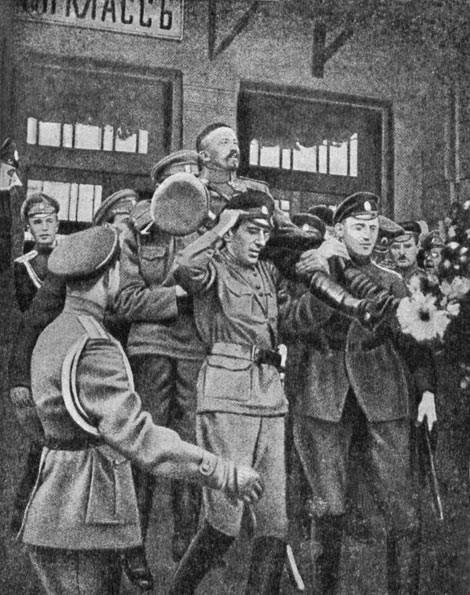
In August 1917 General Lavr Kornilov marched his army on Petrograd (St Petersburg), the capital of Russia. 


This was not something that suddenly happened overnight. Kornilov, a Cossack, was a brilliant linguist who in his youth had done extensive exploration of the Caucasus and his native Siberia, learnt numerous local languages, and as an army officer commanded troops from that part of the Russian Empire. They were called the "Savage Division" by the effete St Petersburg Tsarist Court favourites who ran the military, but of course they loved Kornilov, who spoke their languages and lived like them. 


Then came WWI, and Kornilov - like his sometime commander Brusilov - was one of the few competent, indeed brilliant, generals of the Russian army. He used proactive and aggressive tactics with a lot of initiative, at one point even breaking into the Hungarian heartland. But like Brusilov, Kornilov repeatedly faced the problem of corrupt and useless court favourite generals like Sukhomlinov and Rennenkampf, who did nothing to support their offensives, and a lot of whom were more concerned with enriching themselves than fighting the war*, and repeatedly had to withdraw from war winning positions as a result.


[*Alan Clark in Suicide Of The Empires, his book on the Eastern Front in WWI, quotes a French manufacturer who bid for a contract with the Tsarist regime to supply tents for the army. The Tsarist official deputed to negotiate terms demanded a gigantic bribe to approve the bid. The manufacturer protested that if he paid that much, he would be left with no profit at all on the deal. "Ah," said the official, (with, Clark says, a silky smile) "I understand. But why supply the tents at all?"]


Then came the February Revolution in Russia, the Tsarist regime fell, and the expectation was that the new Provisional Government would extricate Russia from the by now extremely unpopular war. Instead, Kerensky, the Minister of War, launched an offensive in July called the Kerensky Offensive in the expectation that a victory of sorts would unite the people behind the war. The offensive was a disaster, and instead led to days of rioting in Petrograd. Kerensky became prime minister and responded by making Kornilov the commander of the army. He then possibly ordered him to march on Petrograd to restore order. [Many historians think that Kerensky deliberately deceived Kornilov in order to get an excuse to intimidate his socialist political opponents including the Bolsheviks of the Petrograd Soviet.] Instead, Kornilov interpreted it as his duty to either make himself military dictator of Russia or else the power broker who would impose authority at the point of a gun over the chaos of the Provisional Government and the breakdown at the front.


Kerensky suddenly was faced with a monster of his own making. He dismissed Kornilov by telegram, but that had zero effect, since Kornilov simply assumed Kerensky was now a prisoner of the Bolsheviks, Mensheviks, and other factions in the capital. Meanwhile the Bolsheviks used their contacts in the Russian railway network to sabotage the progress of the Kornilov forces, and their own men in those forces to persuade the soldiers to drop out. Kornilov's army broke up before reaching Petrograd, quite bloodlessly, and the coup came to an end. However, it dramatically weakened Kerensky and strengthened the Bolsheviks, directly aiding in the November Revolution.


[What happened to Kornilov? He was arrested by the Kerensky regime, but "escaped" - basically his own guards let him out and joined up with him - and went on to fight in the Civil War on the White side. He was killed by Red artillery in 1918.]


Now look at the current situation with regard to Wagner. Even Putin has admitted that the Russian military was full of incompetent "parquet generals", and it's not exactly a secret that said generals did not perform professionally in combat.


In April 2022 and then again in September, territory won by hard fighting and bloodshed was abandoned without a shot because the generals did not take the proper steps to reinforce them in time. Prigozhin, meanwhile, is a man who shares the privations of his troops, has in many cases given them a way out of prison, visits them on the frontline, travels with them in the hold of a cargo plane eating what they eat, and not surprisingly they love him and feel a sense of loyalty to him.


This same Prigozhin feels - rightly or wrongly - that Gerasimov and Shoigu are corrupt and incompetent, and either thinks or claims to think that it is his duty to rescue Russia from them and the rest of the "parquet generals". He hasn't said a word against Putin to this moment, but exactly like Kornilov has refused to lay down his arms even after orders from the top authority (Putin in this case). His forces are moving on Moscow, just as Kornilov moved on Petrograd. And it is all but certain that his march will not succeed like Kornilov's didn't. 


But just as Kerensky's own actions precipitated the Kornilov Coup, Putin's failure to act in time, either against Prigozhin or against the "parquet generals", created the current situation. This is in the DNA of the Putinist system: it is never proactive, it always puts off even reacting to any situation until no further postponement is possible, and then it does all it can to just restore the status quo. Not even the status quo ante, just the status quo.


In any case, this proves that the armchair generals who have been insisting for the last 9 years that Russia couldn't have destroyed the nazis in 2014 because it needed time to prepare for war were talking through their hats...while calling those of us who repeatedly said Russia should have invaded in 2014 trolls, idiots, etc. 


We were right, they were wrong. If Russia had prepared for 8 years there would have been no need for Wagner to be fighting in this conflict at all.

Saturday, 4 December 2021

The Shadow Of The Shark: The Sinking Of PNS Ghazi


The water lay black and still. In the distance the low hills behind Visakhapatnam harbour were dark and showed not a glimmer of lights.


With a sudden swirl, a long thin shape broke the surface. It swung left, then right, like an elephant's trunk seeking air to breathe. It trailed a thin wake behind it as it went.


Ten metres below, something long and predatory slid through the water, black and smooth and lethal. It resembled nothing so much as a gigantic shark, complete with hydroplanes like pectoral fins and a huge conning tower like a flattened dorsal fin.


Inside the steel cylinder, a naval officer put his eyes to the rubber eyepieces of his periscope and tried to decipher some landmark with which to orient his vessel. Somewhere out there was the enemy he had to bottle up, or, if possible, destroy. It was midnight on the third of December, 1971, exactly  fifty years ago.


_____________________


In 1971, Pakistan was a nation divided against itself. To the west was the largely Punjabi, Sindhi and Pashto speaking West Pakistan. Across the immense stretch of India, in the east, was the Bengali speaking East Pakistan.  The two parts of the country, except for their creation as a "Muslim homeland" carved out of British colonised India, had nothing linguistically, ethnically, culturally, or economically in common with each other. 


By 1971, the differences between the two parts had come to a head. The Bengali speaking East outnumbered the West in population, and the Awami League party of Sheikh Mujibur Rahman won the national elections held under the then military dictatorship and thus the right to form the government. The problem was that Rahman was a Bengali and the Awami League an East Pakistani party, and large sections of the West Pakistani military and civilian political structure didn't want to cede power to them. 


In response to unrest resulting from this, the Pakistani military launched a crackdown on East Pakistan in mid March 1971, leading to millions of refugees fleeing to India. India, in turn, began to openly host, arm, and train "Mukti Bahini" (Freedom Army) insurgents who wanted to break East Pakistan away from West Pakistan to create a new nation, Bangladesh. The Pakistani military in East Pakistan was isolated, surrounded by a hostile population,  and hard to supply and reinforce from West Pakistan,  but even so by autumn the Mukti Bahini had largely been defeated.


In response, India pushed in military regulars disguised as Mukti Bahini guerrillas under one Major General Shahbeg Singh (who 13 years later himself was to become a separatist rebel against India), and by early November had positioned  troops and armour all along the East Pakistani  borders. The only Indian aircraft carrier, the venerable INS Vikrant, was sent to Visakhapatnam harbour on the Indian East Coast. It was obvious that an Indian invasion was coming.


In response the government of Pakistan took certain steps. One of those was to send in PNS Ghazi.


_____________________


PNS Ghazi was originally a US Navy Tench Class submarine, USS Diablo, first launched in 1944, during World War Two and then upgraded to the level of a fleet snorkel submarine. It was leased to the Pakistanis by the Americans in 1964 and became the first submarine operated by a South Asian navy. 


PNS Ghazi while still USS Diablo


(In response the Indian navy – as usual in those days – went crawling to the British pleading for a submarine, if necessary from their scrap-heap: the latter refused on the grounds that Indian personnel were incompetent to operate submarines. India then finally went to the USSR, asked for, and received, eight Foxtrot class subs, of a far later vintage and superior capability to the Ghazi. The first Foxtrot Class sub only joined the Indian navy in 1967, and it was years before all eight had been delivered. I will have a few words about these Foxtrot submarines later.)


Foxtrot class submarine INS Khanderi


In 1965 the Ghazi operated off Bombay harbour without success – the Indian Navy stayed almost entirely in harbour to prevent any potentially prestige-damaging sinkings. Ghazi did claim to have sunk the frigate INS Brahmaputra but this ship was displayed intact for the media at the conclusion of the war. It's said that an Indian anti-submarine Alize aircraft flew right over the Ghazi without noticing it, which says something about Indian anti submarine capabilities in the 1960s.


In 1968 the Ghazi went for a refit in Turkey, travelling the whole way, round the Cape of Good Hope and through Gibraltar, underwater,  which it could do because of its enormous range of 17000 kilometres. In a Turkish  shipyard the Ghazi acquired the ability to lay mines through its torpedo tubes. It returned to Pakistan in 1970.


Now, in 1971, with war threatening, the 26-year-old submarine was the only one of four Pakistani  submarines that had the range to travel to the Bay of Bengal. It left Karachi harbour on November 14, carrying a crew of 93 under Captain Zafar Muhammad Khan. This was 12 personnel more than it had carried in American service, meaning that it was overcrowded as well as old. It was armed with mines as well as torpedoes, but the torpedoes were old and less than reliable American WWII models, and the sub's main mission was to use its mines anyway. 


At this time the Indian carrier Vikrant was supposed to be in Visakhapatnam harbour. I have been to this harbour. It has a narrow mouth, and any ship seeking to enter or exit has to pass through that mouth. The Ghazi, which had been initially positioned off Madras to the south, was ordered north to Visakhapatnam on 26 November. 


Meanwhile,  the war finally started when India invaded East Pakistan on 22 November 1971. This invasion was fully visible to journalists on the ground and openly reported on in international media, but the Indian government  denied it was happening. At this time, Vikrant shifted from Visakhapatnam to a secret anchorage, called X, in the Andaman Islands far to the east. (This was done to keep the carrier from being sunk. The Vikrant would have been of far greater use in the west, where India was about to launch air and sea attacks on the port of Karachi, but the danger of sinking was deemed far too great to be politically permissible.)


According to the Indian claim, Vice Admiral Krishnan, Commander of the Eastern Naval Command, was aware that Ghazi was in these waters and decided to distract attention by laying a false trail of spurious provision orders and radio messages that seemed to indicate that Vikrant was still in Visakhapatnam. Why I do not necessarily believe the Indian claims will become obvious in a moment. These radio messages were, by the way, allegedly made by an old destroyer called INS Rajput which had been prepared for decommissioning and retirement,  but was sent out to sea one last time to steam up and down sending fake signals in Vikrant's name.


Whether on the basis of these diversionary messages or otherwise, the Pakistani authorities, as I said, on Nov 26,  ordered the sub to move to the approaches of Visakhapatnam harbour, and plant mines across the narrow mouth, something that could theoretically keep the harbour - the main Indian naval base in the east - closed for weeks.


On the night of 3 Dec, the evening before Pakistan finally launched air strikes in response to the Indian invasion, Ghazi moved to the harbour approaches to lay its mines. Visakhapatnam  city had been blacked out: the old submarine couldn't use the city lights through its periscope to orient itself. It had to navigate blind.


It was midnight, and Ghazi would never see dawn again.


_____________________


At this point the official Indian account and that of Pakistan  diverge so sharply as to be impossible to reconcile, so I shall take them one by one:


First, the known facts:


Around midnight there was an explosion off Visakhapatnam, so loud that windows were rattled in the city and people thought an earthquake had taken place. The next morning fishermen reported oil slicks and floating wreckage,  and salvaged a life jacket. This was the first indication, despite later claims, that the Indian Navy had of the sinking. Divers, finally, on the 5th December, two days after the sinking, went down, found the wreck and identified it as a submarine with its bows blown out. It was not an Indian Foxtrot submarine; Urdu markings on the wreckage indicated it was Pakistani. From the size - all of 95 metres long - it was not one of the three small French-made Daphne Class coastal submarines that comprised the rest of Pakistan's submarine strength. Therefore, it had to be the Ghazi. Six bodies retrieved from the wreck confirmed it, one of whom even had a letter he'd written to his fiancee in his pocket.


The Indian account:


The Rajput - the old destroyer waiting for decommissioning- was headed out of Visakhapatnam Harbour when the captain suddenly realised, possibly by extra sensory perception,  that a Pakistani sub could be out there. He had a harbour pilot on board, whom he therefore dropped off, when all of a sudden his lookouts noted a swirl in the water. He immediately  dropped two depth charges, following which there was the loud explosion.


There are two major problems with this story. First, the Rajput had already been prepared for scrapping. Its weapon systems, including the depth charges, had been removed. It had no depth charges, so it could not drop any.


Apart from this, an Egyptian submarine was in Visakhapatnam on this date,  and the captain described hearing the explosion. He was categorical that no Indian naval ship had been going to sea at that time. 


Then,  the local Indian naval authorities had already  prepared a statement that the submarine had sunk in an operational accident. It had actually been released to the media before urgent orders had arrived from naval headquarters in Delhi demanding that the Rajput be credited with the kill. Its crew were decorated to boot.


At the conclusion of the war,  both the Americans and the Russians offered to raise the sub at their own expense and find out how it sank, but the Indian government refused to allow it. As for why not, your guess is as good as mine.


Years later, in the early 2000s, the Indian navy finally again sent divers down to the wreck. It was badly deteriorated by then, with the outer hull corroded and overgrown by marine plants and animals, but both the divers' accounts and the photos they took clearly show that a massive *internal* explosion  had blown the bows away. A depth charge is not an internal explosion. It cracks the submarine hull from the outside. Whatever the explosion was caused by, it was inside the submarine.


When in the early 2010s Admiral G Hiranandani set out to write a history of the Indian navy in the 1971 war, he discovered to his astonishment that the navy had destroyed all its documents pertaining to the Ghazi in 2010. Why it would do this, about what it insists is a victory by one of its own ships (indeed, the only submarine sunk in wartime since WWII) is again something for which your guess is as good as mine.


The Pakistani version:


The Pakistanis have advanced three different  hypotheses for the sinking:


1. The Ghazi may have, in the darkness,  struck one of its own mines. 


The problem with this is the same as with the depth charge story; the explosion was internal. 


2. One of the Ghazi's mines,  or more likely one of its ancient WWII era torpedoes, blew up by accident. (Another torpedo explosion would sink the Russian submarine Kursk many years later, so this is *very* likely.) A torpedo explosion in one of the forward torpedo tubes would blow away the bow very efficiently.


3. There is also a third possibility. The Ghazi was a diesel electric submarine,  that is, it had electric motors for running underwater. These electric motors were charged by running the sub's main diesel engine on the surface or at shallow depths under water when the snorkel mast could be raised. The submarine was old, the batteries were old, and it is possible that the charging  process created large amounts of hydrogen gas that could not be vented and resulted in a catastrophic explosion. The bodies brought up by the divers didn't have any burns that might be expected from such an explosion,  but they might not have had any if they had been caught in a different portion of the sub when the hydrogen blew.


Click to enlarge. Graphic from India Today magazine. 


_____________________


So what do we know,  really?


1. At midnight, 3 Dec 1971, *something* exploded inside  the Ghazi, so powerfully that it blew the bows off.


2. The Indian Navy was certainly not responsible for this explosion. 


One hopes, at this distance in time, that the crew all died instantly. Unfortunately that's only likely for the crew in the front section, who would have been killed by the blast or drowned immediately by the rushing water. As in the Kursk, crew members in the rear part of the hull may have spent hours trapped in the wreck, suffocating slowly as the air ran out. One of them, when brought out, still had a wrench clenched tightly in his hand. 


_____________________


A few years ago, Bollywood  made a film on the Ghazi sinking. It was a bit of a surprise, because it made not the slightest attempt to adhere to the tale of the Rajput sinking the Ghazi with depth charges. Instead, it invented an underwater duel between the Ghazi and an Indian Foxtrot submarine, the latter (in real life incomparably superior, the last example serving as late as 2010) being presented as an obsolete but valiant underdog, which finally triumphed owing to the ingenuity of its crew. I suppose not even Bollywood could swallow the Rajput story.


_____________________


Today the Ghazi lies on the seabed off Visakhapatnam, wrapped in fishing nets, its crew, as they say, on eternal patrol.


It is time they were given their due.

Sunday, 27 December 2020

Witches By Night

 During WWII, the Germans were terrified of Russian witches.


This is not a joke.


In 1941, Hitler’s Wehrmacht smashed across the borders of the USSR and speared into the Soviet heartland. The Nazi project, which Hitler had gone into in detail in Mein Kampf, visualised the conversion of the USSR into a Nazi colony, where the “strong” (“Aryans”) would rule “naturally” over the “weak” (the Slavs), who would form a helot underclass. The great Soviet cities, Leningrad and Moscow, would be demolished with their populations even if surrendered. Soviet prisoners of war were frozen, starved, shot, medical experimented, and worked to death, refugee columns bombed and strafed from the air, the entire western reaches of the USSR turned into a hellscape of destruction so characteristic of Nazi Kultur.


In the Soviet system at that time, women were given exactly the same status as men, with Stalin repeatedly stating that there were no differences between the sexes and that they were the same. Many Soviet women – Russians, Latvians, Kazakhs, Ukrainians, whatever – had learnt to fly. Note that under the evil tyrant Stalin, any Soviet girl aged 15 who was interested could get pilot training for free. Many did, and some of them had become really famous. One such was Marina Raskova, who with two other female colleagues had attempted a world record long distance flight in the late 1930s. Due to bad weather and engine failure in the depths of eastern Siberia, it had become obvious that the plane would crash. Raskova, the navigator, was ordered to parachute out by the two pilots so that at least one of the three of them had a chance of survival. She did, but only after leaving her survival kit behind for the other two women. Once on the ground she walked in the direction the plane had taken, and finally found the crash site ten days later, surviving on two bars of chocolate during this time. The two pilots, incidentally, had also survived, and all were eventually rescued by ship. Not surprisingly this had made them all heroines in the USSR, with access to Stalin.


Now, in 1941, Raskova began badgering Stalin about permitting women with aircrew training to take part in combat. If they were equal in all things, Raskova said, why shouldn’t they fight as well? Why shouldn’t they have the same right to sacrifice their lives for the Motherland as the men did? Indeed, some woman pilots, like the fighter ace Lydia Litvyak, were already flying as part of mostly masculine air units, but Raskova wanted fully female units; not just the pilots and other aircrew, but even the ground personnel, the mechanics and ordnance operators, would be women. By 1942, Stalin had had enough and gave in. There was only one problem, which was that with the dire situation of the USSR, every capable fighter and bomber was desperately engaged in action, so there was nothing for the new Soviet women crew to fly in.


Oh, no? the Soviet women said. No, really?


Enter the Polikarpov 2, known as the Po 2 or the U 2 (U as a designation as a trainer, which had been its initial role; it shouldn’t be confused with the Amerikastani imperialist reconnaissance aircraft). First designed as long ago as 1928, it was a wood and fabric biplane which by 1942 was long obsolete even as a trainer and had been relegated to crop dusting and light transport roles in the boondocks. Its only good point seemed to be that it was available in very large numbers. It was weak-engined, low flying, with a top speed of just over a hundred kilometres an hour, and one would think that going into battle with it would be a nice way of committing suicide.


One would be wrong, but it took the system some time to realise just how wrong.


When the newly formed 588th Night Bomber Regiment of the Red Army Air Force, comprising at that time forty aircrew, of two women each, as well as mechanics and other ground personnel, came into possession of a lot of ancient crop duster biplanes and set about turning them into lethal war fighting machines, they – despite Stalin’s explicit injunctions – found themselves at the receiving end of a mix of male chauvinism and apathy from the military establishment. The women were given cast off uniforms and flying gear, billeted in whatever was available – cow sheds, for instance, or barns – and armed with whatever could be spared after the men had been properly equipped and weaponed. And they were all volunteers, all of them, young women from seventeen to twenty four years of age, from all parts of the USSR and all sorts of backgrounds. 


So what exactly did these women do with their ancient biplanes?


Right from the start, it was obvious that they couldn’t possibly fight the Nazis on an even footing. Their slow crop dusters would have been dead ducks even over the trenches of World War One, let alone the blistering technological superiority of the Germans in World War Two.


And there was the answer: the Germans were so technologically superior that this very superiority could be turned against them, and was.


The very features that made the Po 2 such a hopeless day combat aircraft, in fact, made it an ideal light bomber flying harassment missions at night. For one thing, a weak engine was a relatively quiet engine (it got the plane nicknamed the “sewing machine”), with less of a noise signature warning the enemy of its approach. For another, being a plane optimised for training and crop dusting, it could fly at extremely low altitudes, at extremely slow speeds, and its antique biplane configuration meant that it manoeuvrable enough to fly rings around far more modern and faster monoplane fighters. It was too wood and canvas to be visible to radar, and its maximum speed was below the stalling speed of a German night fighter. That’s right, a Luftwaffe fighter attempting to fly slow enough to get a Po 2 in its gunsights risked falling out of the sky. And if a shell struck the metal fuselage of a modern fighter, it might blow the plane apart or at least would do substantial damage. A shell that struck a Po 2, if it missed the engine or cockpit, would more likely than not just rip right through the plane, leaving a small hole, and keep on going (one pilot successfully flew back to base with her cockpit floor shot away, her feet hanging in empty air, but her plane’s controls perfectly intact).


And this is what the 588th Night Bomber Regiment did: night after night after night, they flew out of their airbases – often just meadows converted into temporary airfields – into the German rear. The two member crew (pilot and navigator, both armed with pistols and the latter sometimes given a machine gun if one was available) had no radio, no radar, no cockpit heating (they flew with frozen hands and feet, their flight helmets and jackets their only defence against the wind in their open cockpits). They flew through total darkness as close to the ground as they could, peering through their goggles to make out any trees or buildings or hills in the way in time to change course. Then, when ten to twelve kilometres from their target, they would climb to a relatively sane altitude and...turn off their engines, gliding silently through the night over their target area, so as not to tip off the Germans that they were coming. Once overhead, they would drop their bombs (without, of course, benefit of bombsights, these were crop duster agricultural aircraft, not warplanes), start their engines, and head for home as not-very-fast as they could before the enemy began shooting back.


Sometimes, especially in winter, ice would freeze the bombs to their racks, and they wouldn’t fall when the buttons were pressed. So did the women abort their missions and turn home? Well, not exactly. Standard practice was for the navigator to step out of her cockpit and, standing on the lower wing, kick the bombs until they finally dropped out of their racks on the heads of the enemy.


These women were, for want of a better word, hardcore.


And that was not all. Because their weak engines had only a limited load bearing capacity, they could only carry two bombs each. And because only the first bomber or two in their gliding attacks could count on surprise (after explosives start dropping out of the sky on your heads, it’s only reasonable to assume that there are people doing the dropping and to begin shooting back) they couldn’t fly in large formations. So what they did was, as soon as the plane returned to base, it would pause only long enough for another couple of bombs to be loaded, fuel pumped in if necessary, and back they would fly for another go.


That’s right – these girls and young women, freezing in their open cockpits, flying through dead darkness at a height that might send them straight into a wall or tree, went back again and again and again to bomb the Germans, in the course of a single night. The record holder is Nadezhda Popova, who joined up to avenge her brother, murdered by the Nazis in 1941, and, believe it or not, flew eighteen missions in one night. 


Here's a somewhat personal article on her, if you're interested.


Nadezhda Popova, sometime during WWII


Incidentally, this was in 1944, when an Amerikastani bomber crew’s entire combat tour was 25 missions. Popova, who you’ll be glad to know survived the war with the rank of Colonel, won numerous medals, and lived to a ripe old age – here she is with Dmitri Medvedev in 2008 – did 72% of that in the course of one single night


Sometimes she would deliberately draw attention, flying her plane within reach of German searchlights as a decoy so others of her unit could sneak in to bomb the distracted enemy. Shot down numerous times, she got away unscathed on every occasion.


Oh, and did I mention that until 1944 the 588th Night Bomber Regiment people didn’t have parachutes? Weight was at a premium, and so I assume were parachutes. The women, actually, said that their planes were parachutes, because they were so light and slow and stable that they could often be crash landed safely without injury to the crew, and many times shot down pilots and navigators managed to find their way back on foot to their lines after abandoning their wrecked aircraft. Popova, by the way, met her future husband while hitch hiking back to base with a Red Army motorised column after being shot down yet again.


And in between missions the women stayed determined to remember that “they were women”. The first of their "twelve commandments" - I have no idea what the other 11 were - was "Be proud you are a woman." They embroidered each other’s uniforms with flowers and designs, organised dances for themselves, used map marker pencils as eyeliner... and if they got leave got cheerfully drunk. Why not?


The 588th Night Bomber Regiment was soon renamed the 46th Taman Guards Night Bomber Regiment, and fought from the Caucasus all the way to Berlin. By the end of the war it had dropped 3000 tons of bombs (doesn’t sound like a lot until you remember that each sortie only carried two light bombs) and 26000 incendiary shells, flying 23,672 missions. On average, each member flew over 800 missions (if you’re interested, the aforementioned Popova’s total was 852, while the all time record was Irina Sebrova, 1008) and during the entire course of the war they only lost 32 dead. From all causes. Including accidents and disease.


By the way, Hollywood refused to make a film on them. It would detract from Amerikastani we-won-the-war-single-handed-propgandising, and now of course projecting Russians in a good light would be unthinkable.


So what did they achieve for all this effort? Materially, it’s difficult to judge, since light bombs dropped at the dead of night without benefit of bombsights generally can’t be measured for effect. Wikipedia claims that they


collectively accumulated 28,676 flight hours, dropped over 3,000 tons of bombs and over 26,000 incendiary shells, damaging or completely destroying 17 river crossings, nine railways, two railway stations, 26 warehouses, 12 fuel depots, 176 armored (sic) cars, 86 firing points, and 11 searchlights. In addition to bombings, the unit performed 155 supply drops of food and ammunition to Soviet forces.


Be that as it may, there is absolutely no denying the effect that they had on the Germans at the receiving end. Already exhausted, stressed, harassed by partisans from the flanks and rear, faced with the vengeful Red Army from the front, they couldn’t even rest a moment at night without the constant threat of bombs falling on their heads at any moment from the silent night air. In all weathers – be it rain or snow or ice, conditions where their own aircraft wouldn’t even think of budging out of the hangar – the antique biplanes were there, the wind whistling through the bracing wires on their wings the only warning of their coming. The Germans, who hated and feared them so much that anyone who shot down one of them was automatically awarded the Iron Cross, finally paid them the ultimate compliment, giving them the name die Nachthexen. The women themselves cheerfully adopted it, calling themselves the Russian equivalent, Ночные ведьмы, Nochnie Ved’mi,   


In both languages it means Night Witches.


Who else could possibly deserve it?

Sunday, 11 October 2020

The Sultan And The Grandmaster: Nagorno Karabakh, Armenia, and Azerbaijan

There is a war going on between Azerbaijan and Armenia.


No there isn't. There is no war going on between Azerbaijan and Armenia.


The territory that is being fought over is territory that is recognised by literally everyone (including Armenia) as Azerbaijani territory. This includes two parts:


1. The enclave of Нагорный Карабах (usually written in English as Nagorno Karabakh, roughly meaning "Hilly Black Garden") which is mountainous and heavily settled by ethnic Armenians since ancient times, and until 1993 by many thousands of Azeris. This is surrounded entirely by Azeri territory, and was a part of Azerbaijan as it existed in the USSR.


2. Said surrounding Azeri territory occupied by Armenia, which is also recognised by everyone as Azerbaijani territory.


(a) These two territories are both completely occupied by Armenia since a 1988-93 war and comprise a quarter of Azerbaijan.


(b) The occupation of these territories was accompanied by the ethnic cleansing of over a million people, most of whom were Azeris, so that both parts of the occupied territory are now entirely Azeri-free.


(c) The two territories jointly declared themselves "independent" as a so-called Republic of Artsakh, which is not recognised by anyone, including Armenia. This Artsakh, by the way, is only one of several unrecognised republics that rose from the murder of the USSR; the others are Transnistria (from Moldavia), Abkhazia and South Ossetia (from Georgia) and, latest and far from least, the Lugansk and Donetsk People’s Republics (from post Maidan Ukranazistan).


(d) UN resolutions have demanded the settlement of the dispute by negotiations. However, Armenia, until fairly recently far more militarily powerful than Azerbaijan, saw no need to negotiate on facts it had created on the ground by military force. Also Armenia is a CSTO treaty ally of Russia, which has a small military presence in the country.


(e) However, in the past few years, these things happened:


(i) In 2018 a colour revolution brought yet another "pro-western" regime - under prime minister Nikol Pashinyan - into power in Armenia. The Pashinyan regime has been spending the last two years slowly and systematically distancing itself from Russia, which, let me repeat, is still its CSTO ally and – with its military base in the country – its protector.


(ii) Azeri oil revenues boomed and it massively increased expenditure in defence, buying weapons from everyone from Russia to America to a certain settler ethnostate on the eastern Mediterranean coast that treats the native population abominably. I don’t need to remind you what this so called country is called.


(iii) Sultan Erdogan of the neo Ottoman Empire needed money for his Ottomanisation project, as well as an empire to rule.


(iv) The defeat of the jihadi headchopper invasion of Syria left a lot of armed jihadis trapped in Idlib and desperate to find a way to make a living.


(v) Erdogan suddenly discovered, or more correctly found it suddenly convenient to remember, that the Azeris, though Shia, were fellow Turkic speakers, and, therefore, people it was his “duty” to “protect”.


As a result of all this, Erdogan made an alliance with the (corrupt and easily purchased) Azeri president, the dynast Ilham Aliyev. The Ottomans would supply the means (air cover, weapons, and jihadi headchoppers to use as shock troops) to reclaim the Azerbaijani territory occupied by Armenia. Aliyev, as the Liberator of Azeri Land, could immediately scotch all opposition to his rule. In return, Erdogan would get a share of the oil revenues and the right to station Ottoman forces in the reconquered land.


Simple, right? In fact it played out in full public view, with Ottoman forces conducting “exercises” with Azeri troops in (Azeri controlled) Azerbaijan, after which less than all returned to their own country. Aliyev, too, sharply increased his anti-Armenian rhetoric, clearly signalling that the matter was now to be settled by military force. So obvious was it that even I, with no resources available to me but the news, immediately stated as soon as I heard of the fighting that it was the Ottomans who were behind it. But, as we shall see, someone who could have stopped this war before it started, didn’t.


Meanwhile, Pashinyan of Armenia was facing his own challenges. Armenia has hardly any natural resources. Its best farmland isn't even Armenian, it lies in the occupied zone around Nagorno Karabakh. And like a good little colour revolutionary he needed to obey the orders of those who put him into power. As such, he couldn't even ask Russia for help (this would anger his owners in Washington), or recognise Artsakh, or annex it, even though he "threatened" to when the fighting began.


It is, in fact, possible that Pashinyan has deliberately chosen to sacrifice the territory in order to get rid of a dispute that would normally stop Armenian accession to NATO. We will return to this point later.


Now let’s go over this again:


1.The so-called Republic of Artsakh is Azeri Nagorno Karabakh, historically settled by Armenians, surrounded by Azeri territory occupied by Armenia from which the Azeri population was ethnically cleansed thirty years ago.


2.Azerbaijan is in all but name an Ottoman proxy, which happens to have a sudden glut of oil money and is part of the neo Ottomanisation project of Sultan Erdogan Pasha.


3.Pashinyan is a colour revolution tool owned by Washington as much as Aliyev is the wholly owned property of Erdogan Pasha.


4.Normally, Armenia would have been able to smack down any Azerbaijan attack, but these are not normal times, because Azerbaijan is reinforced by Ottoman command and control, air support, and cannibal headchopper jihadi imports from Syria.


In fact, the Ottoman-Azerbaijan-Headchopper Alliance (hereafter referred to as OAHA for convenience) plan of action is as simple as it is predictable by anyone looking at a map. 


OAHA’s basic operational plan depends on two things:


First, the fact that Armenian manpower is seriously restricted by two factors:


(i)It has a much smaller population than Azerbaijan and therefore a much smaller recruitment base.


(ii)It has an Azeri enclave (Nakhichevan) and the Ottoman Empire on its western borders as well as, you know, Azerbaijan on its eastern borders, the part where it does not occupy Azeri territory.


As such, Armenia can’t, no matter how much it tries, mobilise as many troops as Azerbaijan. And of those troops it does mobilise, it can’t, no matter how much it tries, put all or even most into defending Nagorno Karabakh. It has to hold back many or most of them to defend Armenia itself from any possible attack from the Ottomans and/or the Azeris. It’s the classic dilemma of a two front war.


On the other hand, OAHA has no such constraints. It knows perfectly well that, unless suicidal, Armenia can’t and won’t attack them. They can perfectly well concentrate almost all their forces around Nagorno Karabakh.


Secondly, once said forces are concentrated around Nagorno Karabakh, what happens? Aliyev may be a corrupt sell-out, but he’s no idiot. Casualties in large numbers won’t be popular at home, no matter how popular the conquest might be. To this end, a blitzkrieg offensive into the waiting guns of fortified Armenian defensive positions on the Nagorno Karabakh hills is not exactly the best solution. So what is?


The really brutal, really simple plans are usually also the most successful. And a look at the map shows the extremely predictable strategy OAHA is following:


1.Impose unacceptable levels of attrition on the limited forces that Armenia can commit. At a certain point, the attrition will cause the Armenian lines to collapse. That point, in fact, has been reached north and south of Nagorno Karabakh itself in the plains.


2.Use jihadi headchopper imports from Idlib as shock troops, taking the casualties while the Ottomans achieve air supremacy and the Azeris hold back their own troops for the final push. This is the same way the Ottomans used jihadi headchoppers as shock troops against the Kurds in Syria and against Haftar in Libya, about which I’ll talk in a moment.


3.Attack Nagorno Karabakh cities (just like Stepanakert is being bombed and shelled) to trigger a refugee exodus into Armenia. This has already happened to a large extent with some half of the Nagorno Karabakh population already having been “displaced”, meaning, they’re fleeing.


4.Bypass the mountainous fortified area to cut off Nagorno Karabakh from Armenia in a pincer movement from north and south. As the territory becomes increasingly encircled, the remaining civilian population and at least a substantial part if not all of the surviving defenders will flee. Which sane Armenian, after all, will ever trust himself to the tender mercies of the Ottomans and their anti-Christian jihadi cohorts, not to mention Azeris filled with vengeance for their own ethnic cleansing thirty years ago?


5.Manufacture “Armenian attacks” on Azeri cities as propaganda. It is shoddy propaganda, like the Narendrabhai Damodardasbhai Modi regime’s anti-China propaganda (or like the EU “Novichok” propaganda), but like them, it’s meant as a justification, not to be believed.


And then what happens afterwards? If Erdogan’s actions in Syria, where he settled Uighur jihadi imports in a mini caliphate in Jisr al Shughour are any guide, the headchoppers from Idlib will be put into “liberated” Nagorno Karabakh and protected there by Ottoman forces. Just like the headchoppers in Idlib, come to think of it.


The Ottoman Question:


By this point the reader will have been aware that the driving force behind the entire war is the Ottoman Empire. This same Ottoman Empire is a member of NATO, allegedly not one in good standing, but still a member of NATO. I say “allegedly” because despite all the rhetoric against the Ottomans from the likes of the gerontophiliac Macronist regime in France, the Ottomans are


1.Still the second largest military in NATO, and by far the best – indeed the only competent – military in NATO.


2.The single most strategically located country in NATO, sitting as it does across the chokepoint of the Black Sea and overlooking all of West Asia.


Because of these factors, even if there was any option to expel a member from NATO (there isn’t) the Amerikastani Empire would never do such a thing. And that in turn means that


1.An Ottomanised Azerbaijan is a NATO Azerbaijan in all but name.


2.The endless appeasement of Erdogan by Russia, which I will refer to in the next section, will get nothing for Russia.All it is doing is emboldening Erdogan.


Among Erdogan-watchers there is a remarkable tendency to imagine that the Sultan is flailing around starting wars at random, as though he’s just another tinpot megalomaniac like Muhammad bin Salman al Bonesawi of Saudi Barbaria. This is absolutely not true. Erdogan, whatever else he might be, is a remarkably shrewd political operator. His wars are always extremely carefully chosen. Look at these:


1.From 2011, he assiduously supported headchoppers against Syria, laying out the red carpet for international jihadis, so that the airline from Istanbul to Gaziantep became known as the “jihad express”. In return he got the proceeds of the factories and warehouses the headchoppers systematically looted and shipped off to Ottoman businessmen, and, later, bought oil from ISIS; the Amerikastani Empire left the convoys of oil tankers from occupied Syrian oilfields to Turkey alone until the Russians began bombing them. Erdogan’s son is known to have personally benefited from these transactions.


2.In Libya, Erdogan intervened to save the so-called ‘government’ (the GNA, an outfit of slave-trading, human trafficking gangsters) when it was on the ropes against the forces of the LNA (led by “Field Marshal” Khalifa Haftar, a known CIA asset whose only saving grace is that he’s a secularist). In return he got the “rights” to oil exploration in the Mediterranean and a share of Libyan oil exports. He’d have got away with it, too, but for the fact that Haftar managed to hang on to the city of Sirte, the hometown of the martyr Brother Muammar Gaddafi. Libya’s oil reserves are pretty much all to the east of Sirte, in Haftar territory. In Libya, too, Erdogan used large numbers of jihadi headchoppers imported from Syria. Some of those headchoppers – the very same ones – have been sent on to Azerbaijan.


3.In Iraq, Erdogan’s repeated invasions are mostly a security measure meant to keep the Kurds down. It’s far from a war of choice; the Ottomans actually have, by their standards, a legitimate reason to not empower the Kurds. At the same time it’s not stopped Erdogan from buying oil from other Kurds in Iraq, at prices well below what he would have to pay the legitimate Iraqi government, well, as legitimate as any Iraqi government after the invasion of 2003 can be.


4.In Azerbaijan, as stated, Erdogan’s calculations are simple; victory for Aliyev in return for oil revenue.


In fact, Erdogan, who closely styles himself on the 16th Century ninth Ottoman Sultan, Selim the Grim, like the Ottomans, wages war as a way of securing income. Then it was the loot of conquered cities, and the taxing of vassal states – the Ottomans didn’t really care what their vassals did as long as they paid their taxes – and now it’s the loot of natural resources and protection money from the looters. This is why the crash of the lira is a temporary blip; the Ottoman plan of war will succeed as long as nobody stops them.


And who will stop them? Well, then, let’s talk about...


Russia and the worship of the Greatest Grandmaster Genius The Galaxy Has Ever Known:


A few years ago I wrote an article in which I had compared Putin’s “restraint” against Amerikastani provocations not just failures in and of themselves, but direct encouragement to more provocations. Back in 2014, I had said, Putin was so single issue focussed on the Sochi Olympics that what even the Amerikastani imperialists STRATFOR called the “most blatant coup in history” played out in full public view in Kiev, without Russia lifting a finger. I had written that Putin could have sent in two battalions of Spetsnaz, overthrown Obama’s Ukranazi coup regime, reinstated Viktor Yanukovych, and withdrawn, with the clear statement that if there were any more coups Russia would return and this time to stay. I remember that when the militias of the Donbass were desperately raiding museums to secure WWII weapons to take on Ukranazi armoured columns, when Russian military blogs were demanding “Putin, dai prikaz!” (Putin, give the order!), Putin kept silent. When the defenders of Donbass had to withdraw from Slovyansk and were nearly cut into two, when the Ukranazis were at Donetsk airport, when defeat was only a matter of hours, it was then that Putin allegedly did something. What that something was I’m not clear about. It was certainly not the dispatch of Russian forces, or else Russian tanks would have been rolling down the Kiev streets in two days. It may have been finally sending weapons, allowing volunteers to go to the front to fight (including more than a few brave and laudable Americans; not all of them are brain-dead imperialists), and possibly limited artillery support. At any rate, when the defenders of the republics crushed the Ukranazis at Debaltsevo and were well on the way to liberating Mariupol on the Black Sea, Putin again withdrew support to them, leaving them without a port and stuck in a frozen war interrupted by sniping and shelling.


And what was the excuse presented by Putin’s worshippers online, a species I have recently dubbed “Putinoids”? It’s been changing over the years. At first it was that the Ukranazis would “inevitably” collapse. Well, it’s going on for seven years now, and, absolutely predictably, the Ukranazis are far too convenient a tool to the Amerikastani Empire to be permitted to collapse. Then the excuse shifted to the notion that if Putin had intervened, Russia couldn’t have got back Crimea. Apparently it passeth the limited understanding of these people that had Putin intervened, with a friendly government in Kiev, Russia would not have had to annex Crimea. Then it was something about Yanukovych not having had the courage to fight, so why should Russia fight for him. It seems that we are still in the 17th century, when kings could conduct foreign policies according to their personal likes and dislikes, whims and fancies. It’s not, by the way, surprising that a lot of these Putinoids are people who hanker back to a Tsarist mythical golden age. Arch Putinoid the Saker (Andrei Raevski) is the most infamous, but the internet is full of them.


But let’s ignore the people of the two Donbass republics for the moment and look at the result of this “restraint”. Today, Amerikastani B52 bombers and RC135 reconnaissance planes fly freely through Ukranazi airspace right up to the Russian border, compelling Russian air defence systems to turn on their electronic defences, exposing their signatures for analysis and jamming by said Amerikastanis. Ukranazistan, not being a NATO member officially, is even more valuable to Amerikastan than it would have been as a NATO member, since it can be used for staging actions that could not involve NATO without risk of a world war. How’s that for “restraint”, Putinoids?


In fact, with the one shining exception of the war against Georgia in defence of South Ossetia in 2008, when Medvedev – not Putin – was president, Russian foreign policy has always been criminally defensive and reactive, never proactive. In 2011 Russia permitted Libya to be destroyed, turning an ally into a jihadi hellhole where a slave trading human trafficking regime and a CIA asset fight for control. In 2015 Syria was on the verge of collapse when Putin belatedly and reluctantly sent just enough planes and troops to save Damascus and help the legitimate government of Dr Assad liberate Aleppo, but failed to do a thing to stop the north and east turn into, respectively, an Ottoman colony and a Kurd Quisling puppet state under Amerikastani protection. In 2020 in Belarus it was only the personal courage and genuine popularity of President Aleksandr Lukashenko that prevented a colour revolution that would have turned the country into another NATO stooge. The same 2020 saw the Putin regime allow the racist right wing “liberal” Alexei Navalny to be sent to Germany, and predictably a fake “Novichok poisoning” was immediately manufactured to wreck EU-Russian relations, which were just about beginning to mend, beyond repair.


In none of these cases – none! – did what the Putinoids celebrate as the Greatest Grandmaster and Geopolitical Genius in the Galaxy do a thing to prevent it happening, even when everyone could see it coming. For instance, the moment I heard that the Azerbaijan regime had attacked Nagorno Karabakh, even I, with no information but what I could read in the news, instantly said the Ottomans were responsible. I refuse to believe that Putin, with the Russian intelligence services at his disposal, did not know any of these things were coming. But he never did anything proactive, and when he did react, it was just enough to impose a shaky and unstable status quo. Not a status quo ante, just a status quo.


This same instinct, apparently, is in effect where Putin’s relations with the zionist entity and the Ottomans are concerned. Under the Putinist “help” to Syria, the zionazi pseudostate bombs the country at liberty, and Putin, despite having S 400 air defence systems in place, does nothing. And after the 2016 coup attempt in Turkey, when Russia, for some inexplicable reason, saved Erdogan’s bacon, it’s bending over backwards to appease him. It sold him S400s, offered the latest SU57 fighters, endorsed the Turkstream pipeline, and when Syria attempted to reclaim the Idlib jihadistate earlier this year, it withheld air cover, allowing the Ottoman drones to wreck the Syrian army spearheads. After which it signed yet another agreement that it knew perfectly well the Ottomans had no intention of honouring, as they have not.


Much is made by Putinoids of Russia calling the Amerikastani Empire “not agreement capable”. If it isn’t, and it is not, the Ottomans are a thousand times more “not agreement capable”. Anyone trusting Sultan Erdogan about anything needs a brain transplant. And yet the Putin regime keeps making agreements with them!


When I asked online how Russia has benefited from appeasing Sultan Erdogan, I was responded to by a counter-question. Did I think, a Putinoid asked, that a “western poppet” in Turkey would be better for Russia? I replied back by asking the Putinoid to inform me which conceivable Ottoman regime would be worse than one that occupies North Syria, routinely attacks Iraq, conducts a proxy war with jihadi headchoppers in Libya, and now helps Azerbaijan create a headchopper ministate in Russia’s underbelly. I would, I said, enjoy watching him make the attempt.


Not astonishingly, he never replied to me.


The “arguments” of the Putinoids, assuming one can dignify them with such a term, fall into these basic categories:


1.Putin is such a genius that he is beyond our comprehension; his slightest act (or, much more frequently, total inaction) is loaded with more symbolism and hidden plans than we mere mortals can ever fathom. I do not see this as a particularly persuasive contention.


2.Putin does not need to do anything because of the famous new Russian hypersonic missiles, which make it impossible for the Amerikastanis to attack Russia directly. The so-called analyst Andrei Martyanov, who among other things can’t stop boasting that he’s written three whole books, is a particularly loud exponent of this thesis. It again seems to have escaped the attention of these people that


(a)Said hypersonic missiles will only be of the slightest use in case of an all out war, which is now absolutely the least likely kind of war. Wars these days are first and foremost economic and fought by economic strangulation.


(b)Said economic strangulation is preceded by political strangulation, that is, stripping way friends and allies by jihadi invasions and bought and paid for colour revolutions. That’s what these colour revolutions and NATOisations, even of specks like Montenegro, are about.


(c)Is Putin going to go to war if Amerikastani colour revolutions and NATOisations end up blockading Russia on all or most of its borders? Really?


3.If I don’t like Putin, who do I want to lead Russia in place of him? (Followed by an abusive rant when I name anyone.) Well, I’m not Russian so it’s not my business who leads, but


(a)Is Putin immortal? Is he beyond cognitive degeneration that comes with age? If the answer to either of these is no, why has Putin not only not appointed any successor, but systematically loaded his government with personality-less bureaucrats who can never succeed him? What happens when Putin dies or becomes incapacitated? Apres moi l’deluge?


(b)Literally anyone who’s not of the Russian liberal Quisling set from Moscow, such as Navalny, would be a better replacement than Putin, in my opinion. From the far left or the nationalist right, anybody.


4.Why do I want Russians to die in Armenia?


(a)Let’s remember the Nazi coup in Ukraine. At that time Putin could have overthrown the Nazis at next to no cost in blood or treasure. But Putin was too obsessed with the Sochi Olympics, towards which his attention had been diverted by a few “Putler” memes and some canards about homosexual oppression in Russia. What happened in the end? Far more ethnic Russians (and Russian volunteers) dying than would have happened if Putin had acted in 2014.


(b)The exact same thing happened in Syria when Putin waited till the government was on the ropes before finally, belatedly, and minimally acting. To this day Russian servicemen are dying in Syria because of Putin’s “agreements” with Sultan Erdogan. Inaction costs lives.


(c)Absolutely no Russians needed to die in Armenia, or more precisely in Nagorno Karabakh, if Putin had stopped the war from happening.


Which brings up a couple of questions.


Let us assume (it’s an easy assumption to make, and a safe one) that the Russian intelligence agencies had intimated Putin in advance that the Ottomans were planning an attack in conjunction with the Azerbaijanis and jihadi headchoppers on Nagorno Karabakh. Then we must ask:


First, could Putin have stopped the war from happening at all?


The answer to this is, yes, yes, he could have. All it would have had needed was two phone calls and one public statement.


(i) A phone call to Erdogan saying that Putin knew what he was up to and that it would have dire economic consequences for Russian-Turkish relations, such as another ban on tourism. (The last time that happened, in 2015, it brought Erdogan to his knees within weeks, so important is Russian tourism to the Ottoman economy, so this is no idle threat.)


(ii) A phone call to Pashinyan saying that Russia isn't overwhelmed with joy at his actions since 2018 and that if this continues Russia will stand aside and let any future OAHA offensive overrun not just Artsakh but Armenia itself.


(iii) A public statement that Russia will not tolerate the changing of the facts on the ground by military action - by anybody.


I do not see that the Ottomans would dare to begin their aggression under those conditions. And under the current conditions I do not see them ending their aggression short of the fall of Artsakh entirely or most substantially. Erdogan has too much prestige invested, not to speak of money, to have it any other way.


Secondly, should Putin have stopped the war from happening at all?


To this question the Putinoids have a standard, scripted response. The Greatest Geopolitical Grandmaster Genius The Galaxy Has Ever Seen was teaching Nikol Pashinyan a lesson for sneaking around canoodling with NATO; a defeat in Nagorno Karabakh, apparently, would bring Armenia crawling back to heel.


It seems to have escaped the notice of these sublime geniuses that


(a)It might only play into Pashinyan's hands, assuming the idea (increasingly being voiced on multiple fora) that he wants to lose the war in order to sacrifice Artsakh and - free of the territorial dispute that might block the accession - join NATO is true. Russia would be faced with a NATO Armenia and a NATOised Azerbaijan together. A good idea? I think not.


(b) Officially, Artsakh isn't part of Armenia. Therefore it is not responsible for the crimes of the Pashinyan regime. Therefore allowing it to be overrun is ipso facto an imbecilic response to teach Pashinyan a lesson.


(c) If Artsakh is overrun, what happens to the other republics that seceded from post Soviet states? What about Abkhazia, South Ossetia, Transnistria? What about the two Donbass republics, which let me remind you, Russia doesn't recognise either? Does anyone really think the Ukranazis won't take the hint that Russia won't intervene unless they attack Russia itself?


(d) If part or all of Nagorno Karabakh is captured by OAHA, what exactly is stopping Sultan Erdogan from repopulating the place with jihadi headchoppers just as he did in Jisr al Shughour with his Uighur imports? A jihadi headchopper ministate in Russia's underbelly isn't exactly a great idea.


Or maybe I’m wrong, the Putinoids are right, and Putin is playing some kind of incredibly complex chess game in which he can see hundreds of years into the future, and Russia will save the world yet. We’ll only have to wait 10135 years to find out!


The religion factor:


There’s a school of thought that Russia should intervene, but only because Armenians are fellow Christians. This is rubbish.


Once again: it's entirely an ethnic/economic/political clash. Religion has absolutely nothing to do with it. (Sunni) Muslim Brotherhood Sultan Erdogan is supporting Shia Azerbaijan with, among other things, (Sunni) Wahhabi jihadi headchoppers. Shia Iran is supposedly neutral but is being accused by Azerbaijan of sending weapons to Christian Armenia, with whom it has an open border, and has shot down Azeri drones. So-called Christian Russia – most Russians are atheists or agnostics – has stayed out of the fight completely. And (Sunni) Wahhabi Saudi Barbaria has opened another propaganda offensive in the meantime...against the Ottoman Empire.

There is nothing religious about it.


The Ceasefire:

At the time of this writing, I read that under Russian auspices a temporary ceasefire between the two sides to exchange prisoners and bury corpses has been signed. This is being presented by Putinoids as a “triumph for Russian diplomacy”. Apparently said Putinoids can’t read, because the “ceasefire” is specifically referred to as “temporary”. Both Sultan Erdogan and his ventriloquist’s dummy Ilham Aliyev have far too much invested to back down now.


And finally...what do I believe?


By now it should be obvious that I am not particularly enamoured of Putinoids or, for that matter, Putin. My position is that Russia, in fact, has a duty to the world; it is the only military bulwark (China being the economic entity on that scale) against the Amerikastani Empire. It is what stops the Amerikastani Empire from enslaving us all. When Russia stands up it stands up for all of us. When Putin betrays Russian interests he betrays us all.

Also, Russia is hardly secure. It’s beset on almost all its borders with Amerikastani aggression, colour revolutions, and subversion. It cannot afford “restraint” and complacency. A bit of proactive and aggressive action would only help it, especially if it nipped Amerikastani plans in the bud.

Therefore the Putinoid position that Russia only needs to “look after itself” is asinine, as imbecilic as the idea that Armenia will come crawling back if only Putin allows Nagorno Karabakh to be overrun. In fact, all it will do is convince everybody – including China – that there is no more unreliable ally and protector than Vladimir Putin. Is this what the Putinoids want? Really?

So here is today’s cartoon.


I’m also adding a version without dialogue, in case anyone wants to add their own.