Showing posts with label death penalty. Show all posts

Monday, 15 February 2016

Dispatches from Hindunazistan

Back in the early 1990s, when I was a student in Lucknow, I had a friend from Kenya called Thomas Nicholas Otieno Ogutu.

There was nothing very special about Tom Ogutu except for his height; he was about two metres tall. But, of course, he was black – and that was the problem.

Lucknow is in North India, and if there’s one place I’ve ever seen that’s crawling with racism, North India is it. At that time, twenty-odd years ago, there were a lot of African students in Lucknow: mostly Kenyans and Nigerians, but with a smattering of Malawians, Sudanese, and the odd Somali and Ghanaian. But whatever they were, they faced the same brutal racism from the Lucknowites.

I’ve seen black people called “monkeys” to their faces. I’ve seen them terrified even to be seen in the company of Indian women (my cousins, who visited me in Lucknow in 1992) because, as one said, they “would be skinned alive”. My roommate and his best friend, who were both ethnic East Asians from the state of Arunachal Pradesh and hence was considered to be “Chinese” or “Nepali” by the Lucknowites and subject to racial discrimination as well, thought it hilarious to call Tom Ogutu “Homogutu”  and asked me to “autoclave myself” after visiting him because, being an African, he was naturally crawling with germs, specifically HIV. (The sister of the best friend is now married to a Tanzanian; wonder if he remembers the “Homogutu” slur and what he thinks about it now.) I’ve myself had to explain to many Africans that not all Indians are alike and that I had no racial animosity towards them, and I don’t know how many of them believed me.

That was in North India and back in the pre-internet, pre-cable TV age, and since then India’s gone through a cultural convulsion; we’ve even had a sexual revolution which the Hindunazis have tried, and failed, to contain. One would have thought that with increasing interaction with the world, the tide of racism would’ve ebbed.

One would’ve thought wrong.

A few days ago, in Bangalore – a cosmopolitan, modern city in South India, which has many foreigners from all over the world living and working there – a car driven by a Sudanese man knocked down and killed a woman. The Sudanese was duly arrested, and that should’ve been the end of the story. However, this is India. Intent on revenge, a mob gathered, and, half an hour after the incident, stopped a car in which a young Tanzanian woman was travelling, along with a couple of other men. They beat the men, burned the car, stripped the Tanzanian woman naked and “paraded” her as punishment. The police who were at the scene watched, making no attempt to interfere. When a decent, honest bystander tried to protect her, he was thrashed by the crowd as well.

It was only several days later that the incident made the news, and then the police and the state government tried their best to pretend it was a “case of road rage,” not racism, and that the woman was not stripped. In fact it was the government at the Centre which was more proactive in the matter, and the Tanzanian diplomatic authorities also stepped in. Black African students in India were quoted in the media as saying that this was something they knew perfectly well could happen to any of them, any day, and for a brief instant of time the spotlight was on Indian racism. But of course that won’t change a thing, just as the “new tough” anti-rape laws didn’t decrease rapes in the slightest.
  
******************************************

That was the first of three little vignettes on Hindunazistan I’m going to bring you today, as a window on what’s been happening here during the last few weeks I’ve not been writing. I’m still not fully recovered and there’s a way to go before I can write like I used to, but I need to start because each day I stay away makes it harder to get the mental discipline back which is necessary to write.

******************************************

Siachen is a glacier in the mountains of northern Kashmir, sandwiched between China in the north, Indian Kashmir to the south, and Pakistani Kashmir to the west. When India and Pakistan fought their first “war” over Kashmir back in 1948, which left Pakistan occupying about a third of Kashmiri territory (hilariously, India still pretends it “won” the war), the status of Siachen was left undetermined in the UN-mediated ceasefire that ended the conflict. Since the early 1980s, though, India and Pakistan have faced off over the glacier, in a slow-motion high-altitude conflict which has seen small scale attacks, counterattacks, and some bloodshed. Mostly, though, the casualties have come from the brutal climate, where both sides maintain posts on mountain ridges throughout the year, because to withdraw in winter would mean the other side might be in possession of those heights when one’s own troops are sent back as summer comes round again.

On 3rd February, an avalanche in Siachen struck an Indian Army outpost, burying ten soldiers. A rescue party attempting to dig out the corpses found one of them, Lance Corporal (Lance Naik in the Indian Army rank nomenclature) Hanumanthappa Koppad, alive six days afterwards. Despite being immediately airlifted to hospital, he died on the 11th February of massive organ failure.

Grateful to have a distraction from the racism issue, the media went wild over Hanumanthappa, declaring him to be the “Siachen braveheart”, and celebrating his life and death. While I have no problem over the overfed, overentertained, overpaid Great Indian Muddle Class deigning to take a sympathetic look for once at one of the working class people who fill the ranks of the armed forces, I noticed one signal omission; the media seemed incapable of asking a simple question – what the hell are we doing in Siachen, anyway? What’s so damned important that we have to hold on to it at colossal expenditure of lives as well as money and equipment?

If you ask the Indian Army top brass this, the boilerplate answer is always that it’s a “strategic” location which can’t be given up under any circumstances. To which my answer is: horse dung.

In the interval between 1948 and 1984, India and Pakistan fought three full scale wars. Two of them were fought over Kashmir, in 1947-48 and 1965, while the one in 1971 did involve combat operations in the state as well. During these decades, India had not occupied Siachen and as far as is known Pakistan hadn’t done so either. Did it affect the strategic position adversely in any way?

No.

In 1999, India and Pakistan fought another “war” over Kargil, to the south of Siachen – a conflict which included Indian airstrikes, artillery duels across the frontier, and mass WWI-style frontal assaults up mountain slopes. At that same time, India and Pakistan were faced off over Siachen. Did India’s occupation of Siachen stop Pakistan’s alleged “aggression” in Kargil? Of course not.

According to the Hindunazis who now rule India, the nuclear “deterrent” India possesses makes any aggression by Pakistan suicidal, because India can wipe them out. In that case, what’s the point of hanging on to Siachen? Or are the Hindunazis admitting that their cherished nuclear deterrent isn’t really a deterrent at all? It certainly didn’t deter Kargil!

Then there’s the question of how long this Siachen thing is going to be maintained. Obviously, Pakistan isn’t going to just evaporate like the morning dew. It’s not going anywhere. Nor is India ever going to reoccupy the third of Kashmir it lost in the 1948 war, whatever the rhetoric. So how long does India hold on to Siachen, and condemn its soldiers to death and incapacitation from the weather? Ten more years? Forty? Till the end of time? Is it just the prestige issue of “fighting on the highest battlefield in the world” which is keeping this ridiculous warlet going?

Someone should demand the answers.

 
******************************************

The “sacrifice” made by Hanumanthappa hadn’t yet died away in the media before being revived as a cause celebre and a weapon against students in the Jawaharlal Nehru University (JNU) in Delhi. JNU has historically been a bastion of left liberal thought in the desert of brain-dead Hindunazism that covers North India in a blanket. JNU’s current student union president, Kanhaiya Kumar, is from a student’s association affiliated with the Communist Party of India.

Before I go on further, I must say something: I’m less than enthusiastic about student’s unions and student’s politics, though I recognise (from personal experience) that there have to be safeguards to protect students from official high-handedness. Back in Lucknow I watched faculty members browbeat and hound students they didn’t like literally to suicide; I was myself warned not to contradict teachers in class (when they said things not to be found in any textbook) or else I’d never be permitted to pass the examinations. So, yes, students do need some kind of union to look out for their interests. But that union should be kept totally away from party politics; and in India, party politics is next door to criminal gangdom. JNU’s union is a bone of contention between parties, and the Hindunazis’ constant failure to co-opt the union has merely made them desperate to bring it down in any way they can.

I have written elsewhere about Afzal Guru, hanged as a “terrorist” by the Indian state though even the Supreme Court of India admitted the evidence against him was unclear and lacking. Clearly, Guru was hanged because he was a convenient scapegoat, someone who was being thrown before the public as a way to vent their anger. Though it was the last Congress government which hanged him, not coincidentally shortly before the elections, it was the Hindunazis who had been raving, ranting and rabidly salivating in their demands to have him executed. Recently, the JNU students union held a commemorative function for Guru in which, it is alleged, some slogans were raised saying the Indian state would pay for the crime of hanging him, or words to that effect.

What happened? The police entered the campus, arrested Kanhaiya Kumar on the charge of sedition, and dragged him off to prison. The Hindunazi troll brigade, and Modi’s slaves in the Great Indian Muddle Class media, attacked the JNU, calling the students “traitors”. The Hindunazi BJP Home Minister, one Rajnath Singh, claimed that the Pakistani jihadi outfit Lashkar-e-Toiba’s chief Hafiz Saeed was “behind” the event. Called out on it by all the non-Hindunazi parties – including the Congress, which had committed the crime of hanging Guru – and asked to prove his claim, Rajnath Singh, last I heard, hasn’t attempted to do so.

As of this writing, the faculty of the JNU, as well as other universities across India, and all non-Hindunazi major political parties, are united in supporting Kanhaiya Kumar and the JNU student’s union. The students themselves have gone on strike. Modi’s troll brigade, and his acolytes in the media, have been reduced to dragging up Hanumanthappa as some kind of weapon against the students, as though there was any relation between the two. But then Hindunazis are Nazis, and there’s no expecting sense from them anyway.

I’ll just say this to the Modi brigade: If you have to impose “patriotism” by diktat, it’s likely that your country doesn’t have one hell of a lot to be “patriotic” about anyway.

 
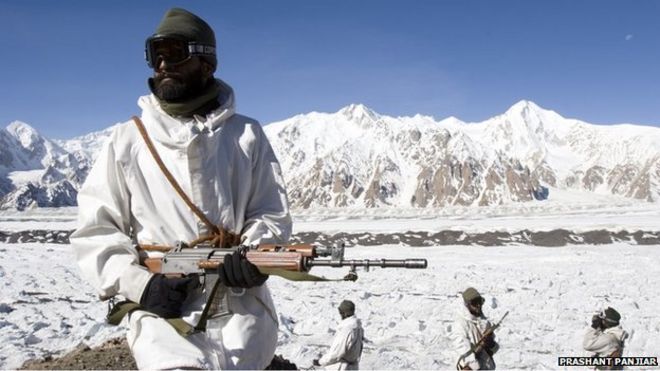
Indian troops at Siachen. Note the obsolete INSAS rifle, rejected even by the Nepali army, which the Indian army still uses. [Source]

Update: While the anti-Hindunazi protests are continuing and spreading, it turns out that the tweet Rajnath Singh cited as "proof" that Hafiz Saeed was behind the original protest was fake.

Sunday, 10 February 2013

Update India: The Noose and the Drone


On the 13th of December, 2001, at around half past eleven in the morning, a squad of five Fidayeen terrorists attacked the Indian Parliament building in New Delhi. Travelling in a white Ambassador car which was furnished with fake security stickers, it somehow managed to make its way through all the concentric layers of policemen and associated guards, until it reached the Parliament building itself. The five terrorists then – in view of TV cameras – opened fire, killing seven and injuring eighteen people before they were shot dead by the security men present. None of the politicians were killed or injured.


The incident sparked off a completely artificial war scare with Pakistan, in which thousands of Indian soldiers were sent to sit at the border and – as a lot of them did – get blown up by their own landmines. Everyone knew it was an artificial war scare because the politicians and industrialists made no attempt to send their money and families abroad, and because any war with Pakistan would mean the annihilation of India’s industrial base, which is concentrated in the west of the country. Besides, an all out attack against a nuclear-armed enemy would be the action of a suicidal moron, and whatever the Hindunazi government then in power was, it was not moronic.

In the aftermath of that attack, some people were arrested. Now, as a general rule, in the aftermath of every terror attack in India in which Muslim terrorists are either involved or suspected to be involved, the security forces magically find incredibly detailed clues (often including mobile phones complete with numbers called, left at the scene) which enable them to speedily round up a whole mess of “conspirators” – not one of whom would be under suspicion otherwise.

So it happened in this case, where these terrorists, despite the planning that got them into shooting distance of Parliament,

... left behind a thick trail of evidence—weapons, mobile phones, phone numbers, ID cards, photographs, packets of dry fruit, and even a love letter.[source]

You know, just what terrorists carry along with them to prove who they are and who their contacts are.

Among the people arrested in this case, then, were a Kashmiri fruit seller, one Afzal Guru, and a teacher in a Delhi college, one SAR Geelani. Both were sentenced to death by a special “anti-terrorism” court – one operating under a lovely, and since repealed, Indian law called POTA under which the burden of proof of innocence was on the accused (who was in custody and hence of course unable to furnish proof) and a confession to police (invariably under torture) was evidence.

But, sentenced to death or not, the case against the accused was full of holes – so full, indeed, that the Supreme Court of India finally acquitted SAR Geelani, to the fury of the Great Indian Muddle Class and the police. Geelani was then most mysteriously shot and badly injured outside his lawyer’s home one evening, but fortunately survived. Not so lucky was Afzal Guru.

SAR Geelani


A couple of months ago, I’d written about the hanging of the (alleged) lone surviving terrorist of the Bombay attacks of 2008, Ajmal Kasab. Now, there wasn’t any real doubt about Kasab’s guilt – he was even photographed in the act. But there was absolutely nothing – nothing at all – that was certain about the guilt of Afzal Guru.

That didn’t stop the Zee TV network from making a film, during the trial, and showing it on national TV, in which SAR Geelani and Guru were both portrayed as a hundred percent guilty. If Zee apologised after the acquittal of Geelani, I never heard about it. (I meant that sarcastically; of course they didn’t.)

Guru, in the "Islamic terrorist" picture in which the media always depicts him. At his arrest he had no beard and a clipped moustache.


Since this post isn’t, per se, about the trial of Guru, I am not going to go into details about the evidence (or, more accurately, lack thereof).  More information on the travesty that was Guru’s trial is here. I’ll just point out this: the Supreme Court of India, in its judgement, admitted that there was no proof that Afzal Guru was a member of any terrorist group and the “evidence” against him was only circumstantial. But, even so, it said it was sentencing him to death to “satisfy the collective conscience of society”. Meaning, someone, anyone, had to pay for the crime, so why not this ready-to-hand scapegoat of a Muslim Kashmiri?


The years went by, with Guru on death row, and with his mercy petition pending before the President of India. The Hindunazi government of the time fell, and another, equally right wing, but allegedly secular Congress Party government took over. Presidents took over and left office, but none of them made a decision on the Guru execution. (It must be understood that the President’s position in India is absolutely that of a rubber stamp; he is a complete figurehead who can’t reject any order advice sent to him by the government. He can only send it back – once – for “reconsideration”. However, he has a considerable moral authority, and anything sent back by the President is just about dead in the water.) Until this last President, Pranab Mukherjee, long a functionary of the ruling Congress Party, took over and instantly began signing death warrants.

There is, of course, a reason why Pranab Mukherjee should be sign executions at this time. Nothing in India happens without a political reason. The Hindunazis have many times over accused the Congress Party of being “soft on terrorism”, and jeered at them for not hanging Guru. Now, those of you who have been reading me for some time know that this is, positively, the worst government ever to contaminate the halls of power in this nation, so much so that (and I’m embarrassed to say this) even their murderous and corrupt Hindunazi predecessors look like angels of shining light compared to them. And now, election season is almost upon us; a plethora of state elections (including in this state) due this month, and national elections next year, which the Congress has not a hope of winning unless the Hindunazis sabotage themselves.

So, Afzal Guru was hanged on the ninth of February, in complete secrecy, the execution announced with fanfare after the fact. Curfew was also clamped down in Kashmir, just driving in the point that the government doesn’t trust the Kashmiris not to revolt. (Nice way to turn the man into a martyr.)

Incidentally, the policeman who was responsible for arresting and, arguably, framing Guru, was killed by a property dealer whom he was extorting for money. The man was an “encounter specialist” – a death squaddie, in other words, who commits extrajudicial murder and gets away with it. (There was a phase during the 2000s when “encounter specialists” were legion in Bombay and Delhi, and noted for their extreme levels of unaccounted wealth. Lately, the species has fallen out of fashion.) In other words, a paragon of honesty he wasn't.

To get back to the story: the net is already full of the Great Indian Muddle Class (who also profess to hate politicians and who claim that the extinction of the political class would gladden their hearts) cheering the hanging of Guru. Of course, if Guru were actually guilty, then they should have been mourning his death – as one person who actually took some action to rid them of the politicians they claim to despise so much. But the fact is that Guru was a Muslim, and if there is one thing that unites the Great Indian Muddle Class, it is their reflexive Islamomisia*.

After all, this same Great Indian Muddle Class makes no effort to demand the execution of (Hindu) Tamil terrorists proven to be complicit in the murder of the former Prime Minister of India, Rajiv Gandhi, in 1991, and they have repeatedly voted for the chief minister of the state of Gujarat, a Hindunazi named Narendra Modi who unleashed a pogrom in 2002 in which more than two thousand Muslims were killed and many more made homeless and destitute. Nor do the courts make any effort to sentence to death Hindu terrorists who are at least as much of a threat to the country as the Muslim terrorists are.

The conclusion is inescapable – the execution of Guru, just like his conviction, was entirely a political act, and its timing gauged for political effect. And if the Great Indian Muddle Class falls into the trap (as it has) of supporting political executions, it should beware. Once a policy becomes institutionalised, it’s only a matter of time before it’s turned on its original backers. How will the Muddle Class react if a future government find it expedient to hang one of its pet Hindunazi icons? Not too well, I think.

Talking about extrajudicial murder, India’s first combat drone is scheduled to fly for the first time very soon. It’s claimed to be roughly the equivalent of the Predator. And, knowing the Indian government’s extreme subservience to the American, if the US can justify droning its own people  purely on suspicion, India can, too.

The only silver lining in this is the fact of the incredible and well-known incompetence of India’s defence industry, which can’t even produce a successful basic infantry rifle, let alone something as complex as a combat drone. One can reliably depend on the Rustom (that’s what it’s called) still being “test flown” twenty years from now, while Indian officials keep talking about how it’s going to be the best in the world when it gets into service.

Meanwhile, please note that, basically, the choice for the nation is between the ultra-right Hindunazis and the pro-Hindu “secular” ultra-right. Whoever wins, we’re all going to lose.

Here’s looking down the drain.


*         I will henceforth use this term in preference to Islamophobia. These people don’t fear Islam, they hate it. There's a difference. (misos=hatred)


Update (11 February)

Information obtained after this article was written indicates:

1. Afzal Guru himself was informed of his imminent execution only at bedtime on the night before the hanging (he was hanged at 8 am). I can only speculate on the reason, but the only thing I can think of is that it was intended to stop him from making any last minute legal appeals for stay of execution. The current Supreme Court - headed by a Muslim to boot - is a tad more liberal than the one which confirmed Guru's execution.

2. Not only was Kashmir put under curfew, but large numbers of Kashmiris in Delhi were arrested as a "preventive" including SAR Geelani, who was taken to an unknown place. As of now I am not aware if he has been released. 

3. I'm mildly surprised by the Indian media. By and large, chest-thumping is absent and some amount of soul-searching is going on. Of course they aren't criticising the execution - they
are in favour of that - but of the possibility that the hanging will wipe out the so-called "goodwill" Indians pretend Kashmiris feel for them. Well, boys - you know what, that bus left town long ago.


Copyright B Purkayastha 2013

Wednesday, 26 December 2012

A Controversial Take On The Delhi Rape "Protests"


Some years ago, there was a little incident in the town where I live. A few young men were drinking one night, and then went cruising in the taxi belonging to one of them. They picked up a young woman (who imagined she was getting a ride home) and drove out to the forest outside town, where they raped her for hours, beat her half to death, and then dumped her on the roadside like a piece of garbage.

The city went ballistic. The incident made the national news, too, and the country could talk of nothing else. The rapists were hunted down, arrested, and, after a dramatic trial, locked up for the rest of their natural productive lives as examples to others of their kind. The victim got the sympathy and help she deserved to recover from her terrible ordeal, and even the criminals’ mothers came forward to apologise to her for what their sons had done.

No, wait. What actually happened was that the rapists got all the sympathy of “society”. They were called poor misguided youth who had made a “mistake”; their mothers marched, along with women’s’ body representatives, demanding that they be let off the hook. The victim was called a whore who deserved everything she got. As for national news, you have to be kidding – they didn’t even mention it in passing.

New Delhi, December, 2012. A 23-year-old female physiotherapy student boards a bus late one night, accompanied by her “male friend”. The bus isn’t on a regular route – it’s actually being taken on a joyride by the driver and five of his friends. They proceed to beat the woman and her “male friend” with an iron rod, rape her for almost an hour, and then throw them out of the moving vehicle before driving away. At the time of writing, the woman is alive, minus part of her intestines; she’s still in critical condition, but off a respirator and it’s becoming more likely that she’ll survive.

This time the nation – or, rather, a part of the nation – did go ballistic. The media, for one thing, made the rape its top news. “Protests” – more in a moment about them – started in many cities, asking for the rapists to be executed. Most especially these “protests” were in Delhi, where the “protestors” attempted to storm the Presidential Palace and demonstrated near India Gate, the heart of the government district. Most of the “protestors” in Delhi were young – college students from the middle class.


A question: is the different response to these two rapes a sign of India’s changing social attitudes? Not exactly. Because, while these protests were going on, a woman was stripped naked, tied to a tree in the state of Tripura and beaten, but nobody said a word. In Manipur, a Naga insurgent belonging to a banned Baptist terrorist group (the National Socialist Council of Nagaland, Isak Muivah faction) beat up an actress on stage, right in front of an audience full of military and paramilitary personnel, and nobody outside the state gave a damn. Elsewhere in this country, a woman continued to be raped about every fifteen minutes, and nothing happened to catch anyone’s attention.

But in Delhi, the “protests” continued.

If you’re thinking that I think there’s more to these “protests” (note the quotes) than meets the naked eye, you’d be right.

For the moment, I’m not going to go into the phenomenon of India and the treatment of women here; I’ll just say that it’s not exactly a surprise. A country where men are indoctrinated from birth to think of women as an inferior species can scarcely expect anything more. It’s hardly as though cruelty towards women is a new phenomenon – it’s been going on at least since the late Vedic period, circa 1000 BCE. From the brothels of Bombay to the forest hamlets of Central India, rape by the powerful male (be he the brothel madam’s pimp or the Indian paramilitary trooper) is happening right now, even as you read this. But nobody even wants to know about that.

There are reasons why the Delhi rape drew so much attention. The first is the simple fact that it took place in Delhi. To Indian officialdom, the media and the Great Indian Muddle Class, only what happens in Delhi, Bombay, and to a lesser extent in Bangalore matters – they are the centre of their version of India. What happens elsewhere makes no difference to them. But other rapes happen routinely in these same cities, daily – and nobody says a word.

That’s where the second reason comes in.

I have repeatedly characterised the Great Indian Muddle Class as incredibly self-absorbed and selfish, to the extent that to it, nothing matters but its own immediate interests. The Muddle Class sees itself as superior to the masses from which it has emerged, and it aspires to separate itself from them as far as possible. Unlike the middle class in other parts of the world, it doesn’t see itself as preyed on by the upper class; the upper class is its ideal, the realm to which it aspires. That’s why the corruption, decadence and dissipation of the upper class don’t fill Muddle Class people with revulsion. That revulsion is only reserved for politicians, whom the Muddle Class excoriates but whom it votes for anyway.

On the other hand, the Muddle Class hates and fears the underclasses. It feels threatened by them – by their increasingly uppity demand for a place in the sun and by their competitiveness. To the Muddle Class, the underclass isn’t PLUs (People Like Us) – they are PLTs (People Like Them). It’s the underclass who threaten the Muddle Class’ upwards march. It’s the underclass which reminds the Muddle Class of the morass from whence it sprung, and where it’s terrified of returning.

So when six members of the underclass rape a woman of the Muddle Class, it’s not a crime against an individual woman. It’s a strike against the Muddle Class. Think of it as a serf raising his hand against a nobleman, and you won’t be far from the idea.

It’s significant that the last time the Muddle Class reacted in such a way was after the Bombay terrorist attacks of November 2008, when it was the Muddle and upper classes which were the focus of the assault. The ordinary people were killed, sure, but the media focussed almost exclusively on the rich set’s hangouts targeted by the terrorists, and it was the Muddle Class which held candlelight vigils to condemn the attacks, signed pledges to “give their lives for South Mumbai” and threatened not to pay their taxes if their security couldn’t be assured. There have been terror attacks before and since, but the victims were of the masses, so the Muddle Class wasn’t particularly stirred.

It’s an absolute certainty that if the victim of the rape had been of the labourer set, there would have been as little reaction from the Muddle Class as there is when (as happens routinely) rich kids driving SUVs get drunk and crush homeless people to death. The Muddle Class doesn’t care about anyone but itself.

Accordingly, whatever the “protests” appear to be, they are not actually against the rapes – they are protests against the Muddle Class being made to feel vulnerable. No more, no less.

And, that being so, therefore, the “protests” will last until the Muddle Class feels reassured of its own position. Currently, the government is talking of making the anti-rape laws stricter, to enhance punishment. The “protestors” are demanding nothing less than the death penalty for the six rapists, even though no such law exists on the books now. They claim to be willing to settle for nothing less, even though they are well aware that laws can’t be made retrospective.

Now, as I’ve said before, the death penalty always works against poor people selectively, because they can’t afford good lawyers. Also, the judges are from the Muddle Class and routinely look down on poor people. So, suppose the laws are changed to make death a penalty for rape. Will the Muddle Class be willing to put its own members’ lives on the line? Will it be content to send to the gallows the rich man’s son who rapes his neighbour’s teenage daughter? Of course not.

The demand for the death penalty for rape is meant to be used against the lower classes, and the lower classes exclusively – just as the death penalty for murder is used exclusively against the lower classes in this country. I can’t even think of the last time I heard of a rich person being sentenced to death for murder, no matter how gruesome the crime. It’s always the poor guy who hangs. Just as the six rapists in this instance have been convicted and sentenced to death in advance, even though they have not yet been put on trial and so in the eyes of the law are innocent until proved guilty beyond reasonable doubt.     

And that is exactly the point, because the “protests” being primarily against the threat from the unwashed masses, the demand is for the law to be used to keep said masses in their place. The Muddle Class is frightened, and like a cornered beast, it’s lashing out.

I'm far from the only person to have noticed that the "protests" are restricted to the Muddle Class. As one newspaper editorial said:


Why are the weaker sections of the society not participating in these protests? Especially, why have those, who live in the slums where the main accused of this gang rape lives, (not) come forward? Indian society is divided and everyone is fighting their own battle. 

It’s not even as though the death penalty could be an actual deterrent. From the point of view of the rapist, it just gives him a powerful incentive to kill his victim instead of just violating her. If he’s going to hang anyway, at least killing her gives him a chance of getting away with it. Making the death penalty a punishment for rape merely dooms the victim.

That’s just logical. But cornered beasts don’t think logically. But, of course, this isn't a protest - it's a glorified lynch mob.

Speaking about lynching, the “protestors” don’t exactly have clean hands either. They’ve managed to kill a Delhi Police constable – a member of the underclass, as it happens – who collapsed and died of a heart attack after suffering injuries including three broken ribs. The Muddle Class and its media are unrepentant, of course – they claim that if such a thing happened, the police was at fault for putting a man with a bad heart into riot control duties. Because, you know, beating some poor cop till he dies is all fine if you’re fighting for a law to keep the other poor in their place.

The conflict is going to get worse. As the so-called economic boom continues to fall apart, and the infrastructure and environment continue to disintegrate, the Muddle Class’ grip on its niche will come under ever increasing threat. Since the Muddle Class relies on the underclass to be its hewer of wood and drawer of water, it can’t isolate itself from them like the ultra rich with their gated communities – it has to interact with the lower class, depending on it while hating it. More violence is inevitable, with lower class criminals (many of whom are poverty migrants to the cities, and forced to live in teeming slums with no facilities at all) preying on the Muddle Class, and the latter lashing back.

We will live in increasingly interesting times.

Meanwhile, I’d like to say something about the victim of the rape that started the whole thing off. All the “protestors”, the Muddle Class media and the politicians are concerned about her, and they want justice. Good. So do I. Try the accused rapists, and if they’re found guilty, lock them up by all means and throw away the key.

But I want to know something – why is it that they don’t mention the fact that we still don’t know the young woman’s name? The answer is that if her identity is disclosed, she’ll be publicly stigmatised as a rape victim and will probably not find anyone willing to marry her, ever.

But all those people so concerned about women’s rights don’t even want to talk about that.


Wednesday, 21 November 2012

Hanging in the Balance


Four years ago, almost to the day, the city of Bombay was subject to invasion from the sea.

According to the official narrative, a ten-man terrorist squad belonging to the Lashkar-e-Toiba set sail from Karachi in Pakistan, hijacked an Indian trawler off the coast of the state of Gujarat, and murdered its crew (save the captain, whom they murdered later after forcing him to sail them to the seas off Bombay). They then transferred to a rubber dinghy, helpfully leaving the trawler full of Pakistani food and grocery items to aid in identification, and landed at a fisherman’s jetty.

That was the evening of 26 November 2008.

Spreading out through the town in twos and threes, the ten man terror cell virtually held the city hostage for three days, battling army and police commandos, killing precious Western tourists, taking hostages and openly communicating by satellite phone with their controllers in Pakistan. Finally, after prolonged fighting inside buildings while ranks of cameras brought the images live to the world’s TV screens, nine of the fidayeen attackers lay dead. The tenth, Ajmal Kasab, was captured alive.

I will not go here into a repetition of why I consider the official account less than honest with the facts – I have already written in detail on that point elsewhere[1]. This article will deal with that tenth man...Ajmal Amir Kasab[2].

The virtually illiterate son of a curd seller in Faridkot, Pakistan, Kasab was then 21 years old. A former petty criminal, he was an unlikely candidate for any kind of recognition, let alone the sort of attention he attracted worldwide, including books written on him and his own Wikipedia article. But strange things happen to people.

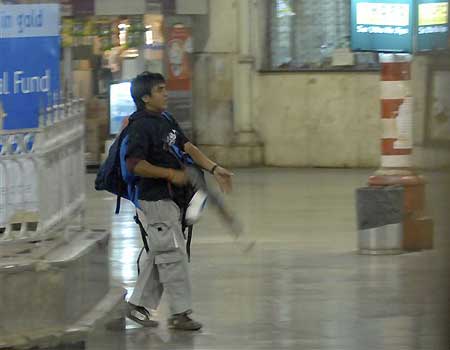
Captured early on – on the very first evening of the attack – Kasab played a relatively limited role in the events of those days, but became a living, breathing symbol of the attack, a sort of stand-in for the other nine, killed, terrorists. There was a famous photo of him splashed across the world’s TV and newspapers, walking along a platform of the Chhatrapati Shivaji Terminus, Bombay’s main rail station, with a backpack slung over his shoulders and an AK series rifle in his hands. 


Subsequent photographs released after his wounding and capture showed him in a hospital bed, being interrogated, and later on sitting in a chair during one of his many later interrogations.


Before I go any further, let me state something clearly and absolutely: Ajmal Amir Kasab was not an innocent man. He was a murderer many times over, having been among the two-man fidayeen team which attacked the CST railway station. He was caught on closed circuit TV at the station and photographed close-up there with a gun in his hands, too. The fact that the people killed at the CST were all middle- or lower-class commuters (and not precious Western tourists or businesspeople, or Zionist rabbis or ultra-rich Indians as most of those killed elsewhere during those days) does not reduce his guilt one iota. He was guilty.

Now, as I said in an article[3] written on the three-year-anniversary of the attack, I am occasionally proud of some things this country does. Unlike a certain nation which mouths off on freedom and human rights while drone-bombing weddings, and locks people in cages for a decade or more without charge, let alone put on trial, India did not dispose of Kasab quietly. He was not waterboarded, placed in stress positions for days on end, deprived of his sleep or deemed too dangerous to be given a day in court. On the contrary, he was tried, and his appeals heard, all the way through the court system, quite openly and legally. While two Indian Muslims accused of aiding and abetting the attacks were acquitted and released, Kasab himself was sentenced to death, whereupon he appealed for clemency to the President of India.

Again, before I go any further, let me say something more: I am opposed to the death penalty in every case. I don’t care what the individual circumstances are, there are other punishments that can be inflicted, some of which are arguably worse than a death sentence. Hell, I wouldn’t even want Barack Obama executed for his war crimes, though I’ve joked about having him drone bombed, and that tells you something. I have written in detail[4] about my reasons for opposing the death penalty, and I’ll just quote a passage from that article:

1.     It selectively targets the poor;
2.     It puts a premium on the status of the victim as to what punishment is given;
3.     It leaves it entirely up to the (individual) judges to decide which case attracts the death penalty and which doesn’t;
4.     It’s carried out so many years later that all concept of “justice” can be thrown in the dustbin;
5.     It uses a cruel and unusual method, very prone to going wrong;
6.     It has no deterrent effect ...;
7.     It ends up as a political football to be kicked around by different parties; and
8.  It leaves the victims' own crimes unacknowledged, let alone unpunished.

Every death sentence has one or more of these features, and a lot of them have them all.

And so -

Very recently – different websites I have seen give different dates, from 5 November to 8 November to even 20 November –  the President, Pranab Mukherjee, rejected Kasab’s mercy petition. Two days ago, Kasab was shifted from the Bombay prison where he was being held (and which has no execution chamber) to a prison in Pune, where he was hanged this morning, 21 November, at 7.30am.[5]

The whole operation was conducted with the greatest secrecy, and the execution was only announced after the event. Since this kind of thing doesn’t happen on the spur of the moment, especially in a notoriously lax nation like India, it’s obvious that the prison and police officials concerned were aware that the mercy petition would be rejected, and when it would be rejected. Also, in a nation where the last hanging happened way back in 2004, hangmen aren’t exactly in plentiful supply; so one had to be found and alerted well in time, further evidence that the rejection of the mercy petition was foreordained and its timing very carefully orchestrated.

Now this is very interesting, you see, because there’s no law compelling the President to dispose of a mercy petition within a particular time period. In fact there are mercy petitions which successive presidents have been sitting on for years on end because they are potatoes simply too politically hot to handle, one way or other; such as the case of Afzal Guru, sentenced for aiding a fidayeen attack on the Indian parliament back in 2001. Even the Indian Supreme Court admitted the “evidence” against Guru was less than overwhelming, but asserted that the “collective conscience” of society demanded someone be punished for the crime. Presidents have come and gone, but Guru’s mercy petition is still pending, and he’s as far from the noose as he is from walking free.

But Guru is a Kashmiri Muslim, and the government of India at the time of the attack on the Indian Parliament was run by the Hindunazi Bharatiya Janata Party (BJP). The BJP demands that Guru be executed. The current government is led by the Congress, which has an electoral alliance with the Kashmiri political party, the National Conference. Also, except for the Hindu right, most people are well aware that Guru is less than provably guilty. Hanging him would therefore damage the Congress party’s relations with the National Conference, and give the BJP a propaganda victory.

Similar is the case of three Sri Lankan Tamils, members of the now defunct Liberation Tigers of Tamil Eelam (LTTE) terror group, one of whose female suicide bombers blew away former Indian Prime Minister Rajiv Gandhi in 1991. Their mercy petitions have been hanging fire because they are Tamils, and the current government depends on support from Tamil parties which are vehemently against these three men’s execution. Hence they have not been executed.

Politics, as I said, is one of the deciders. As surely it was the case here.

Pranab Mukherjee, the President of the nation, is an old Congress functionary who owes his position as president entirely to the party of which he was a member. Like most (but not all) recent Presidents, he is a rubber stamp who obeys the orders of the party which put him in power. Putting Kasab’s mercy petition on the fast track to rejection was obviously a political move. Why was it done at this time?

With the passage of every day, the Congress-led government in Delhi finds itself more and more on the ropes. It’s in a minority and dependent on the support of fractious and unpredictable outside allies who can’t under any circumstances be taken for granted. Popular support has long since been lost – the Congress has managed the monumental feat of proving itself more corrupt than its BJP predecessors. And, when parliament convenes tomorrow, it will face a combined assault from the right and the left over various issues ranging from corruption to foreign direct investment in retail. Also, elections in the Hindunazi-controlled state of Gujarat are due soon, and the BJP government there would have made a poll point of the Congress “coddling” Muslim terrorists.

So, a high-profile anti-terrorist act was necessary, to scrape together what political capital was possible. And Kasab fit the bill. After all, unlike Guru or the Tamils, he had absolutely no political support. Nobody who can be called sane can have any doubt of his guilt. Hanging him wouldn’t alienate the Muslims either, because Kasab and his partner, Ismail Khan, killed many Muslims at CST. The very first person killed in the Bombay attack was also a Muslim taxi driver whose cab was hired by Kasab and Khan from the point of landing to CST; they put a time bomb in the cab before getting out. No, the Muslims wouldn’t vote against the Congress for hanging Kasab.

In Indian politics, where people are treated like voting blocs rather than individuals, such calculations matter. In fact, in the Indian version of “democracy”, such calculations – called electoral arithmetic – are all that matter.

At least Kasab’s hanging didn’t have the long media circus preceding it that India’s last execution, in 2004, did[4]. I suppose we should be grateful for small mercies.

And now for a basic question which anyone supporting the death penalty needs to answer:

Kasab and his band were sent over on a virtual suicide mission, am I right? They had no hope of getting back, and were going for Islamic martyrdom. According to India’s own official transcripts of the conversations between the fidayeen and their Pakistani handlers, they were ordered to die and become martyrs. So, by hanging him, aren’t you basically giving him what he wanted in the first place? Wouldn’t keeping him in jail for the rest of his life be a far more appropriate punishment?

Also, apparently, hanging Kasab brought “closure” to the families of the dead in the attack.

Yes, I’m sure a lot of dead people will come back to life tonight.

Or not.

Sources:


 See also:


Thursday, 1 September 2011

This Case Exemplifies Why I'm Against the Death Penalty


Three men sit on death row in an Indian jail, convicted of conspiring to kill an Indian politician over twenty years ago. That politician was Rajiv Gandhi, the country’s former prime minister, and then owner of the Congress Party. He was blown to pieces in May 1991 by a female suicide bomber belonging to the Sri Lankan Tamil terrorist group, the Liberation Tigers of Tamil Eelam, at Sriperumbudur in South India while canvassing for an election he was expected to win.

The suicide bomber waiting, in orange and green

There wasn’t really ever a doubt about who was responsible; the LTTE had even laid on a photographer to take a video of the assassination, and he was accidentally killed by the explosion (and his cameras recovered, with photographic evidence). Some days later, the rest of the terrorist cell which had actually carried out the assassination was tracked down, and committed suicide when surrounded in a house. And the other members of the support network were arrested, 26 of them, and all condemned to death. As many as 22 of them had their sentences subsequently commuted to life imprisonment, one was pardoned because she was a woman and pregnant, and the other three had their final mercy petitions turned down by the president of the country, and their hanging (yes, India still hangs people to death – more about that in a moment) set for the 9th of September.

Pretty straightforward?

Only if you ignore the background.

Rajiv Gandhi came to power on the death of his mother, Indira Gandhi, who was killed by her own Sikh security guards, one of whom was subsequently killed, and the other (Satwant Singh) hanged along with his uncle Kehar (the latter, almost certainly a miscarriage of justice). Indira Gandhi was killed after she ordered the army to attack the most important shrine of the Sikh religion, the Golden Temple in Amritsar, Punjab, in order to flush out separatist Sikh terrorists who had turned it into a military base. Those Sikh terrorists had turned it into a military base because that self-same Indira Gandhi had earlier encouraged their leader, a fundamentalist Sikh preacher called Jarnail Singh Bhindranwale, to start a violent separatist movement in order to destabilise the government of Punjab, which at that time was under the Akali Dal party, which was opposed to Gandhi’s Congress.

For days after the assassination, armed gangs led openly by Congress functionaries roamed through the streets of North Indian cities, murdering thousands of Sikhs and looting their businesses. Rajiv Gandhi, who took over as Indian Prime Minister on the evening of the murder, had only this to say: “When a big tree falls, the ground shakes.”

This same Rajiv Gandhi later sent Indian troops to Sri Lanka on a “peace-keeping mission”, in which they attacked the Tamil groups fighting the fascist Sri Lankan government of the time, acted as the sword arm of that same Sri Lankan government, and suffered such appalling casualties that by the time they had withdrawn in defeat three years later, the government had long since stopped divulging the casualty toll.

And that attack was the reason Rajiv Gandhi was blown apart by a Tamil girl suicide bomber on 21st May 1991, and why Murugan, Santhan and Perarivalan are now on death row.

You understand, of course, to what I refer? Actions have consequences, and consequences have consequences. And while one condemns the criminal, one should remember that the victim might have had plenty of crimes to answer for, as well.

According to Indian law, the death penalty is reserved for the “rarest of the rare” cases. Of course, it’s up to the courts to decide which cases are the “rarest of the rare”, and few death sentences survive the appeals process, which goes through – at the least – two further courts and then the President for clemency.

Therefore, it’s kind of interesting to see which cases actually seem to qualify as the “rarest of the rare” to enough judges to merit the hangman's noose.

These three aren’t the only people on death row in India; there are many others. A lot of these have appeals pending, and others have mercy petitions pending as well. However, a look at them will show quite clearly that they fall into two distinct groups:

1.     People from poor backgrounds, some of whom may be mentally ill, who can’t pay for proper legal representation, and may not even be guilty of the crime they’ve been condemned for. One recent case was a man from a village in Assam, who decapitated another man and promptly turned himself in to the police. A crime in the heat of the moment wouldn’t normally attract even life behind bars, don’t you think? This man got death.

2.     People whose actions have a political dimension. If you’ve killed a politician, or if you’ve targeted a politician, or if the political class’ prestige has taken a hit due to your actions, you’re toast. You don’t even have to be guilty; as the Supreme Court of India said while condemning a man named Afzal Guru to death for plotting a suicide attack on the Indian parliament, the “collective conscience” of society demanded someone had to pay for the crime.

Meanwhile, if you’re rich or middle class, you can get away with pretty much anything, as long as your victims aren’t politicians or among the rich or famous. If you kill the poor, you’re home free. Certainly, you won’t hang, whatever happens to you. You can literally run over people with your swank car, and then hide the evidence, and you’ll get away with it. You can murder your girlfriend, chop her body into pieces, and cook her in the oven of a restaurant you own – and you won’t get a death sentence.

All that’s not the rarest of the rare, you bet.

The last man executed in India was a man named Dhananjoy Chatterjee, who was hanged in 2004 for the rape-murder of a girl named Hetal Parekh. Chatterjee was a poor man who worked as a security guard; Parekh was the daughter of upper-middle class parents who insisted on his hanging.

So? He was a brutal rapist-murderer, wasn’t he?

Well, I’m not saying Chatterjee was innocent. I am, however, pointing out that he was poor, unable to afford good legal representation, that the media unanimously supported the Parekh family (who were “people like us”) and piled on pressure for his execution – and that the execution neither brought Hetal Parekh back from the dead nor prevented any similar crimes. In fact, the hypocrisy of the entire thing was exposed within weeks when another man was sentenced to life for a crime virtually identical to Chatterjee’s – the only difference was that he was from an affluent background. If Chatterjee had been rich, or if he’d killed some labourer’s daughter, nothing like execution would have happened to him.

Remember also the fact that India still uses hanging as a method of execution. Now, hanging isn’t like a firing squad or like a gas chamber – it’s a fairly skilled job. If you give too little slack in the rope, your victim will strangle (actually, he usually does anyway, but he isn’t supposed to) slowly. If you leave too much rope, you might tear the poor character’s head off (I believe this happened to one of Saddam Hussein’s aides). Hanging’s not for amateurs.

Now, this is India, the land of castes, where each and every occupation has its own caste guilds. Hangmen are rather thin on the ground, and Dhanajoy Chatterjee’s executioner, Nata Mullick, was at the time an 84-year-old relic of the British era, when people got the noose if they looked at the white masters crossly. Mullick became a media celebrity, demonstrated on TV how he would tie the noose to hang Chatterjee, lamented that there were so few executions these days, and tried to wangle jobs for his family members in return for hanging Chatterjee. 


All in all, it was a fairly pathetic performance, but the point is, hangmen are in such short supply that executions can become literally impossible due to a shortage of them – or be messed up totally and completely. If there has to be executions, I’d prefer to see something more humane, like a bullet to the back of the skull or something. But there are people who would call it too easy.

But to get back to the point – Rajiv Gandhi’s killer-helpers. They’ve been behind bars for twenty years, the crime itself is long in the past, and the very organisation which ordered his killing has been destroyed, its leader killed. Gandhi’s party, now in power, is reviled and hated by most Indians, and is certainly in charge of the most evil, incompetent, and corrupt government this nation has ever had, so bad that the previous Hindunazi government now evokes fond memories. If you ask the average Indian, they couldn’t give a flying eff whether Gandhi’s killers meet the noose after all these years or spend the rest of their lives in jail, especially as 22 of their alleged fellow conspirators have got that same sentence – and the heavens did not fall.

But, this being a political crime, politics have been thrown into the mix. So, the politicians of the state of Tamil Nadu have unanimously demanded that the three convicted men (all Tamils) be granted clemency, and their hanging has been postponed eight weeks while the politicians wrangle. Quite logically, the government of Kashmir has asked why it can’t similarly demand a reprieve for Afzal Guru, who happens to be Kashmiri. Of course, Guru is a Muslim, which means the Hindunazis are already up in arms against any such proposal.

I predict that the current owner of the Congress Party, Rajiv Gandhi’s widow Sonia, will try and show a “liberal” face by joining in asking for the sentences for the three to be commuted; her party’s credibility is in the crapper, and she needs every single bit of cred she can get. Whatever happens to them, the final arbiter will be politics – not justice.

These, then, are the reasons I’m against the death penalty, as exemplified by this case – quite apart from the fact that the innocent can be killed, and nobody can give them their lives back:

1.     It selectively targets the poor;
2.     It puts a premium on the status of the victim as to what punishment is given;
3.     It leaves it entirely up to the judges to decide which case attracts the death penalty and which doesn’t;
4.     It’s carried out so many years later that all concept of “justice” can be thrown in the dustbin;
5.     It uses a cruel and unusual method, very prone to going wrong;
6.     It has no deterrent effect (just as hanging Indira Gandhi’s killers didn’t stop Rajiv Gandhi’s assassination);
7.     It ends up as a political football to be kicked around by different parties; and
8.  It leaves  the  victims' own crimes unacknowledged, let alone unpunished.

As for Justice...well, they hanged her already, didn’t they?

Further Reading: