One evening in the late winter of 1979 – I
was eight years old then – I looked, as usual, at my father’s newspaper (the
late unlamented Amrita Bazar Patrika,
for anyone who’s interested). I still remember the banner headline taking over
half the front page: CHINA INVADES VIETNAM, it screamed.
China? I thought. Invading Vietnam?
China, which had, as I knew, “attacked us” in 1962 and would undoubtedly one
day “attack us” again? The same Vietnam which I also already knew had beaten
the Americans? The Americans who were our
enemies? That Vietnam? What on
earth for?
I do not remember much of that article –
after all this time I don’t remember if I even read all the way through it – and
in a few weeks the war was over anyway. I was by then getting ready to go back
to school after the winter break, and it just registered peripherally on my
mind.
But the question never really went away.
Why on earth would China invade Vietnam?
Today, for reasons I will explain, that
question is important again.
****************************************************
THE SINO VIETNAM WAR OF 1979
Whenever any discussion on Chinese military
capabilities comes up, there are sure to be people who try and console
themselves by pretending that Chinese military capabilities are nothing to
worry about, and that “even Vietnam” defeated China in 1979, killing “20000/29000/34000/insert
your own fantasy figure” Chinese soldiers. China was defeated and humiliated,
so nobody should worry too much about fighting the Chinese; they were whipped
and will be again.
Is that so? Let’s see.
The basic facts of this tragic episode are
simple. In 1979, Vietnam – only recently victorious in the struggle against the
Americans and their vassal regime – was involved in a border war against the
People’s Republic of China. In December 1978, Vietnam invaded Cambodia and ousted
the Pol Pot regime, which China supported; in February 1979, China invaded
Vietnam in an effort to compel Hanoi to withdraw forces from Cambodia to
protect itself from the Chinese invasion. After 27days of fighting, the Chinese
withdrew. What the casualties were on both sides is impossible to say because
neither side has given an accurate estimation, and because each side claimed
utterly fanciful figures of the casualties the other suffered.
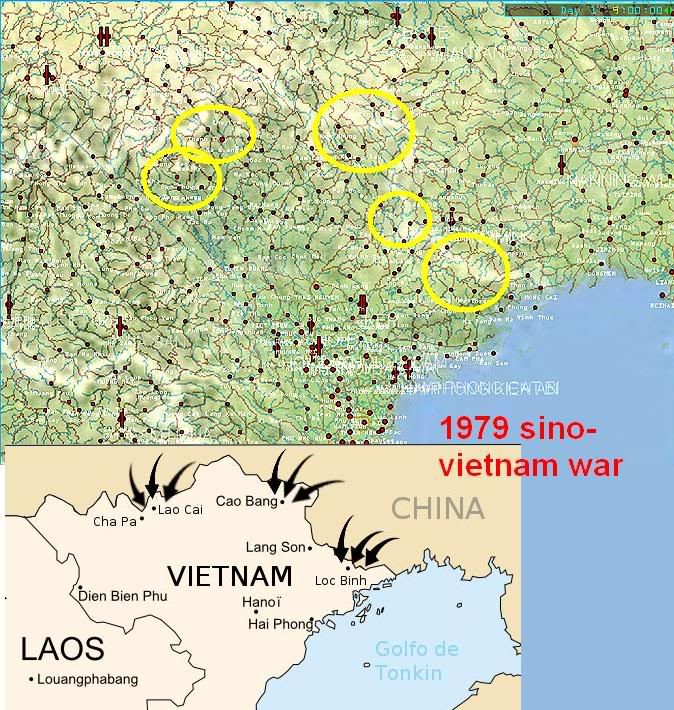
We can, however, judge the results of this
war on both a strategic and tactical level.
Strategic:
China’s plans were three-fold:
First, to compel
the Vietnamese to withdraw partially or completely from Cambodia. Chinese power
projection capabilities back then were strictly limited. It could not send
troops to Cambodia, which was separated from it by Vietnam, Laos and Thailand.
It could, however, seek to draw off Vietnamese soldiers from Cambodia to defend
the homeland, and to teach it that intervention against a Chinese client regime
would have comsequences.
Result:
Failure. The Vietnamese remained in Cambodia until 1989, and though they
suffered fairly severe casualties in the meantime, the Chinese invasion had no
effect on the occupation. However, it did compel Vietnam to garrison the area
more heavily, therefore tying up troops who might otherwise have been re
deployed to Cambodia.
Second, to show Vietnam’s ally, the USSR, that it could not intimidate
China.
Result:
Success. The USSR, which supported Vietnam with weaponry and intelligence, and
massed troops on the Chinese border, completely failed to either prevent the
invasion or affect its course. The Chinese openly warned the USSR that they
were ready for a full scale war if the Soviets intervened in favour of
Vietnam...and the USSR did nothing. At no point after 1979 did the USSR ever
threaten China militarily, or look as though it was about to.
Third, to compel Vietnam, which had a history of hostility towards China
and had mistreated “pro-Chinese” ethnic minorities and ethnic Chinese Vietnamese
citizens, to change its policies towards China.
Result: In
the long run, this paid off, with Vietnam settling its border disputes with
China in 1989, and until fairly recently going out of its way to suppress all
mention of the Sino Vietnamese war even in textbooks and the media. Only now,
when tensions in the South China Sea are increasing, is Vietnam beginning to
allow discussion of the war at all. And today China is incomparably stronger
and in a position to handle such a confrontation than it was forty years ago.
Therefore, on the strategic level, it was
far from an unmixed disaster for China.
Tactical:
On this there can be no argument whatsoever;
on the battlefield, China (no matter what casualties it suffered) handily won
the war. Every single battle that was fought in the 27-day-long campaign
resulted in a Chinese victory. That the Vietnamese refused to commit their main
forces, leaving them in defensive positions before Hanoi, only makes the point
clearer; Vietnam had conceded that the border battles were lost, and that the
capital now needed to be defended. And while China captured over 1500
Vietnamese prisoners during the fighting, the two-hundred-odd Chinese prisoners
taken by the Vietnamese were all captured when they were cut off from their main
force after China had declared the war over and was withdrawing. This is not
how a defeated army loses prisoners of war.
 |
| Vietnamese soldiers surrendering to Chinese PLA troops, 1979 |
Also, there is another tactical feature of
the war that is typically Chinese. Chinese military strategy, developed by Mao
during the Civil War, still influences their thinking to this day. Mao’s dictum
was clear: the guerrilla should never attempt to hold territory, because that
would expose him to being counterattacked. Both in 1962, when China and India
fought a border war, and again in 1979, China fought short duration conflicts –
30 days in 1962, 27 in 1979 – and withdrew as soon as strategic objectives were
met. There is absolutely no reason why this should be different today, in the
21st Century, when most
wars are short and sharp. I will shortly explain why this is important.
To get back to the point: on a tactical basis, the argument that the
Sino-Vietnamese war was a disaster for China is ridiculous.
Why does this ancient history matter
anyway?
Here is why:
****************************************************
THE DOKLAM/DONGLANG STANDOFF
The current borders of the Indian state are
rather unwieldy. A look at the map shows that there is a huge chunk of it
(where, incidentally, the author of this article lives) that is almost isolated
to the east, connected to the rest of the country by a narrow strip of land
only about twenty kilometres wide. This strip is known as the “chicken’s neck”,
and it connects “mainland” India with the landlocked seven north eastern states. Just north of the
chicken’s neck are three territories, two of which are independent countries
(Nepal to the west and Bhutan to the east) and, sandwiched between them,
Sikkim, which was until 1975 (when it was annexed by India under circumstances
that are at least highly dubious) also an independent nation.
 |
| (Map of Kashmir depicted as it really is in this image, not as India claims it to be.) |
For a country which allegedly wants
peaceful relations with all its neighbours, India has managed a remarkable
feat: it has, with just one exception, alienated every single one of them.
The reasons for this are many, but ultimately come down to India’s habit of
acting as the would-be subcontinental hegemon, with a divine right to order
around all the other smaller countries as it sees fit. Nepal in particular has
borne the brunt of Indian bullying, repeatedly being subject to economic
blockades to compel it to bend its policies to suit India’s wishes.
The other South Asian countries,
unsurprisingly, have not exactly been happy about this, and have reacted by
reaching out to alternative partners. And the partner that was ready and
waiting to take over was at hand: China. Today, China is integrating its
communications networks with Nepal’s, rendering future Indian attempts at
bullying inconsequential. It has leased the Hambantota port in Sri Lanka, has
become Bangladesh’s top arms supplier, has bought an island in the Maldives,
and launched multiple projects in Myanmar. Pakistan (which is also improving
relations with Russia, after India went out of its way to court the Americans)
is so closely integrated with China now that they are converging towards
becoming one economic entity.
The one exception to this rule is Bhutan,
and the reasons are interesting.
Bhutan, like Nepal and Sikkim, was allowed
by the British to exist as an independent nation for one reason only; it was
supposed to be part of a “chain of protectorates” separating British India from
Chinese Tibet. The British had signed an “agreement” (in so far that a coercive
treaty can be termed as such) under which Bhutan could have no independent foreign
relations except under British “guidance”. In other words, the Bhutanese would
have to do what the British said, and there were no two ways about it.
When the Brits left, the new Indian government,
which slavishly followed British practice in almost everything, became the “successor
state” to that treaty. It was finally renegotiated in 2007, when the Bhutanese regained,
theoretically, the right to have an independent foreign policy. But the
Bhutanese currency, the ngultrum, remained pegged to the Indian rupee, so that
the Bhutanese economy remained hostage to India’s goodwill. And the Bhutanese aren't happy about it.
In 1962, India had provoked, and subsequently lost, a war by pushing troops across the Chinese border in a very
badly planned and conceived “Forward Policy”, but that had not directly
involved Bhutan. When defeated Indian troops had attempted to flee for their
lives through Bhutanese territory, the then government of Bhutan had compelled
them to surrender their rifles before it allowed them safe passage. At no point
was Bhutan a colony of India’s, or a protectorate; it was, and remains, at
least theoretically an independent nation, even if not treated as such by
India.
Like a lot of other nations which were
carved out by the hands of colonial powers, Bhutan has territorial disputes
with China (it would never dare have territorial disputes with India for obvious
reasons). Specifically, there are three points at which the two sides have a
dispute. Two are not important for the present discussion, except to note that
China has offered to Bhutan to cede them in return for Bhutan ceding the third;
and this spot, sandwiched between Bhutan and a tongue of Chinese territory
stretching south past Sikkim, is called Doklam, or (by the Chinese) Donglang.

Let’s state something right away: Doklam
(to give it a convenient name) is not Indian territory. Not even India pretends
it is Indian territory. The dispute, such as it is, is between Bhutan and
China, and, normally, India would have nothing to say about it.
Unfortunately, these are not normal times.
The 1962 war between India and China was
followed by decades of frozen relations, but by the early nineties the thaw had
begun, with steadily increasing economic cooperation. The border disputes
between India and China, while theoretically still in existence, were consigned
to the Himalayan freezer where they belonged. Huge Chinese investments in
Indian infrastructure and manufacturing projects were matched by Indian business
projects in China. For a while it looked like a growing partnership in the
works.
That changed with the advent of
Narendrabhai Modi, and his ascension to power in the elections in 2014. Almost
overnight, he seemed to look for ways to antagonise China, including
enthusiastically joining with Japan and America in what was supposed to be an
alliance to “contain” the Chinese, including refusal to join in China’s
ambitious One Belt One Road (OBOR) project. It did not (and does not) seem to
have occurred to the people in the government that the Chinese might have their
own ideas about this as well, and be capable of taking steps to counter it. But
of course China did.
One of the things China did was construct a
road near the disputed territory in Doklam. Alleging that this was an
infringement of Bhutanese sovereignty, a 2012 agreement, and also a threat to the chicken’s neck,
India sent troops to the spot, and they have been facing off against the
Chinese ever since. From the rhetoric that began flying around, you’d imagine
that both sides were itching for a war.
 |
| Chinese government image claiming to depict Indian troops intruding into Chinese territory at Doklam. |
This is not true. There is not going to be
a war.
The Chinese reacted by pushing Indian
soldiers back across the territory they claimed as their own, physically, as
they had done in the run up to the war of 1962, and destroyed Indian bunkers in
what they claimed to be their territory. So what was India’s response to that?
Nothing.
The army chief, who was appointed to the
post by Modi over the heads of two more senior generals, is someone who used to
boast that he was ready for a “two and a half front war” – against Pakistan,
China, and Kashmir; he is someone who likes human shield use and has publicly
stated that he wishes Kashmiri protestors were armed so that he could massacre
them. From boasting, he has fallen totally silent as well, Modi’s mouthpiece television
channels Times Now and Republic, which are little more than inventive laden
propaganda outlets for his party, have apparently forgotten China exists.
Modi’s online troll army, formally known as
the BJP IT Cell, is normally tasked with bullying leftists, Muslims, and
secularists online. I love how Bhakts who have contempt for beef eating, Christian North
Eastern "chinkies" and couldn't find the North East on a map get all
nationalistic about China allegedly preparing to cut the same North East off from
India. But then the orders must have gone out, and the
Bhakts fell deafeningly silent on the China issue as well.
There are reasons for this.
First, India has not to this day forgotten the disastrous war
of 1962. The conditions that led to that defeat – overwhelming Chinese military superiority, compounded
by incompetent and politicised Indian military leadership, combined with tremendous
Indian geographical disadvantages – are the same as ever.
 |
| Chinese and Indian troops face off, before the 1962 war. |
And, while the
1962 war was between a Korean War Chinese army and a WWII Indian army, today
the gap is far greater; a 21st century Chinese army, with excellent
logistics, would face a 90s era (at best) Indian army operating in the
territory of another nation, which is hardly enthusiastic about becoming a
battlefield. Indian soldiers have no Kevlar helmets and body armour, their rifles
are of such poor quality that they were rejected even by the Nepali army, and
morale is not exactly high. Apart from all this, the army has only some ten
days’ worth of ammunition. It’s enough to massacre Kashmiri protestors, but
hardly sufficient to take on the People’s Liberation Army.
Secondly, Modi has crafted an image of being a strongman in the Ataturk mould, but he's more like Mussolini; a balloon puffed up with hot air. One puncture and the balloon is done for, and Modi knows that perfectly well. A defeat in a military clash, especially one which India itself provoked, would puncture that balloon once and for all. Especially with the 2019 election edging over the horizon this is not something Modi can risk.
Third, and this is extremely important, China and India are
today economically strongly intertwined, not just in India but abroad. Modi's
corporate owners have huge Chinese investments. Do you suppose they can risk
losing those? If there was a chance of a real war they'd pull on his chain so
fast he'd fall over himself scuttling back to heel.
Fourthly, China isn't alone. India's policy of acting as the
subcontinental bully has systematically alienated just about every single
country on its borders, and China has filled the gap. If India wants a
confrontation, it'll find itself alone, while in 1962 countries fell over
themselves offering lip service support. China has already pointedly
asked what India would do if, just as India “came to the aid” of Bhutan in its
dispute, China sent troops into Pakistani Kashmir. It isn’t a question India
would be too eager to handle.
Nor, to India’s surprise and dismay, did it get the response
it was hoping for from the US. Apparently, to what passes for the minds of
Indian politicians, America would be prepared to commit suicide to back up an
Indian ego clash with China over a stretch of land claimed by Bhutan. To its
consternation, the Trump administration, which is yet to appoint an ambassador
to Delhi, has stayed deafeningly silent, except for a meaningless statement
calling on both sides to resolve the dispute amicably.
No, America won’t kill itself for the greater glory of Modi.
If India fights, it will fight alone.
Therefore, from India’s perspective, a war against China is
the last thing India actually wants, and its subsequent behaviour bears that
out. Despite all chest thumping to the contrary, India is looking for a face
saving way out, and it only remains to be seen what kind of face saving exit
China allows it.
China, despite its own hyper-jingoistic chest-thumping media,
is no more eager for a war than India is. Yes, if there is a war, China will
smash India flat, and that is something both sides know. But then what? China will
win some bragging rights and a stretch of land which isn’t of any use to
anybody unless Beijing wants to actually launch a full scale invasion of India.
Beijing does not want to launch a full scale invasion of India any more than it
did in 1962. So all it will win is bragging rights, a useless stretch of land,
any chance of weaning Bhutan over to its side and....the loss of all the
trillions of currency units of business that it stands to make in trade with India.
There is a third party, though, which might want a war
between India and China, though it would carefully not take part. That is Modi’s
hugging partner Trump and the United States of America. If there is a war, even
if it is a short one ending in an Indian defeat, the immediate order of the day
would be a massive rearmament programme; and the instinctive response of all
recent Indian governments has been to turn to Warshington’s military industrial
complex to supply defence needs.

Ay, there’s the rub, as Hamlet said. It’s all about the money
here, on all sides. That is all there
is to it.
Let us, however, take a look at what might happen in case
there was a war, one caused by, say, some accidental clash or mistake.
The first thing that would happen is that it would not be
long. China, as I said earlier, does not fight long
duration wars. Mindful of both Maoist doctrine and Sun Tzu’s aphorism that no
nation has prospered from a long war, Chinese strategy has always been to hit
hard, make one’s point, and get out. So any idea India might have about bogging
down the Chinese in a war of attrition is futile. Chinese strategy would be to
expose India’s weakness, its inability to protect its Bhutanese client, and the
hollowness of Modi’s own pretensions to being the Defender of India. The 1962
war destroyed Nehru; a war now would as surely shatter Modi.
Secondly, it would not be as per the planned
Indian script; and this is why I started this article out by talking of the
Sino Vietnam War of 1979. There is a repeated claim that the Vietnamese
inflicted massive casualties on the Chinese and this proves that the Chinese,
who use primitive human wave frontal assaults, can be slaughtered in battle.
The assumption, apparently, is that the Chinese themselves failed to notice
that they had taken casualties, and therefore have not taken any steps to
correct that situation. In fact, the magazine India Today reported by the mid-1980s that the Chinese had drastically
changed their war fighting tactics as a result. Instead of waves of Chinese
soldiers swarming up the mountain slopes into carefully prepared Indian killing
grounds, India Today said, India would face
“...massive heliborne commando assaults
from the flanks and rear, backed up by overwhelming artillery fire.”
China had also acquired battlefield radars
to track incoming artillery rounds, so as to locate enemy batteries and put
them out of action; as India Today
said, these were tactics that India could not counter, not then and not to this
day, when Chinese road systems are better, they have better air cover, and
light tanks on the Tibetan plateau ready to exploit breakthroughs.
Ironically, it was India which in 1999, at
Kargil, was reduced to the same tactic of frontal assaults up mountain slopes.
If the Pakistani defenders of those slopes had not been fighting with one hand
tied behind their backs; if the Pakistani government, that is, could have
admitted that it was their soldiers in action (and not, as they ridiculously
kept claiming, “Kashmiri freedom fighters”), and used their air force and as
many troops as India did, we’d have been slaughtered. If India thinks China
wasn’t watching those battles and drawing the appropriate conclusions, it is
deluding itself.
I’ve saved the most hilarious item for
last: the Indian conceit of comparing itself to the Vietnamese. Oh, please; the
Vietnamese fought off the Japanese, the French, the Americans and the Chinese,
all in the course of half a century; they never gave up, never stopped fighting,
even when things looked bleakest. India? India allowed itself to be ruled for
almost 200 years by a few thousand British civil servants backed up by another
few thousand troops.
We Indians, comparable to the Vietnamese in any way?
Give me a break.


