A tale of the not too distant future...
Background:
January
2019. The right-wing, Hindu nationalist led Indian
government of Prime Minister Narendrabhai
Modi is in serious trouble. Steadily
rising prices, widespread unemployment, and economic stagnation have seriously
hurt the government’s image. The nation has yet to recover from the
devastating drought of 2017, which badly hit agriculture and brought
millions to the brink of starvation. A series of corruption scandals in the top
echelons of the prime minister’s own Bharatiya Janata Party have also badly
tarnished Modi’s own image as a clean politician.
 |
| Indian Prime Minister Narendra Modi |
With elections due in May, the government
is on the ropes. Sensing blood, the opposition parties - hitherto in disarray - have started to put
together a ramshackle alliance. The political scene is in turmoil.
Meanwhile, internationally, the scene in
South Asia has changed drastically. After the withdrawal of all American forces
from Afghanistan in late 2017, with the last troops literally pulling out in
the middle of the night without prior warning, the government in Kabul quickly
imploded. The country fairly rapidly split into two, with a Taliban-dominated
government taking over the southern, Pashtun-settled area. In the north, a
Russian-aligned rump state clings on to the Hazara, Uzbek and Tajik majority
zones, but for all practical purposes the main part of Afghanistan is again
controlled by the Taliban.
The US, which until recently controlled the
entire land mass between the Central Asian ‘stans and the Arabian Sea, has lost
interest in the area completely following its withdrawal. The Great Depression
of 2016-17 has hit it hard, and made it concentrate on more profitable sections
of its global empire. For the moment, it’s a non-player in South Asia.
For Pakistan, the Taliban victory in
Afghanistan has proved to be a mixed blessing. While the defence establishment
still thinks that the Taliban Afghan state is an ally which provides strategic
depth to Pakistan, the defeat of the US at the hands of the Afghan Taliban has
encouraged the Pakistani Pashtuns to demand re-integration with their brethren
in Afghanistan. The Pakistani Taliban has launched several offensives, and in
mid-2018 briefly took over Peshawar before being driven back. Meanwhile, the
long-standing Balochistan rebellion against the Islamabad government is still
simmering, and several military bases have been attacked in recent months.
As far as the Indian intelligence agency, RAW, is concerned, the temptation to meddle and bleed Pakistan
has proved irresistible. While it has been arming and funding the Balochi
insurgents for many years, it has recently sent a limited number of weapons to
the Pakistani Taliban as well, on their pledge that they would only attack
Pakistani installations and not turn their guns on Indian interests. The
Pakistani government has retaliated by stepping up support to the flagging
Kashmir insurgency, and by training and funding the Islamic Mujahideen,
Student’s Islamic Movement of India, and other domestic Muslim terror groups in
India.
Politically, too, the Pakistani government
of Nawaz Sharif, which only just retained power in a deeply controversial
election, is in trouble. Pakistan’s economy, without the injection of American
funds, is in even worse shape than India’s, and public frustration is growing.
Prominent young liberal opposition politician
Arsalan Ghumman has called for a rolling series of protests to drive Sharif
from power. Large demonstrations have taken place in the streets of Lahore and
Karachi, and many of these have been targeted by gunmen and bombs; most
Pakistanis, who believe Nawaz Sharif “stole” the last election, think that
these attacks have been orchestrated by the government to crush dissent.
Arsalan Ghumman and several of his supporters are arrested and spirited away to
an unknown destination; all this does is provoke more demonstrations demanding
his immediate release.
 |
| Arsalan Ghumman |
For both India and Pakistan, then, January
2019 is a time of steeply escalating internal tensions, with deeply unpopular
governments looking for a way to survive.
The
Provocation:
9.30 a.m., 26 January: As India celebrates its Republic Day with a massive military
parade marching through the centre of Delhi, a number of coordinated car bombs
– thirteen in all – go off in Ahmedabad, Jaipur and Nagpur, killing at least 700 people
and injuring well over 2000. The news of the bomb explosions reaches Prime
Minister Modi (who also holds the Defence portfolio) as he is watching the
parade in the company of President Lal Krishna Advani and the Chief Guest,
President Gotabaya Rajapaksa of Sri Lanka. Modi immediately leaves the venue
for his office, and calls a crisis committee meeting, attended by top
government ministers and bureaucrats.
 |
| Advani (right) with Modi |
Meanwhile, the private TV channels
interrupt the telecast of the parade for breaking-news footage of the blasts,
including gory images of victims lying in pools of their own blood. By
mid-morning, shrill-voiced commentators on the TV screens have begun openly
blaming Pakistan for the bombs and demanding immediate retaliatory action,
including bombing “terrorist training camps”. In the late afternoon, the first
demonstrators are on the streets of Delhi, waving placards and assaulting any
Muslims they can find. The police seem unwilling to hold them back.
 |
| Times Now, one of the Indian channels most shrilly clamouring for war |
At seven that evening, Modi makes a
televised statement to the nation, appealing for calm, and claiming that the
government will hold those responsible “accountable”. This fails to satisfy the
demonstrators, who burn Modi in effigy alongside Nawaz Sharif. An abortive
attempt is made to storm the Pakistan High Commission.
The Pakistani government, in the person of
the foreign minister, issues a statement condemning the blasts and denying
responsibility; it further offers a joint probe with India to investigate the
bombings. Indian media immediately denounce the offer as “a thief offering to
investigate his own burglary.” The Indian government ignores the offer
completely.
At midnight, Modi, in his capacity as
Defence Minister, holds a second meeting, this one attended by the military top
brass as well as civilian officials. The Prime Minister says that some kind of
military measures will have to be taken against Pakistan, in order to cool down
public anger. In private, he and the Cabinet have already decided that a short
war against Pakistan will not only satisfy the hawks but also regain public
popularity and help win the coming election.
In order to lull Pakistani suspicions, the
government decides not to break off diplomatic relations. The attack will be
launched as soon as possible, to catch the Pakistanis by surprise.
The
military position:
Ever since the military fiasco of 2001-2,
when India had taken a full four weeks to mobilise forces after the terrorist
attack on the Indian parliament, the Indian armed forces had decided on a
so-called Cold Start doctrine.
Though, officially, the Cold Start doctrine did not exist, it called for rapid
mobilisation and concentration of strike forces at the border so as to be able
to launch a short-duration invasion of Pakistan within 48 hours of receiving
orders. The idea is to attack, hit the enemy hard and get out before any
international intervention can be organised.
On paper, the Indians are overwhelmingly
stronger than the Pakistanis, but this is rather diluted by the facts on the
ground. While the common soldiers on both sides are well-trained and highly
professional, the two armies are both completely dependent on their officers
for leadership, and actively discourage initiative. Both sides have made
efforts to modernise, but shortage of funds and jockeying for favour between
the services means that neither has managed to do so with great success.
Besides, India has a much larger land mass to protect, and a great part of its
forces are permanently deployed against China. On the other hand, the Pakistani officer corps is tainted by politics and Islamicisation, while India's is both apolitical in the junior ranks, and strictly secular.
In a short war, both sides will
have virtual parity, and it will come down to tactics and innovation to decide
who wins.
The military plan involves air strikes
against training camps in the Pakistani occupied part of Kashmir, and also on
the Pakistani air force’s bases to keep it off balance and unable to retaliate.
Meanwhile, the army’s strike formations will launch armoured thrusts across the
international border in Punjab and Rajasthan. The attack across the Rajasthan
frontier, directed at Multan, will be a diversion, intended to distract the
Pakistanis from the main assault, which will be across the Punjab border and
against Lahore. The plans call for the capture of Lahore within 48 hours,
followed by a speedy withdrawal. A suggestion for a secondary thrust against
the twin cities of Rawalpindi and Islamabad is turned down as being too
provocative and ambitious.
The plans make it clear that the entire war
is to be concluded within six days, beyond which – according to the Indian army
– the Pakistanis are liable to be tempted to use nuclear weapons. The navy, in
the meantime, will launch attacks on the port of Karachi, using Harrier VTOL
jets from the aircraft carrier Viraat.
The second aircraft carrier, Vikramaditya,
is at the moment in the port of Visakhapatnam, on the other side of the India,
and will take too long to reach the war zone. The third carrier, Vikrant, is still fitting out at Cochin and months from being ready for combat.
On the government side, the advantage of a
short war is that it is the only sort of military engagement which can be
concluded with a minimum of economic pain. With each tank shell costing as much
as a working-class family earns in a month, a longer conflict means economic
disaster. Besides, a short war can be presented as a victory, and by the time
the effects are noticed the elections will be over.
After swearing all present to the strictest
of secrecy, the government issues the necessary orders.
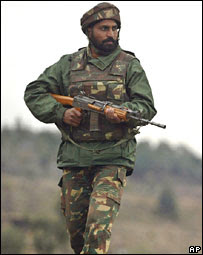 |
| The Indian soldier - well-trained and professional, but lacking individual initiative and with aging equipment. |
 |
| Pakistani soldier: Outnumbered by the Indians, their military is politicised and tainted by Islamicisation |
The
Pakistani preparation:
The Pakistani armed forces are far from
unaware of the existence of Cold Start, and have gone into high alert as soon
as they received news of the bomb blasts in India. Though the Pakistani armed
forces are much smaller than the Indian, they have lesser territory to defend,
and can concentrate faster owing to the lesser distance of Pakistani
communications centres from the border; in addition, the Indian swift assault
plan means that only a small, highly mobile part of the Indian armed forces
will be used.
Also, the Pakistani intelligence service,
the ISI, is much more efficient than the Indian. Before dawn on the 27th,
it has already picked up news of the midnight meeting in Delhi. Although it
doesn’t know what happened at the meeting, the Pakistani army high command
decides to put its troops on combat alert, without waiting for permission from
Nawaz Sharif.
By late afternoon on the 27th, ISI
agents – some of them disguised as tea sellers and labourers in and around
Indian cantonments – begin sending in coded messages that Indian strike corps
have begun making preparations for immediate movement. As soon as darkness
falls, long lines of tanks and armoured personnel carriers rattle down the
highways towards the Pakistan border. Their plan is to be in position to attack
before dawn on the 29th.
Quietly but with desperate speed, the
Pakistani army command begins making its own preparations. As yet, the civilian
Pakistani government is out of the loop. Only when the troop movements are too
far advanced to be reversible, the generals decide, will Nawaz Sharif be
informed.
The ISI also quickly evacuates the
terrorist training camps in the Kashmir mountains. If the Indians strike the
camps, they will be bombing little more than empty tents and abandoned firing
ranges.
 |
| Militants at a training camp, Pakistani Occupied Kashnir |
Meanwhile, the Pakistani military’s Nuclear Command Authority begins moving part of its atomic
weaponry out of its fortified bases and integrating warheads with their
delivery systems. The generals will not inform Nawaz Sharif of this at all.
Meanwhile,
in India:
Since the plans to attack Pakistan are top
secret, the government has kept insisting that it will punish those
responsible. Public anger, stoked by private TV channels competing with each
other for ratings, is boiling over. Large demonstrations have taken place in
several cities across North and West India. Several violent incidents,
targeting Muslims, have taken place. Curfew has been imposed in Delhi, Mumbai,
and Ahmedabad, where the worst riots occurred.
On the evening of the 28th, Modi
again goes on TV to declare that decisive action will soon be taken against
“those responsible” for the bombings, and that he will make another statement in
the morning. Though his comments are meant to assuage domestic anger, the
Pakistanis decide that this is final proof that an Indian attack will be
launched during the course of the night. Their own armoured corps move out of
their bases and begin to deploy to meet the threat.
The Indian troop concentration has not gone
completely according to plan. Some brigades equipped with the Arjun main battle
tank have been unable to reach their jumping off points because the tanks are
too heavy to use most bridges and too wide to fit railway flatbeds. Meanwhile,
many of the aging T-72s have broken down in the Rajasthan desert, so that the
armoured formations are seriously under-strength. The army’s commanders hold
another meeting with Modi just after midnight, and suggest a day’s delay.
However, the Russian ambassador has already sent in a message asking about
Indian troop movements and warning about hasty actions, and it’s obvious that
the preparations can’t be kept secret any longer. A day’s delay might be too late,
Modi says, and orders the attack to go ahead as planned.
The name of the operation is decided at
this meeting. It will be called Operation Badla – Operation Revenge.
The
Attack:
At half past four in the morning of 29th
January, Indian Air Force Mirage 2000, Rafale and Sukhoi 30 MKI aircraft take off
from forward airbases and fly at treetop height over the frontier. By five, air
raid sirens are going off in Islamabad and Lahore, while the flashes of bomb explosions
light up the horizon and startled residents blink awake in the freezing cold.
Pakistani anti-aircraft guns and surface to air missiles attempt to counter the
Indian attack with only partial success; just four planes are brought down.
However, the Indian attack fails to damage the PAF substantially, since the
Pakistanis had moved their aircraft away to satellite airbases and underground
shelters. A second wave of strikes, against the already evacuated terrorist
training camps in Pakistan-occupied Kashmir, achieves precisely nothing.
Just as the first Indian Air Force planes
return from their strikes, Indian 155mm Bofors artillery guns and
multi-barrelled rocket launchers open up a withering barrage on known Pakistani
positions across the frontier. As lines of T-90 and T-72 tanks roll forward,
the barrage lifts ahead of them, hitting roads and railway junctions in an
effort to stop the Pakistanis either withdrawing or reinforcing their
positions. By dawn, the first line of Pakistani defences have been overrun at
relatively little cost, and columns of prisoners are being sent to the rear, to
be photographed by hastily organised TV crews from pro-government channels. By
the time Modi goes on TV at eight in the morning, the news has already gone
out: the nation is at war, and to all appearances it is winning.
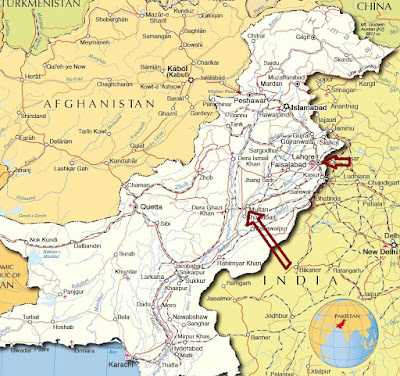 |
| The Indian thrusts towards Lahore and Multan. The border as depicted in Kashmir in this map is the de facto one, not the one officially claimed by either country. |
But the prisoners the Indians have taken
are Rangers – border guards – not regular army, and the air strikes have caused
far less damage than anticipated. By mid-morning, Pakistan’s J-10 and F-16
fighters are engaging Indian MiG-29s over Lahore and Kashmir. The armour has
begun to get bogged down too. A huge dust storm reduces visibility to almost
zero, causing hours of delay to the southern flank of the Indian assault, which
is aimed across the desert at Multan. Meanwhile, the northern arm of the attack,
against Lahore, runs into hastily laid minefields, which disable many of the
tanks. Others are tied down by small but determined teams of anti-tank missile
operators in camouflaged trenches in the middle of the minefields. Artillery
has to be brought up to destroy these positions one by one before the mines can
be cleared.
The
plan goes awry:
By the evening of the 29th, it’s
already evident that the Indian timetable has gone awry, and that Lahore can’t
be captured on schedule – the armoured spearheads still have to break through
the main lines of Pakistani defences east of the Icchogil Canal protecting
the city. The capture of Lahore is essential to the rationale of Operation Badla,
however, because having committed to the attack, India can’t withdraw at this
point without handing Pakistan a propaganda victory. Nor will the frenzied
crowds now dancing in the streets of Indian cities, who imagine that this will
be a final war against Pakistan, be satisfied with anything less than a
demonstrable victory.
At the same time, Pakistani defences are
becoming increasingly effective, taking a steadily rising toll of Indian
armour. Helicopter gunships race at head height over the battlefield, rocketing
tanks, while heavy artillery barrages are tying down the infantry. Without
reinforcement, the Indian strike corps will find it more and more difficult to
reach their targets. The whole attack plan is in jeopardy.
The Pakistani High Command has accurately
identified the Lahore attack as the real danger, and deployed its forces
accordingly. The well-dug-in Pakistan Army regulars, supported by heavy
artillery firing from positions east of Walton Cantonment, will prove extremely
difficult to dislodge. Any Indian units which do manage to break through will
find themselves threatened with encirclement by attacks from the flanks.
In an emergency meeting in Delhi,
punctuated by the noise of firecrackers from celebrating crowds in the streets,
the military chiefs and Modi decide that the original ultra-short duration war timetable
will have to be extended, but only by a maximum of forty-eight hours. Urgent
reinforcements will have to be sent to the Lahore front, with the strategy
shifting from a rapid sword thrust to a battle of attrition meant to wear down
the Pakistani forces. Meanwhile, the 1st Armoured Division,
spearheading the thrust at Multan, is ordered to move forward at top speed, in
order to force the Pakistanis to divert troops from the defence of Lahore.
The
International Response:
At half past eleven in the evening of the
29th, Indian time, the UN Security Council meets in New York to
discuss an urgent Pakistani plea calling for an immediate halt to the Indian
invasion. China, which has had good relations with Modi as well as its old
friend Islamabad, moves a resolution demanding India withdraw all forces and
threatening military action. Although Russia expresses its “deep
disappointment” with the Indian government, it vetoes the resolution, marking
the first overt difference in opinion between the two allies in the UN on any
substantive issue since 2012. France, which has major weapons sales contracts
to both nations, also votes against it. Britain abstains, as does the United
States. Nobody is sure of Indian intentions, and the meeting merely closes with a
statement calling on both sides to exercise maximum restraint.
The Indian government is ecstatic, and
declares a diplomatic victory. On the other hand, the Pakistani army, which has
complete control over the military direction of the war, decides that there
will be no help from abroad, at least in time to make a difference. It is on
its own.
The
Battle of Mirgarh:
The Indian First Armoured Division has been
moving north-west since crossing the frontier, but has been delayed by severe
dust storms during the day. With darkness, though, the wind has died down, and
the division finally begins rolling across the desert, against only sporadic
and largely ineffective resistance. The biggest problem faced by the division
are with the Arjun tanks, which are too heavy to keep up in the soft sandy
terrain, and with the older T-72s, which are still breaking down in
considerable numbers. During the night, therefore, the division becomes strung
out, but by mid-morning of the 30th January the first squadrons of
T-90 tanks are approaching the town of Mirgarh.
 |
| Indian T-90s advancing towards Mirgarh |
Just after eleven in the morning, the lead
Pakistani armoured units, armed with T-80 UD and Al Khalid tanks, counterattack
from the south and north-east, trying to catch the Indians in a pincer. At the
same time, PAF J-10 and F-16 aircraft race over the strung-out lines of Indian
armour, hitting them with cluster bombs and armour-piercing missiles. Indian
SU 30s and Mirage 2000s flying over the battlefield counterattack, and a
confused dogfight develops, during the course of which an Indian Rafale flight attempting to strike the Pakistanis mistakenly bombs an Indian tank squadron instead. The two sides break off combat temporarily in the late afternoon, with
Pakistani forces disengaging to the north-east while the Indians fall back a
short distance to consolidate before renewing the advance. About forty tanks
have been lost on both sides, along with between ten and fifteen aircraft.
 |
| Site of the Battle Of Mirgarh (red square). The border of Kashnmir in the map is the de facto one. |
The Indians resume their advance after
dark, with a change of direction to the north. Unknown to them, the Pakistanis
are returning along the same route, and the two sides meet head-on at about
nine in the evening. In the darkness of the desert night, lit only by
occasional flares, the two armoured forces begin a grinding battle of
attrition. Units soon lose cohesion and become inextricably tangled, with tanks
fighting at point-blank range and occasionally ramming each other like Soviet
T-34s and German PzKw IVs on the Eastern Front in World War II. Both sides are
completely unable to use either artillery or air support because of the
darkness and the confusion.
When morning arrives, the battle is still
in progress, but neither side is able to use its air power or artillery,
because the entire battlefield is by now covered by a gigantic dust cloud from the
tank treads. However, the superior numbers, training, and equipment of the
Indian forces have finally begun to tell. Also, some of the Arjuns have just
arrived, and by good fortune outflank and destroy a Pakistani reinforcement column
driving up from the south-west. Throughout the day, the Indians manage to
isolate and wipe out pockets of Pakistani armour, and succeed in blocking all
attempts by the desperate enemy tankmen to either concentrate together or reinforce. When darkness
falls on the 31st evening, the remaining Pakistani forces disengage
and withdraw as best they can. They have managed to delay the Indian advance,
but have lost almost two hundred tanks and armoured personnel carriers, and are hors de combat for the moment.
The Battle of Mirgarh is over, and has
resulted in a decisive Indian victory. The way to the Sutlej River, beyond
which lies Multan, is open.
The
sinking of the Viraat:
The Indian Navy has sat out most of India’s
conflicts with Pakistan, having participated only in a limited way in the 1971
war, when Seahawk jets from the carrier Vikrant bombed Chittagong and missile
boats launched a seaborne assault on Karachi. In the context of a cold start
war, the navy has no real role to play; but the government is determined to
show that it is using all available means to fight Pakistan. So the navy’s
ancient light aircraft carrier, the INS Viraat
– which, as the HMS Hermes, had
fought in the Falklands War in 1982 – slowly steams northwards across the
Arabian Sea, and on the early evening of the 30th launches an air strike
by eight Sea Harriers against Karachi harbour. The raid is a disaster; six of
the eight Harriers are shot down, in return for limited damage to two corvettes
and a couple of shore installations.
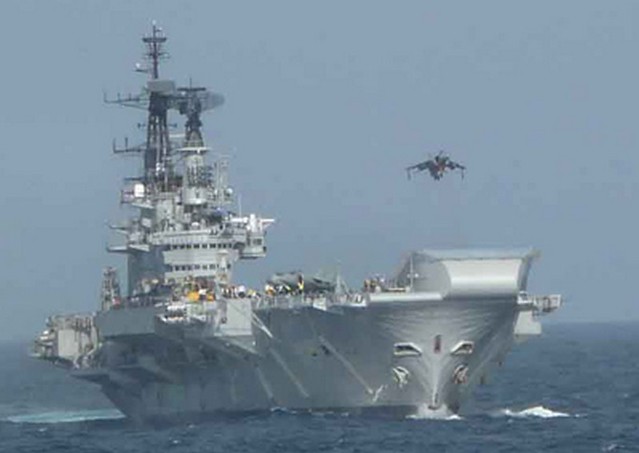 |
| Viraat launching Harrier against Karachi. This is the last known photo taken of the carrier. |
The
Viraat
has no chance to launch a second raid with its few remaining Harriers. The
Pakistani Navy’s Agosta 90B class submarine PNS
Hamza left Karachi on a routine training mission on 26
th
January; with the outbreak of war, it was ordered to patrol the approaches to
the port to prevent a 1971-like Indian bombardment. Shortly before midnight, at
the very moment that Indian and Pakistani tanks are crashing into each other in
the desert sands south of Mirgarh, the
Hamza’s
passive sonar detects the noise of the engines of the
Viraat and its escort of two frigates and a destroyer. The
submarine shadows the ships for an hour, working up to attack position. At
approximately ten minutes past one in the morning, it fires three SM 39 Exocet
anti-ship missiles. All three strike the
carrier at the waterline. Given its slow speed and inability to manoeuvre, they
could scarcely have missed.
 |
| The Hamza setting out on patrol |
The Viraat
is mortally wounded. On fire and taking on water, the ancient carrier slows to
a stop. At four in the morning, the captain issues orders to abandon ship.
Blazing fiercely and listing badly, the old vessel hangs on for several hours
more. At just before eight in the
morning, almost seven hours after being hit, it turns turtle and sinks, taking over
two hundred of the crew with it down to the bottom of the Arabian Sea.
The Hamza
has gone deep and stayed silent after firing the missiles. After evading
several sticks of Indian depth charges, it heads north-west towards the
Pakistan coast. Its part in the war is over.
In Delhi, the news of the Viraat’s sinking is delivered to the
Prime Minister by the Navy Chief in person. Modi immediately orders that it be
kept completely secret until the conclusion of the war, in order to maintain
public morale. In real terms, the destruction of the doddering old carrier is
of no importance anyway. The immediate effect of the sinking, however, is to
remove the Indian Navy from further involvement in the hostilities. The war will henceforth be fought by the two other services.
The
Hatf Option:
The Pakistani top brass, keenly aware of
its relative military inferiority, has prepared several options to counter an
Indian offensive. One option is to launch fidayeen
strikes in Kashmir, using small teams of suicide attackers to infiltrate and
attack army bases in order to tie troops down. However, since India hasn’t
struck across the frontier in Kashmir, such strikes will be of no value. Another option is to fall back, abandon most territory east of the
Indus river, and counterattack when Indian lines are overstretched. But this
will be possible only in case of a longer war, with India planning to clear and
hold territory; it’s useless in the case of a short-duration thrust meant to
defeat and humiliate Pakistan and withdraw.
Nor can Pakistan take the risk of trying to
absorb a defeat; it knows that this will disastrously weaken the state, and
render it unable to resist the various rebellions, from the Balochis to the
west to the Pashtuns in the north. If the army loses the battle, the country
will collapse and disintegrate. Defeat, therefore, is not an option Pakistan
can afford.
It then falls back to its third option –
the Bomb.
As part of its arsenal meant to halt an
Indian invasion, Pakistan has several mobile batteries of Hatf IX (Nasr) tactical
nuclear missiles, with a sixty-kilometre range. These sub-kiloton missiles are
battlefield nukes, meant to knock out armoured thrusts; Pakistani strategists
think the risk involved in their use within Pakistan’s own territory is
acceptable given the alternative.
Two of these batteries – each of four
missiles – are ready at Multan Cantonment. By the afternoon of the 31st,
by which time it’s clear that the battle of Mirgarh is lost, the two batteries
are ordered to move to the south-east. In the early hours of the 1st
February, the transporter-erector-launchers and their support vehicles are
lying in wait for the Indian armour.
At around the same time, near Lahore, the
Indian spearheads finally fight their way to the Icchogil Canal. Engineer
outfits quickly span the waterway with bridges, but the offensive across the
canal will have to wait until Pakistani forces still hanging on to the east of
it are neutralised. The Pakistani army still has defensive positions
determinedly holding on to the western bank, but once the Indian armoured
brigades break loose from their bridgeheads, the fall of the city will be only
a matter of time.
In a bunker somewhere near Rawalpindi, the
exact position of which is known to the Pakistani army general staff alone,
there is a meeting in which the orders are issued: the fall of Lahore can’t be
delayed longer than two days at the most. The final battle is at hand.
The Hatf batteries will launch the first counter-blow.
The Pakistani High Command hopes the Indians will get the message that Pakistan
is willing to nuke its own territory if required, and withdraw, so that it will
also be the last. In case India doesn't, though, the Pakistanis prepare other options.
At about one in the morning of 1st
February, the newly-reinforced Indian armour resumes its thrust northwards
towards the Sutlej, the tanks rolling past wrecked and abandoned Pakistani vehicles.
The soldiers are well aware that they have broken the enemy’s forces for the
moment, and serious resistance is unlikely before they reach the river. Also,
after the past two days’ constant fighting, the soldiers are exhausted; despite
their own efforts, their energies are flagging and it’s impossible to maintain the
same level of alertness as they had managed so far.
At exactly sixteen minutes after two in the
morning, the first Hatf battery shoots off its four missiles, and drives away
from its firing position as fast as possible to avoid retaliatory fire. Seconds later, the second battery follows suit.
 |
| Hatf 9 missile firing (at an exercise) |
The Indian soldiers, riding in their tanks and
armoured personnel carriers with open hatches, savouring the cold night air,
don’t have a chance. The warheads, being low-yield sub-kiloton devices, only
produce brief flashes of searing light as they explode in the air over the
lines of advancing Indian armour, not spectacular mushroom clouds; but they are
more than enough. Most of the division is cremated in its tracks, the crew
reduced to charred skeletons inside the white-hot hulls of their tanks.
The
Indian response:
It has been a night of feverish activity in
Delhi. The war is already in its fourth day, and it will have to be concluded,
even according to the extended timetable, in three days more. While intense
international pressure on the government is growing, it has so far successfully
managed to withstand it. The fact that so far not a single Pakistani air raid
or missile strike has taken place on Indian soil has also allowed the
government to keep public opinion on its side. To be sure, the Pakistanis have
been shelling Indian troops in Kashmir, especially in the Kargil sector, and
have launched small-scale attacks on the Siachen glacier; but these are mere
pinpricks, easily shrugged off. And though PAF planes have made short dashes
across the border, they’ve invariably turned tail at the first sight of Indian
aircraft.
To the people, therefore, India seems to be
obviously winning; already, the TV channels are calling for Pakistan to be
completely defeated and at least Pakistan-occupied Kashmir, if not Lahore as
well, annexed.
Modi realises that he will have to play a
delicate balancing act between what can be achieved and what the public now
expects. At all costs, India can’t be seen to have lost the war – not only must
Lahore be captured, but it must be made clear that India will withdraw at its
own initiative, not in the face of a Pakistani counterattack. He is in the
middle of a pre-dawn meeting with defence ministry officials and army generals
on the plans for the next days when an urgent message arrives. The armoured
thrust towards Multan has been destroyed by Pakistani nuclear missiles.
What exactly followed in the meeting isn’t
known, since no records seem to be extant, and the participants are not available
for questioning. But from Indian actions afterwards, and knowledge of Modi’s
persona and the dilemma he’s faced with, one can make some inferences.
If India retreats in the face of the
missile strikes, it will hand the Pakistanis a victory. Obviously, the advance
on Multan can’t be resumed within the time left to India; and Lahore is still
at least a day away from falling, after which it will take more time to wipe
out remaining pockets of resistance. Besides, Indian military doctrine –
repeated publicly and often – has been to nuke Pakistani population centres in
response even to tactical nuclear use. India can’t back out of that without the
government losing an unacceptable amount of face. Also, Modi’s own vengeful
psychology won’t allow for withdrawal without first exacting retribution. There
is, therefore, no way out for him but to order nuclear strikes against
Pakistan.
It’s known that the director of the Indian
spy agency, the Research and Analysis Wing, was ordered to join the meeting
after the news of the Pakistani nuclear bombs. He will have been asked about
the likelihood of Pakistan’s retaliating to an Indian nuclear strike with one
of its own. RAW, though, is an agency of historically staggering incompetence,
an agency which has repeatedly bent over backwards to please the political
leadership while at the same time pursuing mindless initiatives of its own – as
when it, most recently, began arming the Pakistani Taliban. The RAW Director
will have said what everyone wants to hear – that the Pakistanis will not dare
to strike back against an Indian nuclear attack.
The top military officials, whatever their
personal feelings, will not have demurred either. Like all Indian generals,
they owe their position to political reliability more than anything else, and
are also conditioned to unquestioning obedience of the political leadership. The
RAW statement will also have let them off the hook, since if things go wrong,
it will be the spy agency’s fault, not theirs.
There’s one definite fact to go on –
satellite images, taken the previous afternoon, don’t show Pakistani medium and
long-range missiles readied for immediate firing. If the enemy does decide on a
counter-strike, there should be enough time to detect it and prepare. Delhi is surrounded by batteries of anti-ballistic missiles anyway.
It only remains to choose the timing of the
strike, and the target. It’s crucial to hit back as quickly as possible, before
international pressure to desist grows so overwhelming that a nuclear strike
becomes impossible. As for the target, it’s not realistic to mount an attack on
a purely military objective, since the Pakistani forces are concentrated in a
mass only before Lahore, too close to the Indians to hit at. Therefore, India will
have to nuke a Pakistani city. There are three candidates – Karachi, Multan and
Rawalpindi.
The reason Multan is chosen as a target is
interesting. Rawalpindi, though the seat of the Pakistani army’s top
leadership, is too close to Lahore; fallout from the nuclear explosion might
well endanger Indian troops. Besides, the destruction of the city – along with
the enemy’s top brass – might disrupt the command system, with officers further
down the chain of command hitting back on their own initiative. Karachi is
ruled out because, as Pakistan’s largest and most important city, its destruction
is almost certain to make it difficult to impossible for the enemy to resist
hitting back. Besides, Karachi is far away from the battle front and there’s no
way India can justify nuking it to the international community in military
terms. That leaves Multan.
Situated in the rough geographical centre
of Pakistan, Multan sits astride major communication routes between the north
and south of the country, so its destruction will cut Pakistan in two. It’s
also home to a large cantonment, a legitimate military target. And, most
importantly to Modi, the Pakistanis have used nuclear weapons against Indian
forces advancing on Multan, so destroying it will constitute revenge.
Once the strike goes through, and Multan is
confirmed destroyed, Modi will go on TV to announce that the Pakistanis have
used the Bomb on Indian forces, and justify the destruction of the city; he
will also warn Pakistan of total annihilation if they use nuclear weapons
again. He orders a speech to be prepared accordingly.
An Indian Prithvi missile carrying a
20-kiloton nuclear warhead – about a third more destructive than the bomb used
on Hiroshima – roars into the sky, heading west across the desert.
.jpg) |
| Prithvi being launched. It isn't known if this photo depicts the strike on Multan. |
Dawn is touching the eastern sky. In a few
minutes, a second dawn will briefly light up the west.
Multan dies a few minutes after seven,
Indian time. The fireball is visible to Indian troops south of Mirgarh,
including the tankers who have survived the tactical nuking and are retreating
back towards the border. It’s not recorded what they felt.
The
Bogey:
Modi is due to address the people of India
at nine in the morning. By half past eight, the television crews are ready and
waiting, and speculation is mounting. Rumours are rife; the commonest is that
he will announce the fall of Lahore. Others speculate that the Chinese have
attacked India’s northern borders to take the heat off their Pakistani allies.
Either way, they all say, whatever Modi will announce will be of extreme
importance.
That announcement never takes place.
At seven minutes past the half-hour, Indian
radar controllers detect a single Pakistani aircraft approaching fast from the
west, at a very low altitude, virtually treetop height. It’s already well
within Indian territory when first seen, and is obviously protected by sophisticated
electronic jammers. The radar immediately alerts Indian Air Force interceptors
of the “bogey’s” course and heading, and MiG-29 pilots at Hindon airbase are
ordered to scramble. Just two minutes after the alert, they’re in the air.
Well before they reach the “bogey”, though,
the Pakistani pilot is already trying to get away. Rising in a steep turning
climb, he banks sharply and is headed back home at nearly twice the speed of
sound. The Indian pilots relax slightly, though they keep in pursuit. It’s just
another of the PAF’s attempts to keep the Indian fighters off balance by making
brief intrusions. Nothing to worry about, really.
They couldn’t be more wrong.
The Pakistani aircraft is an F-16D Block 52+ of No 5 Falcons Squadron, flown by
Wing Commander Tauseef Ahmed, one of the PAF’s top pilots. In order to evade detection, Ahmed took off not from his squadron's airbase at Shahbaz, near Jacobabad, but from a highway west of Lahore, where he's been waiting since the start of the war. He’s trained and
prepared for years for this one mission, and has already completed it
successfully long before two Indian air-to-air missiles explode near his tail
and send him spiralling down in flames near Amritsar in Indian Punjab. It was already too late
to stop him by the time he’d completed his climbing turn.
Slung below the belly of Ahmed’s F-16 was a
one-megaton thermonuclear bomb. He armed it just as he began his climb, and
pressed the bomb release seconds before he started to bank away. Even as he was
rushing back westwards, the bomb was climbing into the sky. As gravity began
tugging at it, the weapon slowed, then slowed further, until it finally stalled
and began to fall. Describing a perfect parabola, it began its descent over
Delhi.
 |
| Tauseef Ahmed takes off on an earlier training flight |
The
Destruction of Delhi:
At exactly 0847, Tauseef Ahmed’s bomb
reaches its pre-set altitude and explodes low over Connaught Place in
Delhi. A flash of actinic light precedes
a fireball, which reaches temperatures approaching those at the centre of the
sun. Expanding at terrific speed, the fireball strikes the ground, and
instantly vaporises everything it touches – earth, concrete, metal, human
flesh, all is incinerated in an instant.
The fireball rushes across the city,
consuming everything in its path, in a rapidly expanding circle around Delhi’s
commercial district. Hotels, roadside stalls, elegant politicians’ residences,
the pink sandstone edifice of the Presidential Palace, all turn in a fraction
of a second to incandescent dust. A little further off, some of the thicker walls
survive, with people leaving shadows of themselves on them as they evaporate.
The fireball is preceded by a shock wave, a wall of air moving at the speed of
a supersonic jet, which knocks down buildings, people, trees and vehicles with
equal impartiality, and sends smashed concrete and glass whistling through the
air at lethal velocities, shattering bones and slicing through arteries.
As the fireball slows, the air above it,
heated to solar temperatures, rises, taking along with it the ashes of
everything vaporised by the flash. A column of superheated air ascends into the
upper atmosphere, till it finally begins to cool. As it does, the water vapour
in it condenses, mixing with the dust and ash, and spreads out in the cooler
upper air, forming a cloud. The rising column of air below, now stained with smoke and soot, as well as vapour, is a tether connecting it to the ground. From a distance, it looks like a titanic mushroom.
Like a gigantic, evil monster, writhing in
torment, the mushroom cloud rears its head over the destroyed city.
 |
| Mushroom Cloud Over Delhi |
As the fireball dies out, the winds begin.
Rushing back to fill the space cleared by the column of superheated air and the
shock wave, the winds fan the thousands of fires now breaking out all over the
shattered city, and combine them together into a swirling wall of flame. Within
twenty minutes of the bomb’s explosion – when Ahmed and his fighter already
occupy a smoking crater in a wheat field near Amritsar – the fire has created
its own weather system, sucking in air from all directions. A firestorm roars
across the city, consuming everything in its path. By the time it burns itself
out, nothing will remain but a field of ashes and ruins.
Later in the day, as the fires finally
begin to burn themselves out, the irradiated dust from the first explosion
begins to descend, in a plume over north-west India. Those it touches will know
of their misfortune only much later, as their hair begins to fall out and their
guts cramp in agonising spasms. By then, it will be much too late.
Delhi is dead, along with most of the
Indian government and the top command of the armed forces; but the horror is
just beginning.
Armageddon:
Now that the war is over, and the
governments on both sides which caused it are history, it is probably of little
benefit to go into the details of the nuclear exchange which followed over the
next two days, with detailed description of each strike and counter-strike.
Suffice it to say that both governments and high commands ceased to exist early
on the 1st February, and after that it was left to lower-level
officers to carry out attacks at their own initiative. The destruction of
Multan and Delhi was followed by nuclear bombs over Karachi, Rawalpindi,
Islamabad, Quetta, Hyderabad and Gwadar in Pakistan; and Ahmedabad, Ludhiana, Jalandhar,
Surat, Agra and Kanpur in India. Mumbai was destroyed too, though not directly
– a long range nuclear missile struck the Trombay atomic reactor, sending a
cloud of lethal radiation over the city. It was the last nuclear attack of the
war.
All the Indian strikes on Pakistan are carried out by ballistic missiles. Pakistan uses a mix of toss-bombing raids similar to Ahmed's attack on Delhi, followed by missile strikes as they run out of pilots trained in the technique. Not a single attack on either side is intercepted in time by the respective defences, as far as is known.
The skies over both nations are soon black
with drifting smoke and dust, and lethal radiation falls over the plains like
malevolent, invisible, snow. The loss of medical facilities, concentrated
within cities in both nations, dooms the people of the countryside to death by
radiation poisoning and cancer; what international aid there is arrives far
too late to help anyone.
The legacy of Armageddon:
One of the most destructive features of the
nuclear exchange was that the weapons were almost all set as groundbursts, with
the fireballs from the explosions touching the ground. This limited the
immediate area of damage, but lifted enormous amounts of irradiated dust into
the air, which later came down in lethal fallout. To this day, the survivors of
the carnage in what remains of Northern India and Pakistan have extremely high
levels of cancer, and they have almost stopped reproducing owing to the
enormous levels of mutations among the children.
By the time Trombay was destroyed, late in
the morning of 3rd February, the war was already over in all but
name. Lahore had fallen on the afternoon of the 2nd, but nobody
cared about it by then. The soldiers were no longer shooting at each other –
both sides were trying desperately to find shelter from each other’s missiles.
How many people were killed in the nuclear
exchange is impossible to compute – guesses range from eighteen to twenty
million Indians and eleven to sixteen million Pakistanis by various estimates.
The actual total will never be known, because the death toll keeps rising to
this day. To the deaths from the bombs themselves and the radiation must be added the millions of casualties from the famines which still sweep across northern India and all of Pakistan, where agriculture has all but ceased; and since medical facilities in South Asia are all concentrated in the cities, millions more must have died, and are still dying, of otherwise treatable diseases, including of the epidemics that afflict both nations owing to the total breakdown of sanitation.
Nor is the dying confined to Indians and
Pakistanis. Borne on high altitude winds, the fallout covers South Asia, from eastern
Iran, southern Afghanistan, all of Nepal, till it touches western Bhutan and
the fringes of Bangladesh. Some of it crosses the Himalayas and taints the high
plains of western Tibet. Some of the dust and smoke particles are still in the
atmosphere now, and will be for many years to come.
The war wasn’t ended by surrender on either
side, or by international intervention. In fact, international intervention
wouldn’t have done any good, because by evening on 1st February
there wasn’t any government on either side to intervene with. The war burned
itself out when neither side was able to hit out at the other any longer.
So obvious it was that both sides had lost that there was no TV channel in India which even tried to
claim victory.
Aftermath:
Pakistan virtually ceased to exist. That it
didn’t completely disintegrate can be credited to one man. Arsalan Ghumman,
whom Nawaz Sharif had imprisoned early in January, was released from custody at
the end of the war, and took over the reins of what was left of the country.
Over the next months, he travelled over all of Pakistan, supervising relief
efforts, setting up local administrations, and co-ordinating the distribution
of international aid. He diverted the rump Pakistani army from the Indian front
to rescue and relief efforts, with combat operations restricted to putting down
jihadist outbreaks in the north and west. Even with all his efforts, he was
left with a ruined, devastated nation, which has to this day not begin to
recover from the war and probably never shall.
India, despite its much larger size, did little
better. Most of its industrial base had been wiped out with the destruction of
Mumbai and Ahmedabad, Kanpur and Ludhiana; and with the end of the central
government, the country rapidly began to unravel. State after state in the
north-east of the country declared independence, and had to be forcibly
pacified by military units stationed there, which massacred tens of thousands. Kashmir - over which India and Pakistan had shed so much blood - was blanketed by radiation raining down from both sides. Neither India nor Pakistan was any longer either able to or interested in claiming it, so the people were left to their fate.
As law and order collapsed, the nation began to
disintegrate into a conglomeration of city-states and mini-fiefdoms, each
jealously hanging on to its resources. Finally, a right-wing military
dictatorship led by a junta of colonels took over, with the southern Indian city
of Hyderabad (not to be confused with the destroyed Pakistani city of the same
name) as its seat of government. It
still remains in power, though there isn’t much to rule over any more; its
authority runs only in the large cities, and that only during the day. The
night belongs to the criminal gangs.
Delhi, though it remains India's notional capital, has not, as of this writing, been re-occupied. It remains a sea of ashes and charred ruins. Mumbai is slowly picking itself up, though it's still a shadow of what it once was. There's nothing left of the other destroyed cities.
The silence of the “international community”
was deafening. Once the nuclear exchange had started, it made not the slightest
effort to do anything but watch in horrified fascination as the two countries
destroyed each other. Only much later was a trickle of aid organised, and then
it made little difference because, with communications in the nuked areas
utterly destroyed, little of it ever reached the intended recipients anyway.
To this day nobody knows just who set off
the car bombs which started off the whole thing in the first place. There never
was a proper investigation, not that it really matters any longer.
Operation Revenge is over.
(Note to reader: This account of the India-Pakistan War of 2019 is not meant to be a prophecy. Call it, instead, a warning - and a cry for peace, while we still can achieve it.)
Copyright B Purkayastha 2013


.jpg)


