Wednesday, 4 April 2012

The Mighty Mite

Once upon a time, there was a colony of mites which lived under the skin, in a city of tunnels they had dug out with the labour of their jaws. They lived their mundane lives, sucking blood, excreting, having sex, laying eggs, and all the other activities of mundane mite society, as their forefathers and foremothers had done since the beginning of mite history.

One day, amongst the mites there suddenly arose a Leader, whose eyes, had he had any, would have gleamed with the holy light of revelation. He went out among the other mites, crawling vainly on their daily routine of eating and screwing, and, climbing on a heap of detritus, he waved his forelegs to get the general attention.

“Brothers and sisters,” he shouted, “we spend our lives in these dark tunnels, ignorant of all that is possible to us. There is so much to achieve, such wonders that we the mites are capable of, that it is criminal to waste our abilities as we are doing. It is an affront to our very existence if we don’t make of it better use than we are doing now.”

Soon, a curious crowd of mites had gathered, wagging puzzled antennae.

“In what way do you mean?” one asked. “How should we use our lives, as you say, in a more meaningful way?”

“There’s a world to explore,” the Leader said. “A world for the mite race to take and use as it sees fit, for its own benefit, and for its spiritual betterment. The spirit dies if confined to gloomy caves like ours, with nothing to occupy us but feeding and fornication. Follow me out into the world, where we can achieve great things.”

“But, Great Leader,” said one of the other mites, “what of the dangers of the world outside, dangers we are wholly unfamiliar with and which we are completely unable to counter?”

Then the Leader smiled and raised his antennae solemnly, blessing the gathered crowd. “Come with me,” he said. “Follow me out of these dank caverns, and whatever we find outside, we shall grow and fulfil our potential, which the Mighty Mite has imbued us with, and free us from the blind crawling we are condemned to endure from the moment we hatch to the time we die.”

And many of the mites acclaimed the Leader, and said that he was filled with the spirit of the Mighty Mite Himself; but others, older and more reactionary, grumbled.

“You are a visionary,” they said, “and visionaries are fools. If you go outside, the light will burn your skin, the cold will chill you to the core, and you will surely starve.”

“The Mighty Mite will save us,” the Leader countered. “He tells me what to do, and will make sure we come to no harm.”

“You commit heresy,” the old reactionaries said. “If the Mighty Mite had wanted us to leave our warm dark burrows, where we have all we could ever need, He would have put us where He wanted us. Obviously, it is His plan that we remain where we are, and that this city of ours is the best of all possible worlds, and the way we mites have always lived, the best possible of all lives.”

In response, the Leader merely shook his august head. "The Mighty Mite has sent me,” he said, “to help all the mites to fulfil their destiny. Therefore, anything I do cannot be heresy.”

But the conservative old mites muttered and threatened, and warned the others not to listen to the Leader, for they said he would surely bring disaster down on them all. Besides, they said he was equating himself with the Mighty Mite, than which there could be no greater blasphemy.

“The next thing you know, he’s going to say he is the Mighty Mite Himself,” the old mites proclaimed. “And that will provoke the Great One’s wrath, than which there can be no greater fury in all of the Universe.”

And so the Leader saw plainly that it would be of no use to attempt to persuade them further.

“Come with me,” he said to his followers, “and pay no heed to the mutterings of those of weak will and fearful heart, and of those who are sunk in their slothful ways. The future belongs to those who are brave and bold, and to them alone.” So saying, he crawled out of the caverns under the skin and into the great world outside, and his disciples trooped out after him.

And the bright light burned their skin, and the cold chilled them to the core, until they could scarcely move, and there was no blood to drink. There were only hairs to cling on to, and they clung on tight.

“Great Leader,” the mites cried out, holding on tight to the hair, “we are cold and starving, and the light makes our skin shrivel. Great Leader, tell us what to do.”

Then the Leader said, in his wisdom, “Let go of your grip on the hair, and trust in me, for the spirit of the Mighty Mite fills me, and I know what to do.” So they let go of their grip on the hair, and fell to the ground, and were trampled down and crushed until none were left. Except, that is, for the Leader, who crawled into a crevice and cursed them all, those who had followed as well as those who had not, for having failed him.

And, lo, the portals through which the Leader and his band had emerged from their city under the skin lay open, for they had scorned to close them; and they who remained with knew their fate, and congratulated themselves for having escaped, and for remaining in their dark warm burrows where there was nothing to do but what mites had done since the beginning of time; and, gathering all together, they thanked the Mighty Mite for having saved them.

While they were thus joined in prayer together, a flood of permethrin ointment came down the burrows and killed them all.   
And then, of all the denizens of the great mite city, only the Leader was left. At the end of a long search, crawling over dead and living things without number, he found skin, and eventually, he came down a burrow till he reached another city of mites. Climbing on to a pile of tissue debris, he waved his forelimbs about to get everyone’s attention.

“I am come in the name of the Mighty Mite,” he called out, and watched with satisfaction as heads turned and antennae trembled. “I am come," he said, "to lead the mite race towards the fruition of our manifest destiny.”

Already, a crowd had begun gathering.


Copyright B Purkayastha 2012

Tuesday, 3 April 2012

Turmoil in Timbuktu


Once upon a time, in the depths of Africa, there was an ancient empire called Mali. Situated at the crossroads of caravan trails across the Sahara, Mali grew rich from commerce in gold, ivory and slaves. The centre of the ancient empire was the city of Timbuktu, of which you may have heard. 


As time went on, the trade declined, the desert advanced, and the great city of Timbuktu shrank to a poverty-afflicted town of fifty thousand. The empire itself faded and died away, to be replaced by a French colony and then, in the fullness of time, one of those nations of Francophone Africa that are nominally independent but still under close control by the puppet-masters in Paris. And this nation, the Republic of Mali, was itself ethnically divided between the Tuareg people of the north, along with others, and the West African population to the south. The Tuaregs, who are spread over several nations, have rebelled several times over the last decades, seeking a homeland called Azawad; and each time they were crushed.

During these years, Mali went through the usual African stages of being a military dictatorship, before one of the officers to stage a coup, for whatever reason, decided to hand over power to an elected civilian government. This officer, Amadou Toumani Touré, later returned as civilian president, and was due to remit office in an election to be held a month from now. Under him, Mali was one of those “bastions of democracy” so beloved of the Empire, and Malian troops were trained by Imperial stormtroopers in “anti-terrorist operations”. As I’ve said more than once before, regimes which receive the approbation of the Empire tend to be less than wholesome when seen up close and personal, so I’ll not exactly fall over myself endorsing Mr Touré.

If you’re reading this article at all, you’ll be aware of the civil war in Libya, and the NATO/Al Qaeda Alliance’s destruction of that nation. You'll know of the overthrow and murder of Libyan leader Muammar Gaddafi. You’ll also be aware that the civil war in Libya continues, and that there have been arguably genocidal measures, including ethnic cleansing, taken by the “victorious” Al Qaeda affiliated militia against black Libyans, who are called “mercenaries”. Many of these “mercenaries” were ethnic Berbers and Tuaregs, who had fought for Gaddafi because they had been well aware that under him their rights had been protected.

Now, at the time of the collapse of Gaddafi’s government, Libya was awash in arms, a lot of which were left over from the government’s own stocks, and a lot of others supplied to the “brave freedom fighters” of the Al Qaeda-affiliated NATO-backed militia; everything from heavy armaments to “thousands” of shoulder-fired surface-to-air missiles. And while Libya (as I’d predicted a year ago) disintegrated into a patchwork of militia-controlled statelets, the Tuareg “mercenaries” took these weapons and moved down into northern Mali.

Remember what I’d said about the Tuareg rebellions the Malians had suppressed? Well, guess what happened next.

In January, Tuareg rebel factions united under the flag of a new separatist movement, the National Movement for the Liberation of Azawad (MNLA). With the help of the weapons flooding south from Libya, in battle after battle they’ve routed the (Empire-trained) Malian army, who are by and large fleeing the battlefield without a fight.


If that sounds interesting – apparently the Empire’s training doesn’t count for much when it comes to fighting a determined and well-armed enemy – there’s more to come. Remember that the Tuaregs are routinely called “Gaddafi mercenaries” by the same shining sources of Western truth as those who called Gaddafi the embodiment of all evil. Also, remember that Gaddafi had cracked down hard on Al Qaeda and on Islamic fundamentalism in general, and that the “brave rebels” fighting him were Al Qaeda affiliated militia, the same people who are now on the ground in Syria, fighting with NATO backing against the anti-Al Qaeda government of President Assad. Well, the MNLA in Mali, the alleged “mercenaries in the pay of Gaddafi”, are affiliated with...guess who.

In a situation which will surprise absolutely nobody who's been paying attention, the MNLA’s allies are Al Qaeda In Maghreb (AQIM), the franchise of the base Al Qaeda which is active in North-Central Africa. AQIM has been active in recent years in the desert regions of northern Mali, and has – by means of attacks on and kidnappings of tourists – virtually ended foreign tourism in Timbuktu. So, the NATO liberators destroyed Libya, handed it over to Al Qaeda, and left widening ripples of consequences all over North Africa.

Some liberation, I must say!

As the MNLA (and its AQIM allies-of-convenience) routed the army of Mali, the aforesaid government of Amadou Toumani Touré was due to cede power after elections at the end of the month. That didn’t happen, because the Malian army (the same Malian army which is getting its ass soundly whipped by the Tuaregs) turned on its own president and on 22 March overthrew him in a military coup. They blamed Touré for their defeat, which is pretty interesting since he was supposed to be one of the “good guys”, a “democratic ruler” who “cooperated in the War on Terror.” Even more interesting, the coup leader, one Captain Amadou Haya Sanogo, was trained by the Empire and can be assumed to be in their pockets.

Wheels within wheels within wheels, did someone say?

As Sanogo suspended the constitution and the West African union, ECOWAS, turned its heat on his new junta, the MNLA continued to blaze its way across the territory the Tuareg claim as their homeland of Azawad. In just three months - their rebellion began on 17 January - they have captured almost all of the territory. The latest city to fall is Timbuktu – yes, the Timbuktu. The Malian army fled without a fight.


Since this map was prepared, most of those red dots have turned yellow


Let’s just try and take a moment to make sense of the line-up in Mali:

On one side, there’s, first, the various factions of Tuareg rebels under the MNLA. They, of course, have very legitimate grievances. Like so many other peoples of post-colonial Africa, they are the victims of colonial borders, which have taken no account of their own traditional home territories. Meanwhile the Malians have refused them their rights, neglected their desert home, bombed their refugee camps, and kept them out of the power structure. As the desert has swallowed their settlements and pastures, they have little economic opportunities except gun- and drug-running.

Yes, the MNLA is full of ex-combatants from Libya. Some of them fought for Gaddafi; some of them probably fought against him. One can only speculate how long their internal contradictions will stay buried. Since January, their victory march has looked unstoppable. But if and when they are fought to a standstill, or even more if they win their independent state of Azawad, how long will it be before they are at each other’s throats?

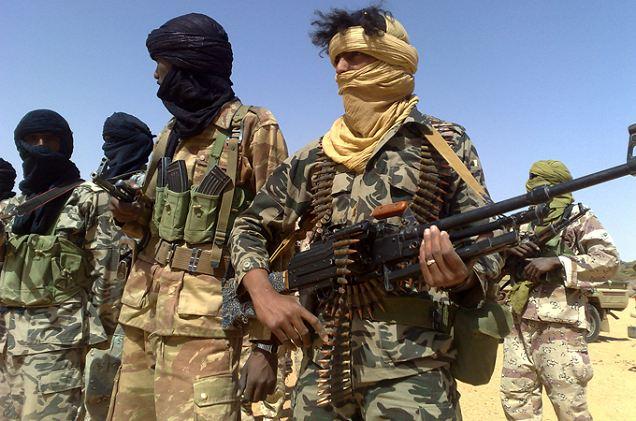
MNLA soldiers

Going by the history of similar rebellions, not too long.

Then there are the Al Qaeda In Maghreb. If it is true that the bulk of the Tuaregs fought for Gaddafi, they are unlikely to have much sympathy for AQIM. As I’ve said elsewhere, I don’t place too much reliance on Western media claims on anything, so I won’t automatically believe that they are allied with the MNLA. But, for the sake of argument, let’s assume they are. At the moment, they are likely to benefit from the chaos and confusion of war, with its attendant breakdown of law and order.  But once an independent Tuareg Azawad is established, the first point on the new rulers’ agenda will be to establish control and the rule of law (their law). Guess just who will suddenly metamorphose into their biggest enemies then? 

It's unlikely that the alliance will even last that long, if certain reports are to be taken seriously, though it's just as likely that they are an attempt at KONY2012-style interventionist propaganda. As the reader will probably be aware, the "Radical Islamist Threat" is today's Red Under The Bed; a standard excuse for meddling, war and endless occupation.

Now, on the other side, there’s the Malian government, or, rather, governments. There’s Touré, who’s still the legitimate president of the country, and whose whereabouts seem to be unknown; at least he doesn’t seem to be in the junta’s custody. There’s Sanogo’s weeks-old dictatorship, which is opposed to Touré, of course, but which is supposed to share with him the agenda of defeating the Tuareg rebellion. Sanogo is himself opposed, meanwhile, by ECOWAS, which has imposed sanctions on Mali. And in the background is the glowering presence of the Empire, which is largely responsible for creating this mess in the first place; the Empire, which trained Sanogo, which allegedly favours democracy, and which gave Al Qaeda a free hand in Libya.

Does that sound complicated enough? No?

I haven’t even mentioned the other minority populations of Azawad, the Songhai and others who have their own quarrels, buried in history, with the Tuaregs. In an independent Azawad, they will have their own grievances, their own resentments. It’s certain they will feel discriminated against by the Tuareg power structure, and there will be enough other players to fish in troubled waters to make sure they are given the opportunity to act on those grievances.

So, this is what an independent Azawad is likely to look like – deeply impoverished, with absolutely no development or source of income (nobody has discovered oil there yet!), with competing factions jockeying for power, and a slow-burning civil war going on with multiple players and shifting alliances. Meanwhile, Mali, unwilling to reconcile to the loss of the majority of its territory, will continue to provoke border clashes. Overall, it will be very much like the situation in South Sudan, but because there’s no oil involved, nobody will really care very much apart from the people who live there.

Also, the Tuaregs, as I said, don’t all live in Mali – substantial populations inhabit contiguous areas in neighbouring nations. How long after an independent Azawad is established before they begin fighting to secede from those nations and join their ethnic brethren in the new country? And what happens when those other nations react violently, as they inevitably will? Why do you think that none of the four countries in which Kurds live, Iran, Iraq, Syria and Turkey, are willing to consider for a moment the possibility of an independent Kurdish state?


Or maybe, though at the moment it looks highly unlikely, the Tuaregs won’t win. Maybe the Malian army, with or without Imperial or other help, will beat back the MNLA, and reassert control over Azawad. That’s hardly likely to be a better situation, because the Tuareg people have, as Mao Zedong said, “stood up” and will not easily lie down again. Battle hardened and well-equipped, they will fight back hard against what they will undoubtedly see as Malian colonial occupation. And in a world where much less deserving secessionist movements have received the Empire’s blessings and aid, it’s difficult to justify leaving them under Malian occupation when they clearly do not want to be.

Ultimately, the fact is that the Mess in Mali is the fault of the Empire and its ceaseless meddling. Actions have consequences, and these consequences have further consequences. The anti-Soviet jihad in Afghanistan spawned Al Qaeda and eventually the Taliban, for example, and you’d have thought even the Empire would have learnt a lesson or two from that.

But as anyone standing in the sandy streets of Timbuktu will confirm, it’s obvious that it has not.

 Copyright B Purkayastha 2012

Update India: The Army Goes Under


Hey, people, remember some time ago when I talked about the Indian army’s chief and his two dates of birth, and how he went to the Supreme Court to try and make the Defence Ministry accept that his version of his own date of birth was the correct one? Well, you might have thought that with the government finally deciding he was born in 1950, and that he should retire at the end of this month, the whole thing was over and done with.

You’d think so, but you would be wrong.

Even his medals have medals

As the time for his retirement came closer, General VK Singh came out in public with allegations that he’d been offered the equivalent of $2.7 million in bribes by a former subordinate, Lt Gen (Retired) Tejinder Singh, now an agent for an armament company (a very large number of ex-generals and admirals end up as armament company agents in this country; those with political favour end up as governors – that’s a different post from the “governor” of states in the US – or ambassadors, or enter politics themselves; more on that in a moment). This Tejinder Singh had allegedly offered the bribe in return for the army placing orders for 600 “substandard” (VK Singh’s word) Tatra trucks. That the manufacturers claim that the trucks aren’t substandard is hardly germane; they would, wouldn’t they?

The much more interesting thing is the claim by VK Singh that he’d brought the bribe offer to the attention of the Defence Minister, the “honest” AK Anthony, a long time ago, but Anthony had refused to act on it. Anthony countered by saying that VK Singh had refused to put anything down in writing, thus making it impossible for him to act. And while this buck-passing was going on, yet another can of squirming worms popped open.

Apparently, VK Singh had written a letter to the Defence Ministry in which he’d said that the state of the Indian armed forces was, to say the least, parlous, with “97%” of India’s air defences being obsolete (that isn’t a surprise to me; during my time working for the air force I discovered that the 1960s-era SAM-3 missile was still considered “modern” by Indian standards) and, among other things, that there’s such a shortage of ammunition that the troops allegedly don’t have enough for target practice. This letter was then leaked to the media by someone; who, it’s not known. The government accused the army chief himself of leaking it; the general countered by blaming it on “treasonable elements”. I wonder what kind of “treason” that is, since Indian security is like a sieve; with the single exception of the nuclear tests of 1998 (assuming they even took place as described), just about nothing in the Indian military is secret to anybody except the Indian people.

There was, then, shouting and hollering in Parliament, where politicians competed to demand the general’s immediate sacking on the one hand and condemning the government on the other. At the moment, the stand-off, though simmering, continues; it won’t remain quiescent for long.

One of the principal casualties of this brouhaha is the alleged “honesty” of the Indian military, a carefully constructed myth that has endured for far longer than its sell-by date. Any military reflects the society from which it is drawn, and these men are from the same hyper-corrupt Indian society as the rest of us. As I’ve said elsewhere, one of the top qualifications for promotion to flag rank in the Indian armed forces is political reliability, and has been since at least the 1950s when the government grew anxious about the possibility of a military coup.

Also, in the today’s bandit-capitalist Indian system, money power is all that matters. It’s unrealistic to expect the armed forces to draw the best of candidates; only those who have few to no other career options choose a life in uniform (I’m talking about the officers here; there are enough poverty draftees to fill the rank and file). As even they are well aware, honesty may be the best policy, but it’s hardly the most lucrative one. And, with a million-man army, there’s more than enough money to be made on the side with a little creativity. (In fact, the logistics branches are now more prized as postings for officers than the combat arms, for obvious reasons.)

As for General VK Singh, he may well be on the level where these two controversies are concerned, but forgive me if I feel it’s suspicious that he waited till his birth “controversy” was laid to rest and his retirement date finalised before coming out about the bribe offer and the lack of modernisation. Would he have spoken out about either if he’d been given another year at the top? Why on earth hadn’t he spoken out before? If it isn’t because he wants to enter politics on an “anti-corruption” platform after retiring, I can’t think of his reason. The right-wing parties will welcome him with open arms; they’re already full of retired generals.

Meanwhile, there is the Defence Minister, one of the Congress Party members who owe their positions to their sucking up to the dynasty that rules this country by proxy. AK Anthony might be “honest”; everyone keeps repeating he’s “honest”. Well, maybe he’s honest in the way the so-called, unelected, “prime minister” is honest; that is, he turns a Nelson’s eye to corruption under his watch. That is not called honesty; it’s incompetence at best and collusion at worst.

I’d like to believe that the “investigations” we’ve been promised would lead to a cleaning of at least a few of the Augean stables, but given my well-developed cynicism, I’d be inclined to doubt we’ll ever hear anything of their conclusions. After all, cynicism in these things is usually more than justified.

Some superpower-in-waiting, we are!