Today, I read that ISIS just killed an
Italian aid worker in Bangladesh.
To be honest, this was not entirely
unexpected. I have been anticipating for a while that ISIS would set up shop in
that nation; in fact I was mildly surprised that they hadn’t already done so.
The reasons aren’t that difficult to see.
The nation of Bangladesh was always an
artificial one. Back in 1947, when British India was vivisected into Pakistan
and the new independent India, the Indian province of Bengal was messily cut
up, broadly but far from entirely along religious lines, into the Indian state
of West Bengal and East Pakistan. This, of course, wouldn’t have happened if
the Muslim Bengali-speaking people of what became East Pakistan hadn’t demanded
it. In the new Pakistan, they thought, they would be free. But, as they very
soon found, all they did was exchange an equal status with Hindu Bengalis in
undivided India with subservience to the Urdu-speaking Punjabis and Sindhis of
West Pakistan, which, despite its smaller population, was the dominant partner
in the relationship. By 1970, East Pakistan had developed little if at all, the
people were poor, and they blamed all their problems on West Pakistan’s
tyranny.
Actually, this was inevitable. East
Pakistan was almost entirely agricultural, as all the industrial and commercial
centres, as well as the most important transport links, were in the part of
Bengal that went to India. But in the 24 years after East Pakistan’s independence
from India the new half-nation seemed to have been neglected so much that it developed
not at all.
To what extent this is true is debatable.
The Indian writer Sarmila Bose, in her book Dead
Reckoning: Memories of the 1971 Bangladesh War, suggests that the West
Pakistanis tried at least to a certain extent to develop East Pakistan, but it
was simply too poor, too isolated, and the difficulties in communication and
logistics too great to allow rapid development.
As usual in these cases, the development
that did occur helped only the educated urban elite. The poor in the villages
remained where they had been a hundred years earlier. Then, in 1970, the new
military dictator of Pakistan, Yahya Khan, announced what was definitely the
first free and fair election in Pakistan’s history. Predictably, given the
demographics, the majority of seats were won by the East Pakistani Awami League
of Sheikh Mujibur Rahman – an ethnic Bengali
party. This roused the ire of Zulfikar Ali Bhutto, Pakistan’s prime minister,
who refused to cede power. Mujibur Rahman began to make bellicose public
speeches threatening secession. Armed Bengali mobs attacked and massacred ethnic
Biharis – who were not even West Pakistani, but migrants from India – and any
West Pakistani they could find. Yahya Khan responded by launching a savage
military crackdown in March 1971. Tens of thousands of Bengalis fled to India,
where the Indian government at once set up training camps for a growing
separatist insurgency. By mid-1971, Indian forces were fighting inside East Pakistan,
launching hit and run attacks on isolated Pakistani units; and, on 22nd
November, India launched a full-scale invasion of the territory.
Why did India do this? Partly, it was the
pure desire to weaken Pakistan at any cost whatsoever. Also, the then Indian
prime minister, Indira Gandhi, saw an easy way to gain popularity ahead of an
upcoming election. After all, the isolated and badly outnumbered Pakistani
soldiers in the east could hardly provide serious resistance to India in case
of a war. Besides, the horror stories told by the floods of refugees – blown up
by themselves, and then again in the media – inflamed public opinion to an
extent that “something had to be done”. A lot of these refugees were East Pakistani
Hindus – but, as Bose says, the majority of them had been forced out not by the
Pakistani army, but by their own Muslim neighbours, who took the opportunity to
loot their belongings.
It does not seem to have occurred to anyone
in power in India then that East Pakistan was a problem for Pakistan, and the longer the problem continued, the worse
things would get for Pakistan; and by
cutting off the territory, India was actually relieving the rump state of Pakistan of a major burden.
Now, far from all the East Pakistani
Bengalis had been anti-Pakistan. As usual in these cases, the vast majority
were neutral, their primary effort being to survive. A fairly small number,
mostly of educated urban youth with Marxist leanings, were for the secession
movement. And a significant portion was of fundamentalist Muslims, from among
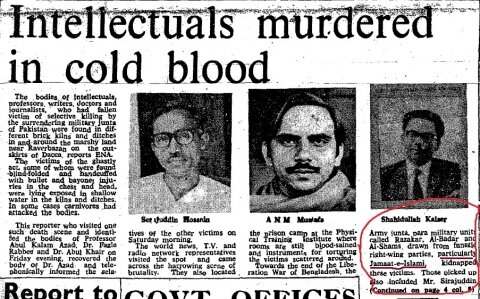
whom the West Pakistanis raised a militia force called the Razakars. As the
Indian army advanced into East Pakistan and converged on the capital, Dhaka, the
Pakistani army was tied up fighting the invasion – and the Razakars let loose a
reign of terror, abducting and murdering professionals, intellectuals, and
anyone else who might be of use to the new country of Bangladesh.
By the middle of December 1971 the war was
over. Mujibur Rahman took over as the new ruler of the country. Naturally, the
problems that had led to the East Pakistanis growing disillusioned at the West
didn’t disappear. If anything, they intensified, because now even the links to
the western wing were severed, along with the markets and sources of
manufactured products that it provided. As is also the normal human reaction,
the Bangladeshis blamed everyone but themselves. An easy target for their ire
was India; by January 1972, a bare month after the end of the war, anti-Indian
sentiments were already on the rise.
Instead of harming Pakistan, India had
freed it of a burden and given it a reason to seek revenge; and, in the
bargain, it had gained an increasingly unfriendly neighbour in the east.
Mujibur Rahman was far from a good leader.
Soon enough, he had declared his own party as the only one in the nation, and in
1975 he and his family – all but a daughter, about whom we’ll speak in a while –
were murdered in a coup. In the original 1972 constitution, Bangladesh (despite
being about 90% Muslim) was a secular nation; but in 1977 the new military
dictator, Ziaur Rehman, declared Islam the state religion and lifted the ban on
Islamic parties. The old Razakars, who had disappeared in the aftermath of the
war, came crawling out of the woodwork and soon achieved considerable
influence. Ziaur Rehman was himself killed in a coup in 1981, and another
military dictator, Hussein Mohammad Ershad, took power. Ershad was ousted in a
popular revolt in 1990 led by two women. One of these two was the sole
surviving daughter of Mujibur Rahman, Sheikh Hasina Wajed. The other was the
widow of Ziaur Rehman, Khaleda Zia. Once Ershad was gone, though, these two
began bitterly feuding with each other, and their respective political parties,
the Awami League and the Bangladesh National Party, fought each other with
their respective goon squads, in and out of power. Today, it’s the Awami League
which rules, and the BNP is marginalised. But, of course, the situation of the
average Bangladeshi has improved not at all.
I had said the old Razakars were brought
back by Ziaur Rehman. The Muslim fundamentalists had flourished under the BNP,
and therefore the Awami League were against them. It began arresting some of
the more prominent among the Razakars who had been living openly for decades,
and has hanged a number on “war crimes” charges. It didn’t escape anyone’s
notice that the perpetrators of the massacres of Biharis and ethnic West Pakistani
civilians were never charged.
By the early 2000s, a new wave of Islamic fundamentalism
was sweeping Bangladesh. A lot of this came from the very large number of
Bangladeshis who lived and worked in the Gulf, particularly Saudi Barbaria, and
got infected with Wahhabism. Some of it also came from domestic disgust at the
corruption of the old Razakars, living in comfort – those of them who weren’t
arrested and executed, that is – and the ineptitude of the government. Soon,
there was a growing fundamentalist terrorist movement in Bangladesh, which
launched spectacular but fairly ineffectual attacks in the towns, while
murdering secularists, leftists and other undesirables in the countryside.
One major target was the increasingly
vulnerable Hindu community, who, ironically, found that they’d been better off
under Pakistan than they were in Bangladesh. Temples were attacked and
destroyed, Hindu women abducted and raped, and once again Hindu refugees began
streaming across the border into India. This time, though, the Indian
government’s reaction was total indifference.
Among the prominent Islamic Holy Warriors
was one Siddiqul Islam, popularly known as Bangla Bhai (Bengali Brother). The
military commander of a terrorist outfit grandly called the Awakened Muslim
People of Bangladesh (JMJB), he was finally captured in 2006, tamely
surrendering after being injured in a bomb blast. In a move of incredible
stupidity, the government executed him in 2007, along with several other
Islamic fundamentalists, thereby not just washing away the stain of his
surrender but immediately promoting him to the rank of martyr. The terrorist
movement went temporarily underground, but was far from destroyed. And, as time
went on, the fundamentalists began asserting themselves again, hacking to death
several atheist bloggers in recent times, among other victims. The Awami League
government seemed, and seems, more interested in keeping the BNP at bay than
defeating the fundamentalists.
 |
| Bangla Bhai on capture [Source] |
As the state of Bangladesh weakens
steadily, therefore, the fundamentalists are gaining influence, feeding off the
resentment of the people at the government; a resentment at least partly the
result of the very artificial nature of the country, which doomed it to poverty
from the start by amputating it from India. The government itself is concerned
virtually entirely with its own survival. The BNP is itching for revenge
against the Awami League, and not particular how it gets it. Wahhabi influence
is rising. And with increasingly uncertain weather patterns, the consequence of
global warming, things for Bangladesh – a low lying agriculture-dependent
country – can only get worse.
Can you imagine a more fertile ground for
ISIS? Can you wonder why I was surprised they hadn’t moved in already, especially since it's not exactly a secret that they have Bangladeshis among them?
 |
| Alleged British ISIS member of Bangladeshi origin, Rakib Amin [Source] |
Let me make a few predictions here. Please
understand that these are only my opinion, and in no way do they pretend to be
a cast-iron prophecy for what is to come:
1.As ISIS is pressurised in Syria and Iraq,
especially by the recent Russian entry into the war – and Russia does not mess around – it will try and spread
into other territories. The technique is the same as a metastasising cancer:
even if the original source is totally excised, it will start up again
elsewhere.
2. For a new place to expand into, Bangladesh
is a sitting duck for ISIS. The JMJB and other fundamentalist terrorists will
instantly flood to its banner. Bangladeshi citizens who have been trained by
ISIS and have fought for it in Syria and Iraq will come home and train more
members (in fact, as I’ll talk about in a moment, they almost certainly already
have). They will have, with ISIS’ funds and resources, far better weapons than
the tiny bombs and crude guns that the JMJB had. And, most important of all,
they’ll have a cause and an idea – something to aspire to, a goal that’s
greater than themselves. Whether this is even possible or not is not as
important as the idea itself. All revolutions in history ultimately grow out of
an idea.
3. By its own actions, the government of
Bangladesh has provided the Islamic State with a ready-made collection of
martyrs, who can be readily harnessed into the propaganda effort. Also, again
by its own actions, it’s created a powerful political enemy thirsting for
revenge, which more likely than not will cheerfully ally with ISIS if that
means damaging and bringing down the Awami League. Yes, I am saying that Khaleda
Zia’s BNP will prefer to side with ISIS against Hasina Wajed. South Asian
history has showed that we always side
with our greater long term enemy against our smaller, immediate enemy. Always.
4. Therefore, once ISIS secures a foothold –
once, not if – the state of Bangladesh is pretty much doomed. Peripheral
areas like the Buddhist Chakma tribes of the eastern hills, who fought a failed
secessionist war with Indian help, will once again try to break away. The
government will react with all the agility of a soggy biscuit. It will soon
lose control over large areas of the countryside, and be isolated in the
cities. Car bombs and assassinations will become daily news in Dhaka. Attempts
to send the army into the villages to conduct sweeps will fail. If these
missions are made in force, ISIS will keep its head down until the soldiers
leave. If they attempt to secure the area, they’ll be ambushed and attacked in
their bases. The more they try to control, the less they’ll end up controlling.
5. What will the government do then? Appeal
to India for military aid? That will at once paint it as a traitor to even the
neutral Bangladeshis. And it’s hardly clear that India would even send aid. It
would certainly not send troops,
because that would at once make it into an occupation army in a country where
the people already hate it. Any weapons it might provide, as it did to the army
of Nepal during the civil war in that country, would more likely than not be
swiftly seized by the insurrection. And, quite frankly, I don’t see Bangladesh
as being important enough for any other
nation to send forces there. It’s got no oil, no mineral wealth, minimal
strategic importance, and not much of a voice in world affairs anyway.
Che Guevara wrote that a guerrilla war
develops in certain clearly demarcated phases. The first one is ideological
indoctrination and recruitment. That, in substance, already exists in
Bangladesh. The Razakars and the JMJB have already prepared the way for that,
and, in addition, the Gulf Bangladeshis and their Wahhabi ideology can only
help. Remember that – again – they don’t have to recruit everyone. The majority
of people will be neutral and try just to survive.
The second phase is training. A lot of
this, again, already exists, both in terms of what Bangla Bhai and his gang
achieved. The groundwork is already there; ISIS merely has to build on it.
The third phase is hit and run attacks, building
up to creating “liberated areas” where the government can’t operate freely and
where its writ does not run. The fact that ISIS has already launched at least
one attack is proof that it’s at least arrived at this stage.
The fourth is the phase of full
conventional war, designed to try and defeat the government forces in the field in
battle. That is the stage where ISIS is in Syria and Iraq – or where the
Taliban are in Afghanistan. If and when it comes to that, India might step in – might, with air strikes,
try to turn the tide. But what good that would do is doubtful. And long before
that stage, ISIS would most certainly have got active on Indian territory as
well, so one can safely assume that India will have more important things on
its mind than what happens in Bangladesh.
All this is of particular interest to me,
you see, because I am an ethnic Bengali, and because I live not far from the border;
just about sixty kilometres from Bangladesh. When they come, they'll come here first. The car bombs will go off in the streets of this town.
Of course, I may be wrong, and this ISIS
attack might be only a flash in the pan.
But I’ll wager, against my own hopes and
inclinations, that I’m right.